A product can look flawless on a computer screen and still reveal unexpected problems when manufactured. A button may feel awkward, two components may not assemble correctly, a housing may be too bulky, or the surface may simply fail to deliver the premium appearance expected by customers.
For this reason, experienced product developers rarely jump directly from CAD design to mass production. Prototyping creates an important checkpoint between the two.
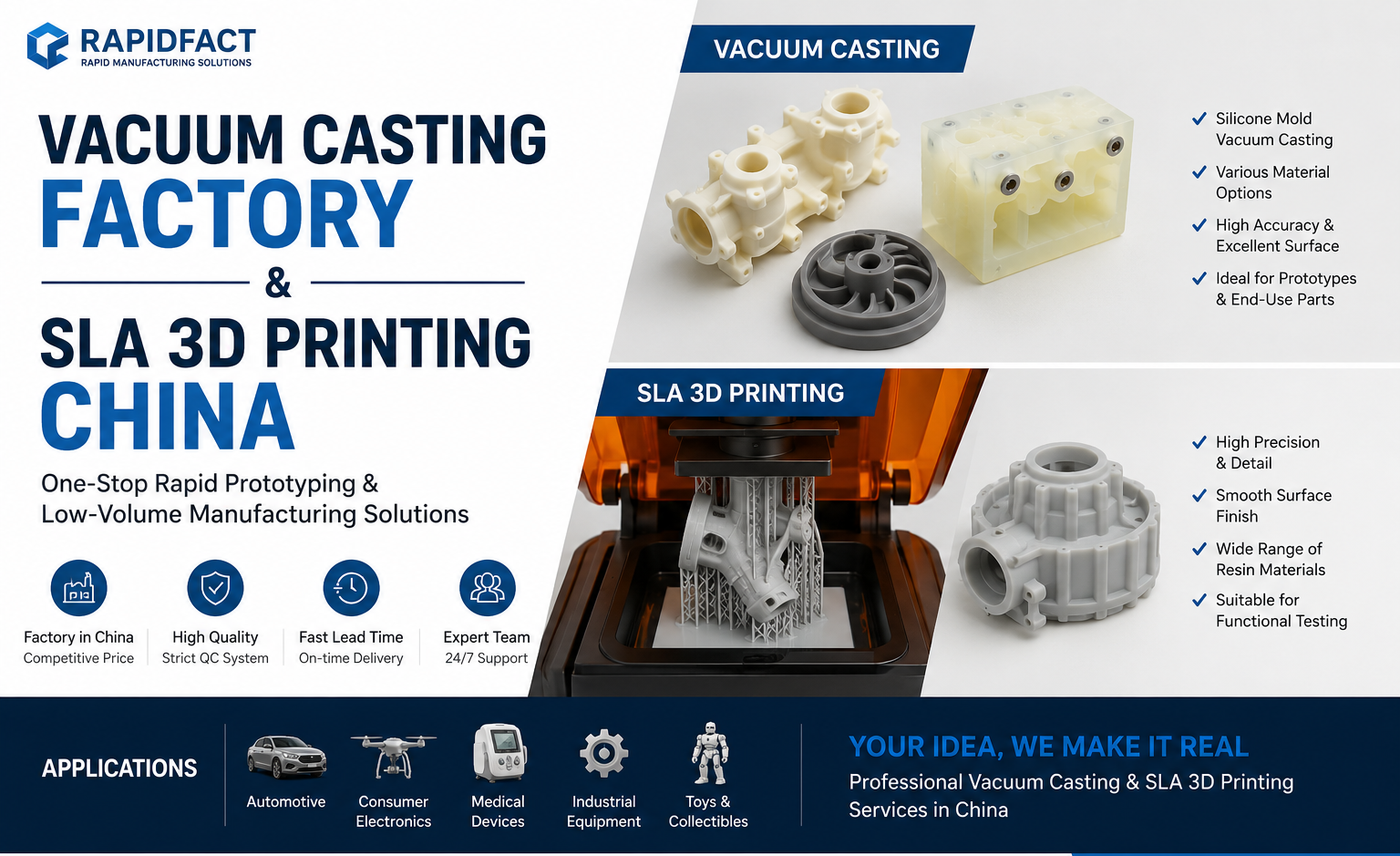
Working with a professional vacuum casting factory and using SLA 3D Printing China services can help manufacturers turn digital concepts into physical prototypes, evaluate designs and produce small batches before committing to expensive production tooling.
Why Physical Prototypes Still Matter in a Digital World
Modern CAD software can simulate dimensions, assemblies and product appearance with impressive accuracy. However, a digital model cannot completely replace holding and evaluating a physical product.
A prototype allows engineers and product teams to answer practical questions:
- Does the component fit correctly?
- Is the size appropriate?
- Can different parts assemble as intended?
- Does the product look professional?
- Are design changes necessary?
- Is the surface finish acceptable?
- Does the product feel comfortable in the user’s hand?
- Is the design ready for customer presentation?
Finding these problems early can be far more efficient than discovering them after production tooling has been completed.
Where SLA 3D Printing China Enters the Development Process
SLA 3D Printing China is commonly considered when a project requires a detailed physical model directly from 3D CAD data.
SLA, or stereolithography, is an additive manufacturing process based on photopolymer resin. Instead of machining a component from a solid block, the printer creates it layer by layer.
A controlled light source selectively cures liquid resin according to the geometry contained in the digital model. The process continues until the complete component has been formed.
The printed part is then cleaned and post-cured. Depending on the intended application, additional sanding, polishing, painting or other finishing may be performed.
Why Product Designers Often Select SLA
SLA is not simply a way to make a product “look real”. Its real value lies in how quickly a digital design can become something engineers can physically inspect.
Complex Details Can Be Evaluated
Products containing small openings, curved surfaces, fine features and intricate geometry can be difficult to assess accurately on a monitor.
SLA 3D Printing China allows these details to be physically examined before further manufacturing investment.
Design Revisions Are Easier
Suppose the first prototype reveals that a housing needs to be 2 mm wider.
Instead of modifying production tooling, the designer can update the CAD file and manufacture another SLA version. This makes SLA particularly useful during iterative product development.
Appearance Can Be Assessed
SLA’s relatively smooth surface makes the process valuable for visual models, presentation prototypes and master patterns.
But What Happens When You Need More Than One Prototype?
This is where the development strategy becomes interesting.
Producing one SLA model may be ideal for evaluating an initial design. But what if you need 10, 20 or more similar samples for engineering teams, exhibitions, customer demonstrations or pre-production testing?
A vacuum casting factory can become the next stage of the process.
Instead of manufacturing every component individually, an approved prototype can be used to create silicone tooling for producing multiple replicas.
Inside a Vacuum Casting Factory
The process normally begins with a carefully prepared master pattern.
The quality of this master is extremely important because its geometry and surface characteristics influence the silicone mould and subsequent cast components.
Creating the Master
An SLA model is often used as the master. CNC machining and other technologies may also be selected depending on dimensional, material and surface requirements.
Building the Silicone Mould
The master is positioned inside a mould box before liquid silicone is poured around it.
Once cured, technicians carefully separate the silicone and remove the master. What remains is a flexible mould cavity matching the original component.
Casting the Component
A suitable casting resin is prepared and introduced into the mould under vacuum conditions.
The vacuum helps reduce trapped air and bubbles. After the material has cured, the component is removed and prepared for finishing.
A vacuum casting factory may repeat this process to manufacture the required small batch.
Why Not Go Directly to Injection Moulding?
Injection moulding is an excellent manufacturing process when a design is stable and sufficiently large production quantities are required.
The challenge is timing.
Creating production tooling too early can be risky if the product design is still evolving. Significant modifications may require expensive tooling changes.
Vacuum casting fills the space between individual prototyping and higher-volume production.
It allows businesses to manufacture multiple production-like samples without immediately committing to hard tooling.
SLA 3D Printing and Vacuum Casting at a Glance
| Requirement | SLA 3D Printing | Vacuum Casting |
| One prototype | Excellent option | Usually unnecessary |
| Frequent design revisions | Highly suitable | Less convenient |
| Small production batch | Possible | Particularly suitable |
| Silicone tooling | Not required | Required |
| Master pattern | Not required | Required |
| Complex geometry | Strong capability | Depends on mould design |
| Material | Photopolymer resin | Casting polyurethane/resin |
| Surface appearance | Smooth and detailed | Reproduces master quality |
A Practical Product Development Scenario
Imagine a company developing a new handheld electronic device.
The engineering team completes the initial CAD design and orders a prototype through SLA 3D Printing China.
When the prototype arrives, several issues become obvious. The grip needs adjustment, one button is positioned too close to another and the charging opening requires modification.
The CAD model is revised and another SLA prototype is manufactured.
This time, everything works correctly.
The company now needs 25 presentation samples for distributors and potential customers.
Rather than immediately investing in injection-mould tooling, the approved SLA model can become the master for a vacuum casting factory. Silicone moulds are prepared and the required components are cast.
This illustrates why the technologies can complement rather than compete with each other.
What Makes a Reliable Manufacturing Partner?
The cheapest supplier is not automatically the most economical choice.
A manufacturer should understand both the drawing and the purpose behind the component.
Look for capabilities such as:
- CAD and DFM review
- SLA manufacturing experience
- Professional master finishing
- Silicone mould expertise
- Multiple casting material options
- Dimensional inspection
- Surface finishing
- Painting and polishing
- Clear project communication
- Quality documentation
For international buyers considering SLA 3D Printing China, communication and technical understanding can be just as important as equipment capability.
Questions to Ask Before Requesting Production
Before placing an order with a vacuum casting factory, clearly define what you actually need.
Ask yourself:
- How many parts are required?
- Is the design final?
- Which dimensions are critical?
- What surface finish is expected?
- Does the component need to be rigid or flexible?
- Is transparency required?
- Will the prototype be functional or visual?
- Does it need painting?
- Will components need assembly?
- What is the target delivery schedule?
Providing these answers with the CAD model can help the manufacturer recommend a more appropriate production route.
Frequently Asked Questions
What is SLA 3D Printing China?
SLA 3D Printing China refers to stereolithography prototyping and manufacturing services provided by suppliers in China using photopolymer resin-based 3D printing technology.
Why use SLA before mass production?
It allows manufacturers to physically evaluate a design and make modifications before committing to production tooling.
What does a vacuum casting factory do?
A vacuum casting factory creates silicone moulds and uses them to manufacture small batches of resin components.
Can SLA models be used as master patterns?
Yes. SLA prototypes are commonly used as masters for silicone mould production.
Is vacuum casting good for low-volume production?
Yes. It is particularly useful when multiple components are required but full production tooling is not yet justified.
Does vacuum casting use plastic?
Vacuum casting commonly uses polyurethane and other casting resin systems designed to provide different physical characteristics.
Can prototype parts have different colours?
Depending on the material and process, colours may be incorporated into the casting material or achieved through painting and finishing.
Can SLA produce smooth components?
Yes. SLA is known for relatively fine detail and smooth surfaces, which can be further improved through post-processing.
How long does a silicone mould last?
There is no fixed number of parts. Mould life varies according to component geometry, material, mould design and processing conditions.
What information does a manufacturer need for a quote?
Provide the 3D CAD file, required quantity, material requirements, colour, tolerance, surface finish and intended application.
Read more – https://shopnets.com/china-cnc-custom-machining-how-to-choose-the-right-manufacturing-partner/
https://newsgrow.blogspot.com/2026/08/china-cnc-custom-machining-practical.html
https://newsgrow.blogspot.com/2026/08/china-cnc-machining-suppliers-and.html
https://newsgrow.blogspot.com/2026/08/sla-3d-printing-china-and-vacuum.html
https://newsgrow.blogspot.com/2026/08/vacuum-casting-factory-and-sla-3d.html