Silicone has become one of the most useful materials for manufacturers that need flexible, durable, heat-resistant, and reliable components. From medical devices and consumer electronics to automotive equipment and industrial machinery, silicone parts are used wherever performance and longevity matter.
However, selecting the right manufacturing process is just as important as selecting the material itself. Two options that deserve particular attention are Silicone Compression Molding and low volume silicone molding. Both can provide dependable custom components, but they are designed for different production needs, budgets, geometries, and order quantities.
Understanding how these processes work can help product developers reduce tooling costs, improve part quality, and move from prototype to production more efficiently.
What Is Silicone Compression Molding?
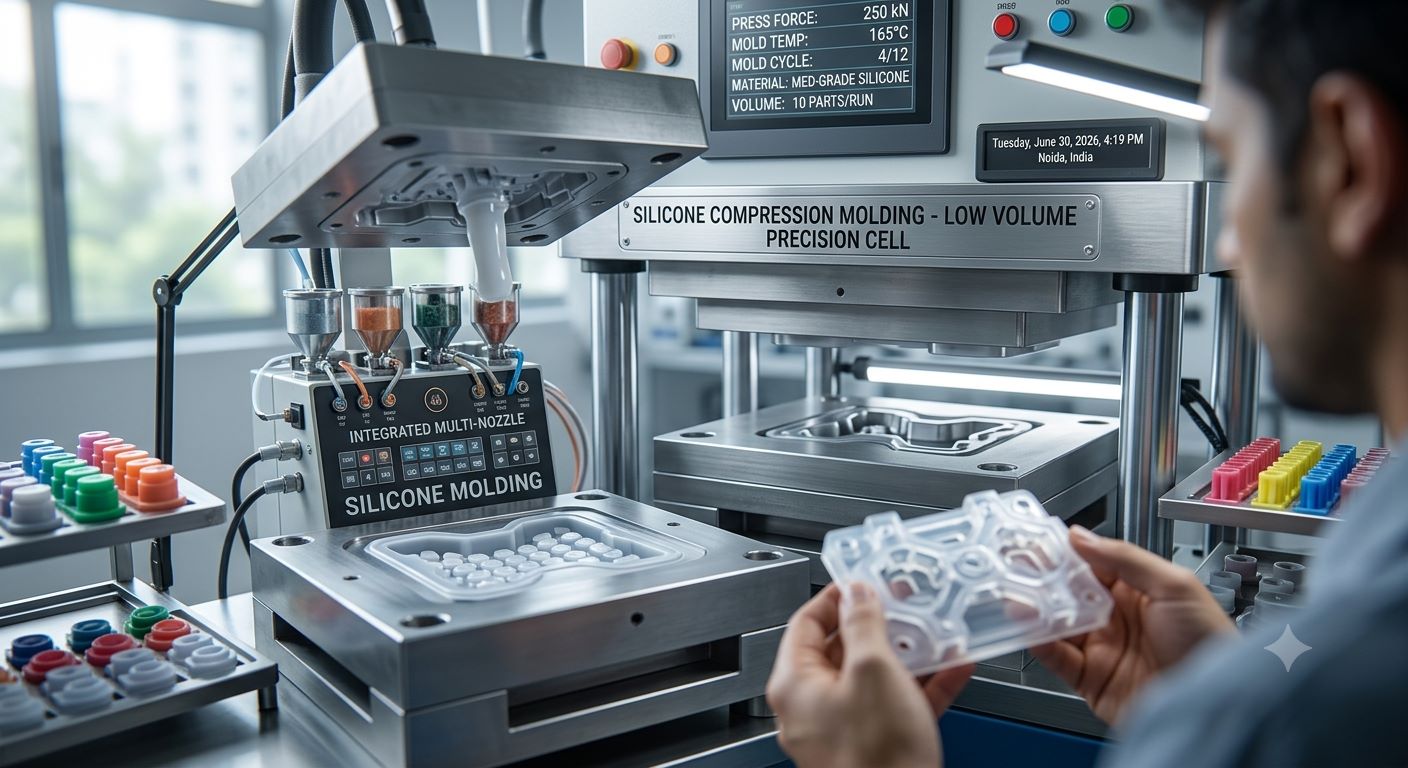
Silicone Compression Molding is a manufacturing process in which a measured amount of uncured silicone material is placed inside a heated mold cavity. The mold is then closed under pressure, forcing the silicone to spread and take the required shape.
Heat and pressure cure the silicone, after which the mold opens and the finished component is removed. Any excess material around the edges can then be trimmed.
The basic process usually includes:
- Preparing and measuring silicone material.
- Placing the material into the mold.
- Closing the mold under controlled pressure.
- Applying heat for vulcanisation or curing.
- Opening the mold and removing the component.
- Trimming, inspecting, and finishing the part.
Compared with some automated molding technologies, Silicone Compression Molding can involve relatively straightforward tooling. This makes it especially useful when manufacturers want dependable silicone components without the investment associated with extremely complex production systems.
Why Manufacturers Choose Silicone Compression Molding
One of the main advantages of Silicone Compression Molding is its versatility.
Manufacturers can use the process to produce components in numerous shapes, thicknesses, sizes, and silicone grades. Depending on design requirements, it can be suitable for everything from simple seals to specialised industrial components.
Common applications include:
- Silicone seals and gaskets
- O-rings
- Protective covers
- Medical silicone components
- Electrical insulation parts
- Keypads and buttons
- Automotive seals
- Silicone diaphragms
- Industrial rubber components
- Appliance parts
The process is particularly attractive when components have relatively simple to moderately complex geometries.
Key Benefits of Silicone Compression Molding
Cost-Effective Tooling
Compression molds can often be simpler than highly sophisticated injection molds. For moderate production quantities, this may help lower the initial manufacturing investment.
Material Flexibility
Different silicone formulations can be processed depending on hardness, temperature resistance, elasticity, colour, chemical resistance, and application requirements.
Reliable Mechanical Properties
Properly cured silicone components can provide excellent flexibility, compression recovery, weather resistance, and resistance to extreme temperatures.
Suitable for Larger Components
Compression molding can be particularly practical for comparatively large silicone parts that may be difficult or unnecessarily expensive to manufacture through alternative processes.
Reduced Material Complexity
The manufacturing process is relatively straightforward, making it practical for companies that need customised components without unnecessarily complicated equipment.
What Is Low Volume Silicone Molding?
Low volume silicone molding focuses on producing silicone components in smaller quantities than conventional high-volume mass manufacturing.
Rather than investing heavily in production systems designed for hundreds of thousands or millions of units, businesses can use low-volume manufacturing to produce prototypes, pilot runs, replacement components, customised products, and limited production batches.
Typical applications include:
- Product development
- Engineering validation
- Market testing
- Medical device development
- Custom industrial equipment
- Replacement components
- Limited-edition products
- Start-up product launches
Low volume silicone molding bridges the gap between prototype development and full-scale manufacturing.
Why Low Volume Silicone Molding Is Growing in Importance
Modern product development cycles are becoming shorter. Companies frequently need to test a product before committing to expensive mass-production tooling.
This is where low volume silicone molding becomes particularly valuable.
Instead of manufacturing excessive inventory, companies can order smaller production quantities based on genuine market requirements.
This approach may help businesses:
- Minimise initial investment
- Test product functionality
- Reduce inventory risk
- Introduce design improvements
- Respond to changing customer demand
- Validate new markets
- Shorten product-development cycles
For start-ups and specialised manufacturers, these benefits can be significant.
Silicone Compression Molding vs Low Volume Silicone Molding
Although these terms are sometimes discussed together, they describe different aspects of silicone manufacturing.
| Factor | Silicone Compression Molding | Low Volume Silicone Molding |
| Primary focus | Manufacturing method | Production quantity strategy |
| Production volume | Low to medium or higher | Primarily small batches |
| Tooling investment | Usually moderate | Usually focused on minimising upfront cost |
| Best suited for | Custom silicone components | Prototypes and limited production |
| Design changes | Possible but may require mold modification | Often easier during product development |
| Main advantage | Reliable and versatile production | Manufacturing flexibility |
| Typical users | Industrial manufacturers | Start-ups, engineers and specialised businesses |
In many projects, the two approaches can actually complement each other. Silicone Compression Molding may be selected as the manufacturing process specifically because it can work effectively for a low volume silicone molding programme.
Materials Commonly Used for Silicone Molding
The final performance of a molded component depends significantly on the silicone formulation selected.
High-Temperature Silicone
These materials are suitable for components exposed to elevated operating temperatures, including automotive and industrial environments.
Medical-Grade Silicone
Medical applications may require specially formulated silicone materials that meet relevant safety, biocompatibility, cleanliness, and regulatory requirements.
Food-Grade Silicone
Food-contact applications require materials designed to comply with appropriate food-safety requirements for the target market.
Electrically Insulating Silicone
Silicone’s dielectric properties make certain formulations useful for electrical protection, insulation, connectors, and electronic components.
Design Factors That Affect Silicone Molded Parts
Successful silicone production starts long before material enters the mold.
Wall Thickness
Consistent wall thickness can promote more uniform material flow and curing while reducing manufacturing defects.
Draft Angles
Appropriate draft helps molded components release from tooling without unnecessary deformation or damage.
Parting Lines
Engineers should carefully select the mold separation point because it can influence the appearance and finishing requirements of the final product.
Tolerances
Tighter dimensional tolerances may increase tooling complexity and manufacturing costs. Designers should specify realistic tolerances based on functional requirements.
When Should You Choose Silicone Compression Molding?
Silicone Compression Molding can be a practical choice when your project involves:
- Relatively simple silicone geometries
- Medium or thick components
- Custom gaskets and seals
- Moderate production quantities
- Large silicone components
- Projects requiring controlled tooling investment
The final decision should still consider component dimensions, silicone type, tolerance requirements, production quantity, and expected lifecycle.
When Does Low Volume Silicone Molding Make Sense?
Consider low volume silicone molding when uncertainty or flexibility remains important.
It is especially useful when:
- The design is still being validated.
- Annual demand is relatively low.
- Custom components are required for specialised equipment.
- Market demand has not yet been established.
- A pilot manufacturing run is required.
- Replacement components are needed in limited quantities.
- Multiple product variations must be tested.
Small-batch manufacturing can help organisations obtain real-world information before increasing production.
How to Improve Silicone Molding Results
Successful silicone component manufacturing depends on collaboration between designers, engineers, tooling specialists, and manufacturers.
Before production begins, confirm:
- Required silicone hardness
- Operating temperature
- Chemical exposure
- Environmental conditions
- Component dimensions
- Surface finish
- Colour requirements
- Dimensional tolerances
- Expected production quantity
- Regulatory requirements
Providing this information early allows the manufacturer to recommend a suitable material and molding process.
FAQ About Silicone Compression and Low Volume Molding
1. What is Silicone Compression Molding?
It is a manufacturing process where uncured silicone is placed into a heated mold and compressed under pressure until it cures into the required shape.
2. Is compression molding suitable for custom silicone parts?
Yes. Silicone Compression Molding is frequently used for customised seals, gaskets, covers, pads, and numerous industrial components.
3. What is low volume silicone molding?
Low volume silicone molding means manufacturing relatively small quantities of custom silicone parts rather than committing immediately to mass production.
4. Is low-volume production suitable for prototypes?
Yes. It is particularly useful for functional prototypes and engineering validation because actual molded silicone components can be tested.
5. Can silicone withstand high temperatures?
Many silicone formulations provide excellent temperature resistance, although exact operating limits depend on the selected material grade.
6. What industries use molded silicone components?
Automotive, medical, electronics, consumer goods, industrial equipment, aerospace, food processing, and appliance manufacturers commonly use silicone parts.
7. How expensive is silicone molding tooling?
Tooling costs depend on component size, complexity, cavity quantity, tolerances, mold material, and expected production volume.
8. Can silicone parts be produced in different colours?
Yes. Silicone can generally be pigmented in numerous colours depending on the selected material and manufacturing requirements.
9. Can low-volume production become mass production later?
Yes. Many manufacturers begin with small production batches and move to higher-volume tooling after validating demand and component performance.
10. Which silicone molding method should I select?
The correct process depends on part design, required quantity, material, tolerances, application, budget, and expected future demand.