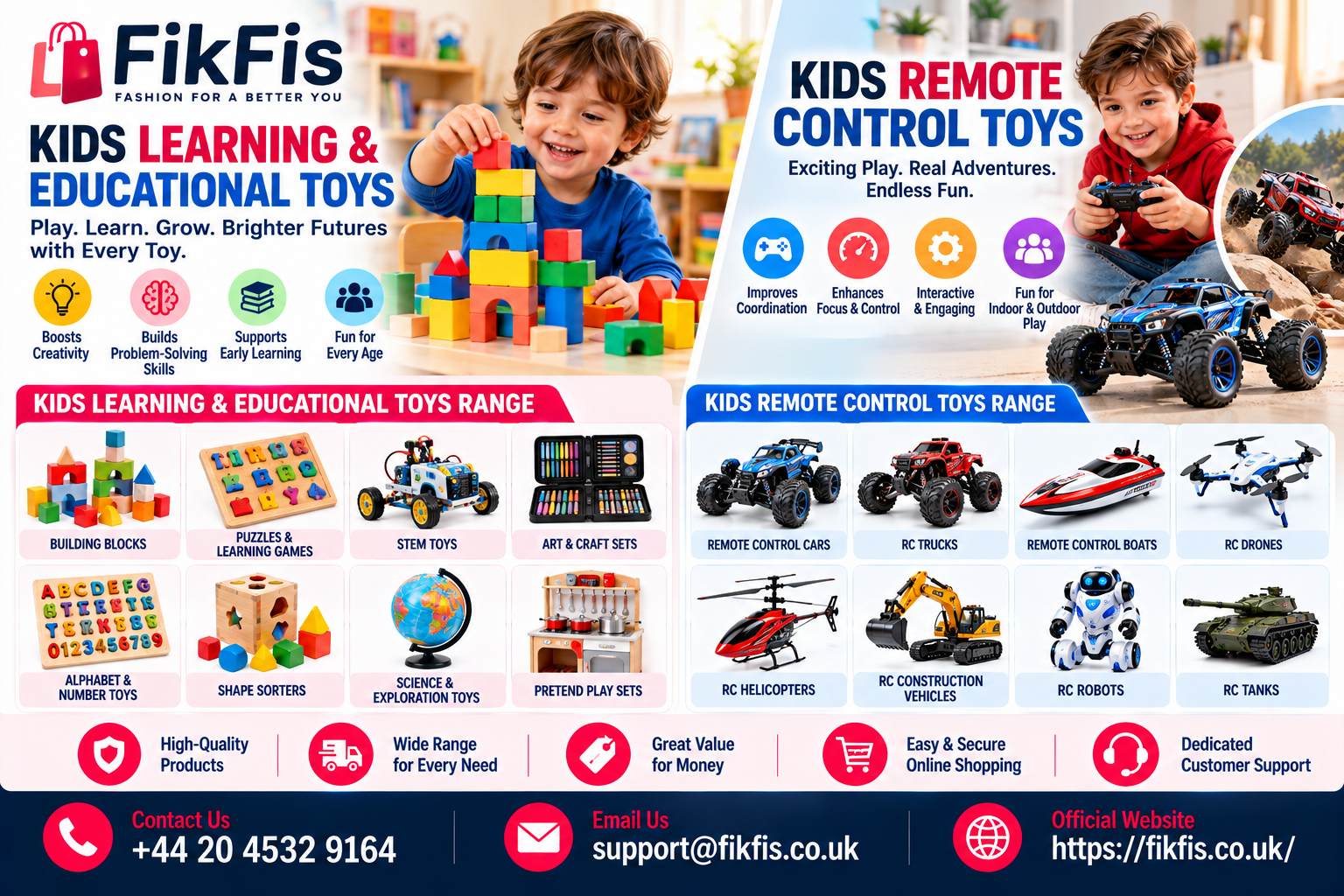
As parents increasingly look for play products that combine entertainment with skill development, demand for Kids Learning & Educational Toys and Kids Remote Control Toys continues to grow. These categories appeal to families because they can encourage curiosity, coordination, problem-solving, imagination, and hands-on interaction while helping children enjoy screen-free or more active forms of play.
From puzzles and building sets to remote control cars, robots, and interactive vehicles, today’s toy market is increasingly focused on products that offer more than short-term entertainment.
What Are Kids Learning & Educational Toys?
Kids Learning & Educational Toys are play products designed to support age-appropriate learning while keeping children engaged through interactive activities.
Common categories include:
- Building blocks
- Puzzles
- Alphabet toys
- Number games
- Science kits
- Art and craft sets
- Magnetic building sets
- Memory games
- Shape sorters
- STEM toys
- Learning boards
- Pretend-play sets
These toys can support different areas of early development, depending on the child’s age and interests.
Why Educational Toys Are Popular With Parents
Parents often prefer toys that provide both enjoyment and developmental value.
Kids Learning & Educational Toys can help support:
Problem-Solving Skills
Puzzles, construction toys, and matching activities can encourage children to think through challenges.
Fine Motor Development
Stacking, sorting, building, and drawing activities can help children practice hand-eye coordination.
Early Literacy
Alphabet-based games and word-building toys can introduce letters, sounds, and vocabulary.
Number Awareness
Counting toys, number puzzles, and simple math games can make early numeracy more approachable.
Creativity
Art sets, building toys, and imaginative play products give children more freedom to create their own activities.
Choosing Educational Toys by Age
Age suitability is one of the most important factors when selecting toys.
Toddlers
Younger children may benefit from:
- Shape sorters
- Large building blocks
- Simple puzzles
- Sensory toys
- Color-matching activities
Preschool Children
At this stage, families may consider:
- Alphabet games
- Counting toys
- Pretend-play sets
- Magnetic construction toys
- Creative art products
School-Age Children
Older children may enjoy:
- Science experiments
- Advanced building sets
- Logic games
- Coding toys
- Strategy-based learning products
The right level of challenge helps keep play interesting without becoming frustrating.
STEM Toys and Practical Learning
STEM-focused toys are designed around science, technology, engineering, and mathematics.
They may include:
- Construction kits
- Mechanical models
- Beginner coding toys
- Circuit sets
- Science experiments
These products can help children understand cause and effect through hands-on play.
Rather than simply reading about how something works, children can build, test, change, and observe the results.
This active learning approach is one reason Kids Learning & Educational Toys continue to attract attention from parents and educators.
Creative Toys Encourage Imagination
Not every educational toy needs electronics or structured instructions.
Creative play products can be equally valuable.
Examples include:
- Drawing kits
- Clay
- Craft sets
- Building blocks
- Role-play accessories
Open-ended toys can be especially useful because children can use the same product in different ways.
A set of blocks, for example, can become a house, bridge, vehicle, tower, or imaginary world depending on the child’s ideas.
What Are Kids Remote Control Toys?
Kids Remote Control Toys are battery-powered or rechargeable toys operated through a handheld controller or other remote interface.
Popular types include:
- Remote control cars
- Trucks
- Construction vehicles
- Boats
- Robots
- Stunt vehicles
- Animal-shaped toys
These products can provide exciting interactive play while helping children practice control, timing, spatial awareness, and coordination.
Why Kids Remote Control Toys Remain Popular
Remote control toys continue to appeal to children because they offer immediate interaction.
A child can press a button or move a control and instantly see the toy respond.
This can make play feel more dynamic than passive toys.
Benefits may include:
Hand-Eye Coordination
Children need to watch the toy while controlling direction and speed.
Understanding Direction
Forward, reverse, left, and right controls can support basic spatial awareness.
Cause and Effect
Children learn how different control inputs change the toy’s movement.
Active Play
Remote control toys can encourage children to move around and create their own games.
Social Interaction
Friends or siblings can create races, obstacle courses, or cooperative challenges.
Remote Control Cars and Vehicles
Cars are among the most popular Kids Remote Control Toys.
Different models may be designed for:
- Indoor floors
- Outdoor paths
- Rough terrain
- Stunt play
- Racing
Before buying, parents should consider:
- Recommended age
- Vehicle size
- Control range
- Battery type
- Charging time
- Indoor or outdoor suitability
A high-speed toy may be less appropriate for a younger child than a slower, easier-to-control model.
Rechargeable vs Battery-Powered Toys
Remote control products may use disposable batteries or rechargeable battery packs.
Rechargeable models can be convenient for frequent use.
Parents should check:
- Charging instructions
- Recommended charging time
- Battery compartment safety
- Replacement battery compatibility
Children should use charging equipment according to the manufacturer’s guidance, with adult supervision when appropriate.
Combining Learning With Remote Control Play
Educational and remote control toys do not need to be completely separate categories.
Some products combine both forms of play.
Examples may include:
- Programmable robots
- Coding vehicles
- Build-and-drive kits
- Interactive construction machines
These toys can introduce children to simple engineering or programming concepts while maintaining the excitement of remote-controlled movement.
This crossover between Kids Learning & Educational Toys and Kids Remote Control Toys is likely to remain an important trend.
Safety Should Always Come First
Parents should review toy safety before purchase.
Important considerations include:
- Age recommendation
- Small parts
- Battery compartments
- Material quality
- Moving components
- Product instructions
Toys intended for older children may contain parts unsuitable for toddlers.
Remote control toys should also be used away from stairs, roads, water, pets, or fragile household items unless the product is specifically intended for those environments.
Toy Durability Matters
Children’s toys are often dropped, pushed, carried, and used repeatedly.
Durable construction can therefore improve long-term value.
When shopping online, customers should review:
- Material descriptions
- Product dimensions
- Recommended age
- Battery requirements
- Included accessories
For educational toys, buyers may also want to confirm whether all pieces required for the activity are included.
Screen-Free Play Remains Important
Many parents are seeking ways to balance digital entertainment with physical, hands-on activities.
Traditional Kids Learning & Educational Toys can encourage children to manipulate objects, build, draw, imagine, and solve problems directly.
Remote control products can also create more active interaction than watching a screen.
The goal does not necessarily need to be eliminating technology, but offering children a wider variety of play experiences.
Choosing Toys Based on a Child’s Interests
One of the easiest ways to encourage longer engagement is to consider what the child already enjoys.
A child interested in vehicles may enjoy a remote control truck or construction machine.
A child who likes puzzles may prefer logic games or building sets.
A science-focused child may enjoy experiments or STEM kits.
Matching toys to genuine interests can be more effective than choosing purely by popularity.
Frequently Asked Questions
What are Kids Learning & Educational Toys?
Kids Learning & Educational Toys are products designed to combine play with age-appropriate learning, creativity, problem-solving, or skill development.
What skills can educational toys support?
Depending on the toy, they may support coordination, literacy, numeracy, creativity, logic, memory, and problem-solving.
Are educational toys suitable for toddlers?
Yes. Simple shape, color, stacking, matching, and sensory toys can be suitable when designed for the appropriate age group.
What are Kids Remote Control Toys?
Kids Remote Control Toys are interactive vehicles, robots, or similar toys controlled using a remote device.
Can remote control toys help children learn?
Yes. They can support coordination, directional awareness, timing, and understanding of cause and effect.
Are rechargeable remote control toys better?
Rechargeable models can be convenient for frequent use, while battery-powered toys can also be practical depending on usage.
What should parents check before buying?
Review age recommendations, dimensions, material information, battery requirements, small parts, and included accessories.
Are STEM toys educational?
Yes. STEM toys can introduce concepts related to science, technology, engineering, and mathematics through hands-on activities.
Can educational toys reduce screen time?
They can provide engaging alternatives that encourage physical, creative, or interactive play.
Are remote control toys suitable for indoor use?
Many are, but buyers should confirm the product’s intended environment and size.
Media Contact
Kids Toys & Product Enquiries
Email: support@fikfis.co.uk
Official Website: https://fikfis.co.uk/