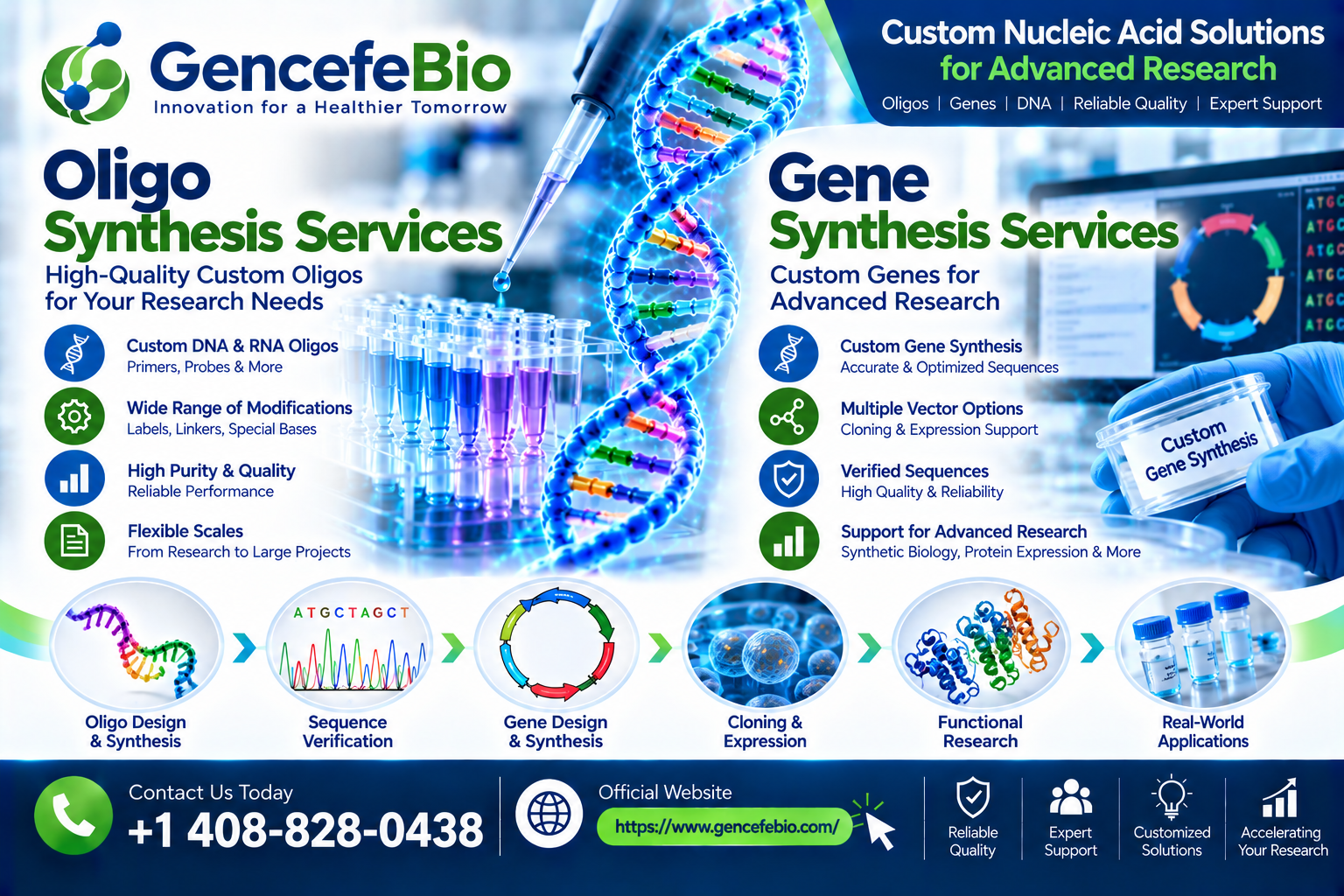
As molecular biology, genomics, and synthetic biology continue expanding the possibilities of scientific research, demand for precisely designed genetic materials remains important. Professional oligo synthesis services help laboratories obtain customized DNA and RNA oligonucleotides, while gene synthesis services support the development of defined genetic sequences for protein expression, molecular engineering, and biotechnology applications.
Research institutions, pharmaceutical companies, and biotechnology laboratories rely on synthetic nucleic acids for experiments involving genetic analysis, molecular detection, and biological function.
With increasing attention to sequence accuracy, purification requirements, and analytical quality, understanding how these synthesis technologies support modern research has become essential for scientific teams.
Growing Importance of Oligo Synthesis Services in Biotechnology
Oligonucleotides are short strands of DNA or RNA designed for specific molecular applications. They are widely used as primers, probes, and other research components.
Oligo synthesis services involve manufacturing these short nucleic acid sequences according to requirements established by researchers.
Common applications include:
- PCR and quantitative PCR experiments.
- DNA sequencing and genetic analysis.
- Molecular probe development.
- Gene expression investigations.
- RNA interference research.
- Synthetic biology applications.
- Molecular assay development.
These materials help researchers investigate genetic targets and design suitable laboratory experiments.
The selection of suitable oligonucleotides can influence experimental consistency and assay performance.
What Are Oligo Synthesis Services?
Oligo synthesis services refer to the customized production of short DNA or RNA sequences through suitable chemical synthesis methods.
Researchers specify nucleotide sequences and may request chemical modifications, purification levels, and quantities according to their intended applications.
Important Customization Options
DNA Oligonucleotides: Commonly used as primers and probes in molecular biology.
RNA Oligonucleotides: Support suitable RNA research and gene regulation investigations.
Fluorescent Labeling: Selected oligonucleotides may incorporate fluorescent molecules for detection applications.
Biotinylation: Biotin-modified sequences can support compatible molecular recognition and capture assays.
Purification Requirements: Different applications may require desalting, chromatography, or electrophoretic purification.
The appropriate specifications depend on experimental sensitivity and molecular complexity.
Understanding Gene Synthesis Services
Gene synthesis services involve producing custom-designed DNA sequences that represent genes or other genetic constructs.
Rather than obtaining genetic material exclusively through extraction from biological samples, scientists can request DNA sequences based on defined research designs.
Synthetic genes may be incorporated into suitable laboratory systems to investigate protein expression, genetic functions, and molecular interactions.
Common Applications
- Recombinant protein expression.
- Synthetic biology research.
- Genetic engineering investigations.
- Enzyme characterization.
- Molecular biology experiments.
- Research involving engineered genetic constructs.
Successful downstream applications depend on construct design, system compatibility, and experimental validation.
How Oligo and Gene Synthesis Support Different Research Needs
Although both technologies involve nucleic acid production, they address different molecular requirements.
Short oligonucleotides are commonly used in experiments requiring sequence-specific recognition or amplification.
Synthetic genes generally contain longer DNA sequences designed for suitable biological or molecular engineering applications.
In some research projects, oligonucleotides can be used as components in the assembly or analysis of larger DNA constructs.
Understanding these differences helps laboratories choose appropriate products for their research objectives.
Key Benefits of Custom Oligonucleotide Production
1. Sequence-Specific Research
Researchers can obtain precisely specified nucleic acid sequences for targeted molecular investigations.
2. Flexible Chemical Modifications
Compatible modifications may support labeling, molecular capture, and experimental detection.
3. Different Purification Options
Purification requirements can be selected according to the sensitivity of the intended application.
4. Broad Laboratory Applications
Synthetic oligonucleotides support genomics, molecular biology, biotechnology, and selected diagnostic research.
5. Analytical Characterization
Appropriate testing helps establish product identity and assess relevant quality characteristics.
These benefits depend on product specifications and manufacturing capabilities.
Why Gene Synthesis Services Matter in Modern Research
Customized gene production enables researchers to investigate biological sequences without relying exclusively on naturally isolated genetic material.
Gene synthesis services can provide defined DNA constructs for molecular experiments and suitable expression systems.
Researchers may investigate protein sequence changes, gene function, or selected genetic designs.
However, a successfully synthesized DNA sequence does not automatically guarantee biological activity or successful protein production.
Further experimental assessment remains necessary.
Oligo Synthesis vs Gene Synthesis: Key Differences
| Feature | Oligo Synthesis | Gene Synthesis |
| Main product | Short DNA or RNA sequences | Designed DNA genes or constructs |
| Common applications | PCR, sequencing, probes | Protein expression, genetic research |
| Production methods | Primarily chemical synthesis | DNA synthesis and assembly |
| Customization | Sequence, labels, modifications | Genetic sequence and construct design |
| Quality requirements | Identity, purity, modifications | Sequence accuracy, identity, integrity |
Both approaches can complement each other within molecular research programs.
Quality Control in Nucleic Acid Synthesis
Quality assessment is important because unexpected sequence changes or impurities may affect downstream experiments.
Depending on the product, suppliers may use analytical methods such as mass spectrometry, chromatography, electrophoresis, and DNA sequencing.
For oligonucleotides, commonly evaluated characteristics include molecular identity, purity, and modification accuracy.
For synthetic genes, sequence verification helps confirm that the manufactured construct matches the requested design.
Laboratories should review available certificates of analysis and product documentation before use.
How to Choose a Reliable Molecular Synthesis Provider
Research organizations should assess technical capabilities and service specifications before placing orders.
Important considerations include:
- Supported DNA and RNA sequence lengths.
- Available chemical modifications.
- Purification and analytical testing capabilities.
- Gene construction and sequence verification options.
- Product quantity and format requirements.
- Storage and shipping conditions.
- Technical communication and documentation.
When ordering oligo synthesis services, researchers should provide accurate sequence and modification details.
For gene synthesis services, important information includes the desired sequence, construct format, intended application, and verification requirements.
Frequently Asked Questions (FAQs)
1. What are oligo synthesis services?
They are laboratory services that manufacture short DNA or RNA sequences according to specified research requirements.
2. What are gene synthesis services?
They involve producing custom DNA sequences representing genes or designed genetic constructs for suitable research applications.
3. What is the difference between oligo synthesis and gene synthesis?
Oligo synthesis generally produces short nucleic acid sequences, while gene synthesis focuses on longer, designed DNA constructs.
4. Where are synthetic oligonucleotides commonly used?
They are used in PCR, sequencing, molecular detection, gene expression studies, and other laboratory applications.
5. Can oligonucleotides include chemical modifications?
Yes. Depending on technical feasibility, modifications may include fluorescent labels, biotin, and other functional groups.
6. Can synthetic genes be used for protein expression?
Yes. Suitable synthetic genes may be used in compatible expression systems, although successful protein production requires validation.
7. How is oligonucleotide purity evaluated?
Chromatography and other appropriate analytical techniques may be used to assess product purity and identity.
8. Why is sequence verification important for synthetic genes?
It helps confirm that the manufactured DNA construct corresponds to the intended nucleotide sequence.
9. What affects nucleic acid synthesis pricing?
Pricing depends on sequence length, complexity, modifications, purification requirements, quantity, and analytical testing.
10. What should researchers verify before placing an order?
Researchers should check sequence accuracy, product format, required modifications, analytical documentation, storage recommendations, and application compatibility.
Media Contact
Industry: Biotechnology, Genomics, Molecular Biology & Life Sciences
Service Enquiries: Oligonucleotide Synthesis, Gene Synthesis & Customized DNA Research Materials
Contact Number: +1 408-828-0438
Email: gene@gencefebio.com
Official Website: https://www.gencefebio.com/