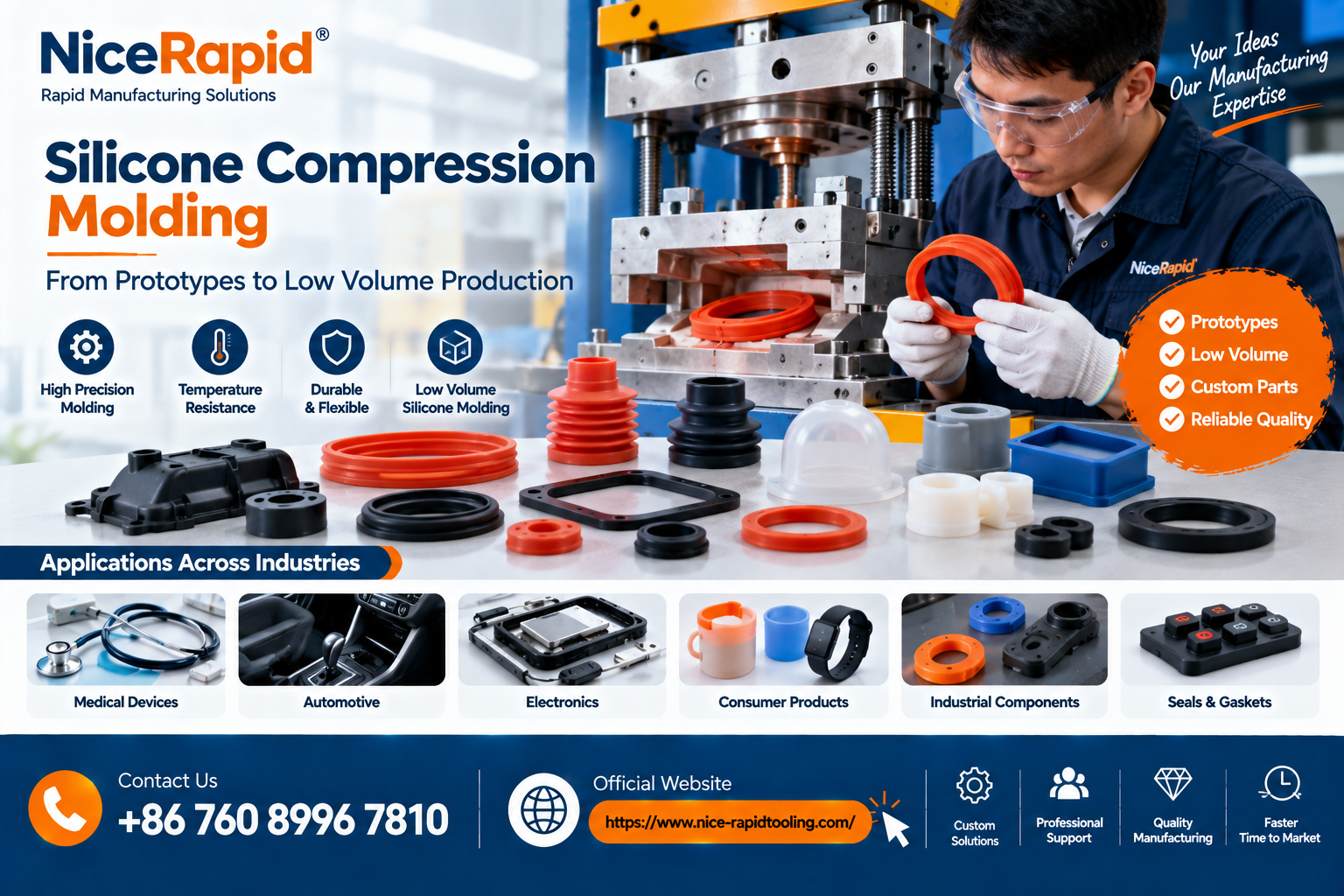
As manufacturers seek greater flexibility in product development and custom component production, Silicone Compression Molding remains a practical manufacturing method for creating durable, flexible, and precisely shaped silicone rubber parts.
From industrial seals and electronic components to medical-device applications and consumer products, manufacturers are evaluating low volume silicone molding to support product testing, specialized manufacturing requirements, and smaller production quantities.
The growing importance of flexible manufacturing strategies highlights the need to balance tooling costs, material performance, design complexity, and product quality when selecting a silicone molding process.
Understanding Silicone Compression Molding in Modern Manufacturing
Silicone Compression Molding is a manufacturing process in which a measured quantity of silicone rubber is placed inside a heated mold cavity and compressed under controlled pressure.
Heat and pressure allow the material to fill the mold and cure into the required shape.
After curing, the component is removed, inspected, and finished when necessary.
This process is commonly associated with high-consistency silicone rubber and can be used to manufacture components with specific dimensions, flexibility, and environmental resistance.
Typical applications include:
- Industrial rubber gaskets and seals.
- Silicone washers and protective covers.
- Electrical insulation components.
- Flexible consumer product parts.
- Automotive rubber components.
- Custom silicone pads and cushioning elements.
- Selected healthcare and laboratory components.
Material grades and manufacturing controls must be appropriate for the intended application.
What Is Low Volume Silicone Molding?
Low volume silicone molding refers to producing silicone rubber components in relatively small quantities rather than through continuous mass production.
It can be useful for businesses developing new products, validating designs, or manufacturing specialized parts with limited market demand.
Unlike large-scale manufacturing programs, low-volume production often prioritizes flexibility, manageable initial investment, and opportunities for product refinement.
Common Applications
Businesses may choose smaller production runs for:
- Engineering prototypes.
- Product evaluation samples.
- Customized industrial components.
- Pilot production programs.
- Replacement parts.
- Limited-edition consumer products.
The most economical manufacturing method depends on component geometry, mold design, material selection, and required production volume.
How Silicone Compression Molding Works
The manufacturing process involves several carefully controlled stages.
1. Product Design and Engineering
Engineers review part dimensions, wall thickness, tolerance requirements, and intended operating conditions.
2. Mold Design and Preparation
A mold is designed to create the required component geometry. Tooling must account for silicone curing behavior and dimensional changes.
3. Material Selection
The manufacturer selects a suitable silicone compound based on hardness, temperature requirements, chemical exposure, and other performance needs.
4. Compression and Curing
A measured material charge is placed inside the mold. Heat and pressure shape and cure the silicone.
5. Demolding and Finishing
The finished part is removed and may require trimming to eliminate excess material.
6. Quality Inspection
Components are checked against agreed specifications, which may include dimensions, appearance, hardness, and functional performance.
Major Benefits of Silicone Compression Molding
Flexible Production Quantities
Compression molding can be suitable for smaller manufacturing batches when tooling and part complexity make the process economical.
Material Performance
Properly selected silicone rubber can offer flexibility, temperature resistance, and useful electrical insulation properties.
Custom Component Design
The process supports various molded shapes, dimensions, and hardness options, subject to tooling limitations.
Production Consistency
Controlled tooling and processing conditions can help manufacturers achieve repeatable component characteristics.
Suitable for Specialized Products
Custom seals, pads, and industrial rubber components may be manufactured according to application-specific requirements.
Compression Molding vs Injection Molding
Manufacturers should compare processes before selecting a production method.
| Factor | Compression Molding | Silicone Injection Molding |
| Material introduction | Material placed into the mold | Material injected into the mold |
| Tooling | Can be simpler for certain designs | Often requires more complex equipment |
| Production volume | Suitable for selected small and larger runs | Often attractive for repeat production |
| Design considerations | May require more trimming and finishing | Can support complex production requirements |
| Automation | Varies by equipment and process | Often offers greater automation potential |
Neither method is universally superior. The best choice depends on technical requirements, part geometry, and economics.
Industries Using Low Volume Silicone Molding
Several industries require customized rubber components in smaller quantities.
Electronics: Silicone parts may provide cushioning, sealing, or electrical insulation.
Automotive: Specialized gaskets, protective components, and vibration-management parts may be manufactured using suitable silicone materials.
Industrial Equipment: Custom seals and flexible components support machinery and equipment applications.
Consumer Products: Manufacturers use silicone for buttons, protective covers, and other flexible molded components.
Healthcare Applications: Certain devices require specialized silicone materials and validated manufacturing controls. Medical suitability cannot be assumed from the material alone.
Important Design Considerations
Before ordering custom molded silicone parts, businesses should evaluate several technical factors.
- Material Hardness: Select appropriate Shore A hardness according to functional requirements.
- Operating Temperature: Verify the selected compound’s thermal performance.
- Wall Thickness: Consider how geometry influences filling, curing, and dimensional accuracy.
- Tolerance Requirements: Establish realistic tolerances with the manufacturer.
- Chemical Compatibility: Confirm suitability for expected environmental exposure.
- Tooling Design: Review parting lines, undercuts, and potential flash.
- Inspection Criteria: Define measurable quality requirements before production.
Early engineering discussions can reduce unnecessary design revisions and manufacturing complications.
How to Select a Silicone Molding Manufacturer
Choosing a manufacturing partner requires evaluating both technical capability and communication.
Businesses should review available materials, tooling experience, equipment capabilities, inspection methods, and minimum order quantities.
It is also important to clarify sample approval procedures, production schedules, quality documentation, and the responsibilities of each party.
For low volume silicone molding, manufacturers should be able to explain how tooling investment and per-part costs change with different order quantities.
Clear specifications and realistic expectations are essential for successful production.
Frequently Asked Questions (FAQs)
1. What is Silicone Compression Molding?
It is a manufacturing process that uses heat and pressure to shape and cure silicone rubber inside a mold.
2. What is low volume silicone molding?
It involves producing relatively small batches of customized silicone rubber components.
3. Is compression molding suitable for prototypes?
Yes. It can be suitable for functional prototypes and pilot production when the required tooling is economically justified.
4. Which silicone materials are used in compression molding?
High-consistency silicone rubber compounds are commonly used, with formulations selected according to application requirements.
5. Can compression molding produce custom gaskets?
Yes. The process can manufacture various customized silicone gaskets, seals, and washers.
6. Is silicone rubber resistant to high temperatures?
Many silicone formulations offer useful thermal resistance, but performance depends on the specific compound.
7. What affects silicone compression molding costs?
Tooling complexity, material grade, component size, production quantity, and finishing requirements influence costs.
8. Is low-volume manufacturing suitable for startups?
It may be useful for startups testing product designs or preparing initial market releases.
9. What is the difference between silicone compression molding and injection molding?
Compression molding places material directly into a mold, while injection molding introduces material through an injection system.
10. How can manufacturers maintain silicone part quality?
Quality can be supported through controlled processing, appropriate material selection, dimensional inspection, and clearly defined acceptance criteria.
Media Contact
Industry: Custom Manufacturing, Silicone Rubber Components & Product Development
Service Enquiries: Silicone Compression Molding, Low-Volume Production, Custom Tooling & Component Manufacturing
Contact Information: +86 760 8996 7810
Email: enquiry@nice-rapidtooling.com
Official Website: https://www.nice-rapidtooling.com/