
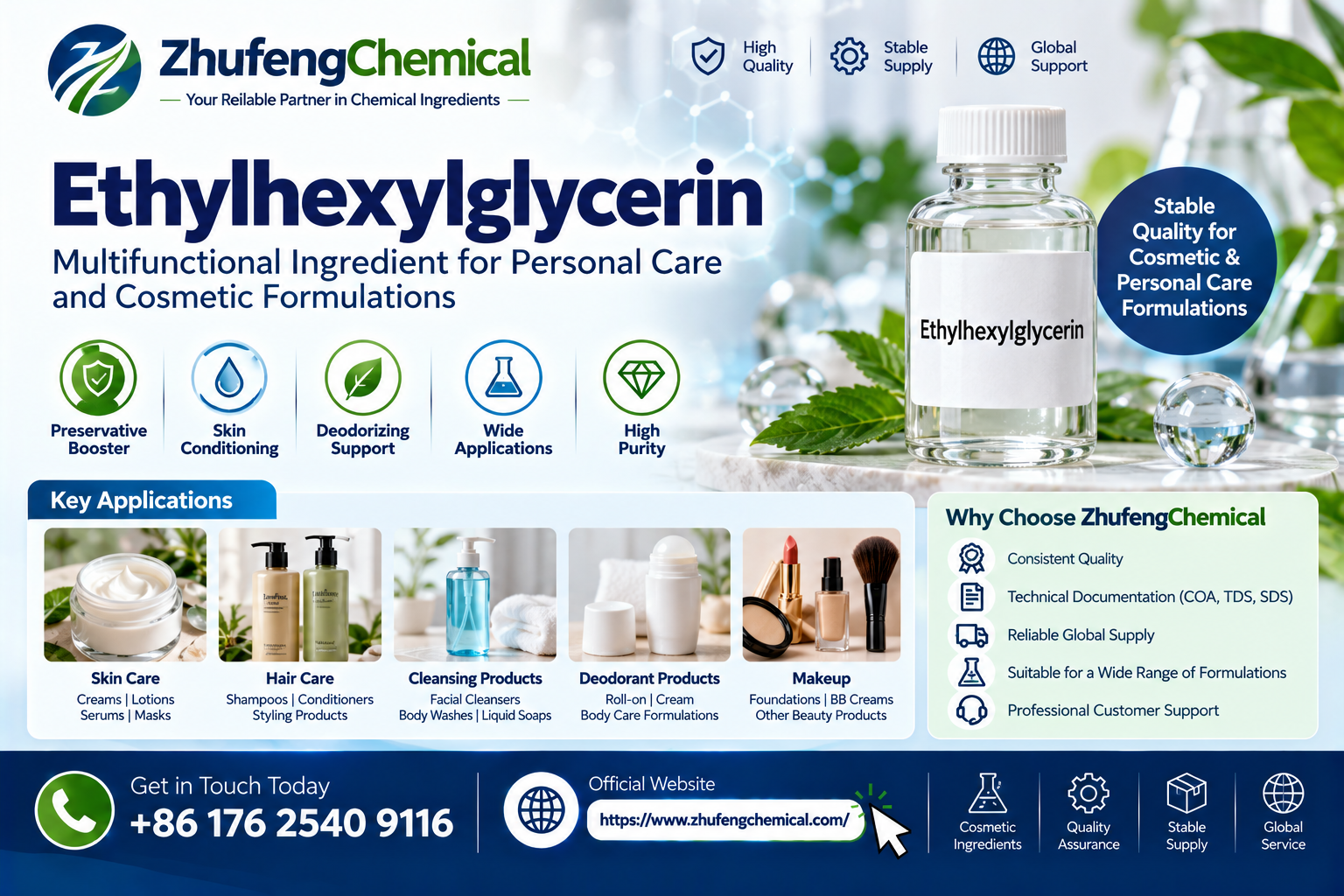
The cosmetics and personal care industry continues to explore multifunctional ingredients that support product stability, skin compatibility, and formulation performance. Among these ingredients, Ethylhexylglycerin has become an important component in skincare, haircare, deodorants, and cosmetic preservation systems.
Its versatility makes it useful for formulators developing products that require effective ingredient combinations and dependable quality standards.
Choosing a professional Ethylhexylglycerin Supplier is equally important for manufacturers seeking consistent raw material specifications, reliable documentation, and suitable production quantities.
Understanding this ingredient’s properties, applications, and quality requirements helps businesses make informed sourcing and formulation decisions.
What Is Ethylhexylglycerin?
Ethylhexylglycerin is a synthetic glycerol-derived ether widely used as a multifunctional ingredient in cosmetics and personal care formulations.
It is commonly incorporated into products as a skin-conditioning ingredient, deodorant component, and preservative booster.
One of its important applications is supporting the effectiveness of appropriately designed preservation systems.
Unlike a complete preservation system, the ingredient should not automatically be relied upon to protect a finished formulation against all microbial contamination.
Common applications include:
- Facial creams and moisturizers.
- Body lotions.
- Shampoos and conditioners.
- Facial cleansers.
- Deodorants.
- Makeup products.
- Personal care formulations.
- Selected cosmetic cleansing products.
Why Is Ethylhexylglycerin Important in Cosmetic Formulations?
Modern cosmetic manufacturing requires ingredients that contribute to both product functionality and formulation compatibility.
Ethylhexylglycerin is valued because it can perform several useful roles.
Skin-Conditioning Properties
The ingredient can help support the skin-conditioning characteristics of suitable cosmetic formulations.
Preservative-Boosting Function
It is commonly combined with preservatives such as phenoxyethanol to help improve the performance of certain preservation systems.
Deodorant Applications
The ingredient may contribute to deodorant formulations by helping reduce conditions associated with the development of unwanted body odor.
Formulation Versatility
Its compatibility with different cosmetic ingredient systems makes it useful across multiple personal care product categories.
Actual performance depends on concentration, ingredient compatibility, formulation design, and appropriate testing.
How Does Ethylhexylglycerin Work as a Preservative Booster?
Preservation is essential for many water-containing cosmetic products because microbial contamination can affect product quality and consumer safety.
Ethylhexylglycerin may enhance the activity of certain preservatives when incorporated into properly designed formulations.
It is frequently used alongside phenoxyethanol and other compatible preservation ingredients.
However, a preservative booster is not necessarily a substitute for an effective preservation system.
Manufacturers should conduct appropriate preservative efficacy testing, commonly known as challenge testing, to assess the finished formulation.
Major Industrial Applications of Ethylhexylglycerin
The ingredient is primarily associated with cosmetic and personal care manufacturing.
| Application | Typical Purpose |
| Facial creams | Skin conditioning and preservation support |
| Body lotions | Multifunctional formulation ingredient |
| Shampoos | Preservation-system enhancement |
| Deodorants | Supporting odor-control formulations |
| Makeup products | Ingredient compatibility and product preservation support |
| Cleansers | Supporting appropriate preservation systems |
Product manufacturers must determine suitable usage levels through formulation development and safety assessment.
Important Properties of Ethylhexylglycerin
When evaluating the ingredient, formulators should consider its physical and functional characteristics.
Chemical Classification: Glycerol-derived ether.
Appearance: Generally supplied as a clear liquid, although specifications may vary.
Functionality: Skin conditioning, deodorant applications, and preservative boosting.
Formulation Compatibility: Must be evaluated with the finished product’s other ingredients.
Storage Requirements: Follow the supplier’s recommendations for temperature, packaging, and shelf life.
Manufacturers should consult current technical documentation before introducing any raw material into commercial production.
Why Choosing an Ethylhexylglycerin Supplier Matters
A dependable Ethylhexylglycerin Supplier supports cosmetic manufacturers by providing materials with clearly defined specifications and appropriate quality documentation.
Raw material consistency is particularly important when manufacturers produce products in large quantities.
Factors to evaluate include:
- Clearly defined product specifications.
- Consistent raw material quality.
- Availability of a Certificate of Analysis.
- Safety Data Sheet documentation.
- Batch identification and traceability.
- Suitable industrial packaging.
- Reliable supply arrangements.
- Clear technical communication.
Suppliers should also explain available product grades and relevant application limitations.
How to Evaluate Ethylhexylglycerin Quality
Quality evaluation begins with verifying the material’s identity and technical specifications.
A manufacturer may review:
- Chemical Identity: Confirm the correct ingredient and documentation.
- Purity Specifications: Assess relevant compositional requirements.
- Appearance: Check that the material meets agreed specifications.
- Batch Consistency: Review documentation across supplied batches.
- Packaging Integrity: Ensure suitable protection during storage and transportation.
- Storage Stability: Follow documented shelf-life and handling recommendations.
- Regulatory Suitability: Verify compliance with applicable market requirements.
Independent analytical testing may be appropriate when needed for supplier qualification or product development.
Ethylhexylglycerin and Cosmetic Product Safety
Ingredient safety should always be evaluated within the context of the finished cosmetic product.
Relevant considerations include concentration, skin exposure, product type, and potential interactions with other ingredients.
Although widely used in personal care products, Ethylhexylglycerin can cause irritation or sensitivity in some individuals.
Manufacturers should conduct suitable safety assessments and follow applicable cosmetic regulations.
Finished-product testing remains essential because raw material quality alone does not establish product safety.
Emerging Priorities in Cosmetic Ingredient Sourcing
Cosmetic manufacturers are placing greater emphasis on documented ingredient specifications, reliable supply chains, and transparent quality procedures.
When selecting an Ethylhexylglycerin Supplier, businesses should evaluate both technical suitability and commercial reliability.
Companies may also consider packaging efficiency, raw material traceability, and long-term supply consistency.
Product claims relating to sustainability, safety, or performance should be supported by appropriate evidence.
Frequently Asked Questions (FAQs)
1. What is Ethylhexylglycerin?
It is a glycerol-derived cosmetic ingredient commonly used for skin conditioning, deodorant applications, and preservative boosting.
2. What is Ethylhexylglycerin used for?
It is commonly found in skincare, haircare, cleansers, deodorants, and makeup formulations.
3. Is Ethylhexylglycerin a preservative?
It is primarily used as a preservative booster in many formulations rather than as a complete standalone preservation system.
4. Is Ethylhexylglycerin suitable for skincare products?
It can be suitable when incorporated at appropriate levels within a properly assessed formulation.
5. Can Ethylhexylglycerin be combined with phenoxyethanol?
Yes. This combination is commonly used in cosmetic preservation systems.
6. What does an Ethylhexylglycerin Supplier provide?
Depending on the supplier, services may include raw material supply, product specifications, quality certificates, and technical documentation.
7. Is Ethylhexylglycerin safe for sensitive skin?
Suitability varies by formulation and individual sensitivity. Some users may experience irritation.
8. How should Ethylhexylglycerin be stored?
It should be stored according to the supplier’s documented packaging, temperature, and handling recommendations.
9. What affects Ethylhexylglycerin pricing?
Purity specifications, order quantity, packaging, transportation, sourcing conditions, and quality requirements may affect pricing.
10. How can businesses choose a reliable Ethylhexylglycerin Supplier?
Evaluate product specifications, batch traceability, quality documentation, supply capabilities, and commercial terms.
Media Contact
Industry: Chemical Supply, Specialty Ingredients & Cosmetic Raw Materials
Service Enquiries: Ethylhexylglycerin, Cosmetic Ingredients, Personal Care Raw Materials & Specialty Chemical Supply
Email: sales@zhufengchemical.com
Contact: +86-510-83957198
Official Website: https://www.zhufengchemical.com/