
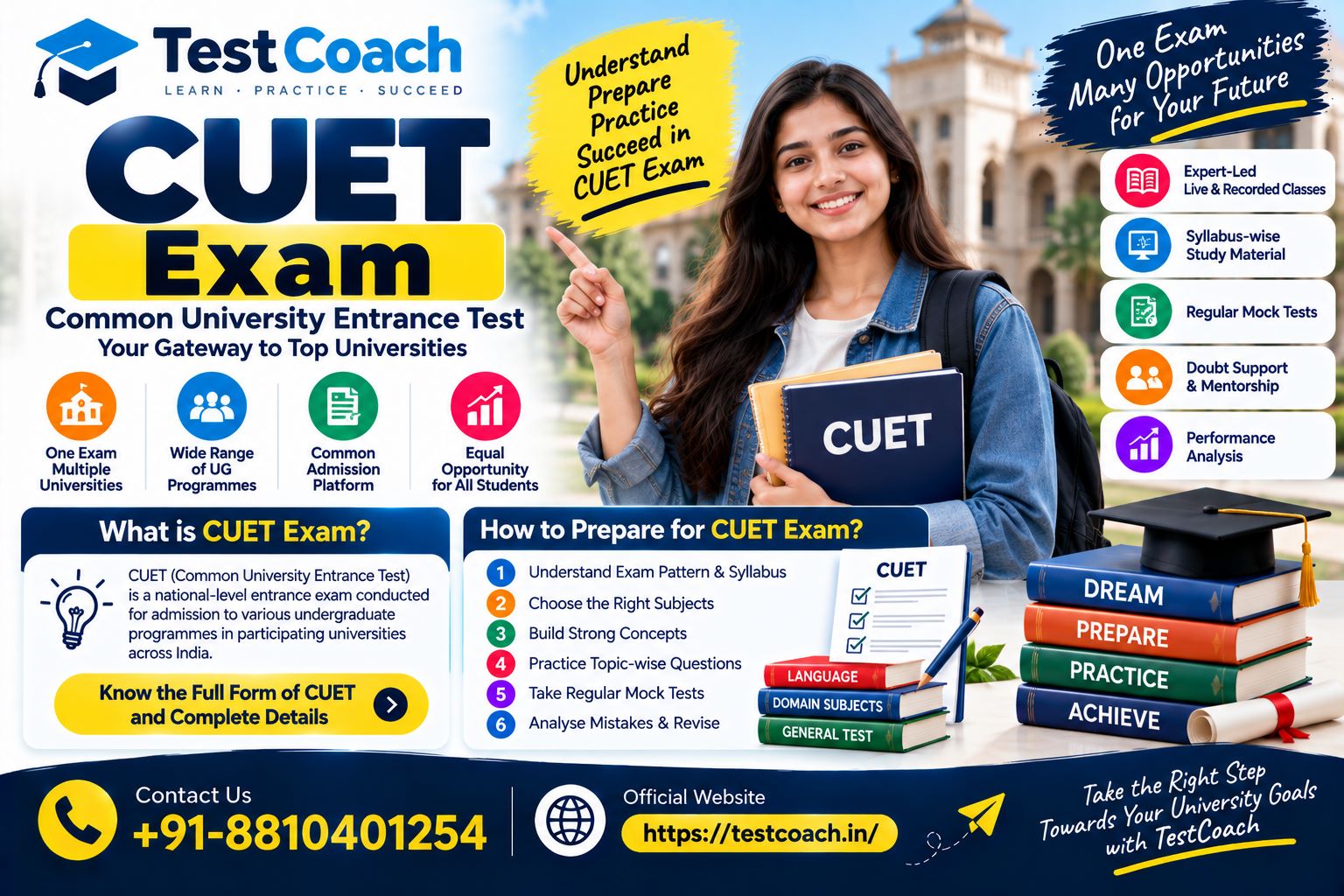
As students across India explore higher education opportunities, the cuet exam continues to play an important role in undergraduate university admissions. With growing awareness of centralized entrance examinations, students and parents are seeking reliable information about eligibility, examination structure, preparation strategies, and the full form of cuet.
The Common University Entrance Test provides a standardized admission assessment for various academic programs offered by participating universities. It allows eligible students from different educational backgrounds to apply for higher education opportunities through a common examination framework.
Understanding how the examination works can help aspirants make informed academic decisions and develop effective preparation strategies.
What Is the Full Form of CUET?
The full form of cuet is Common University Entrance Test. It is a national-level entrance examination used for admission to various programs at participating universities across India.
The examination is administered by the National Testing Agency (NTA) and is organized through separate undergraduate and postgraduate admission frameworks.
The two major categories are:
- CUET-UG: Common University Entrance Test for undergraduate admissions.
- CUET-PG: Common University Entrance Test for postgraduate admissions.
The undergraduate examination is particularly relevant for students completing Class 12 who wish to pursue bachelor’s degree programs.
Rather than preparing for multiple separate entrance examinations where CUET is accepted, students can use their applicable examination scores to seek admission to participating institutions.
Why the CUET Exam Matters for University Admissions
The cuet exam provides a common assessment framework for students applying to participating universities.
It helps institutions evaluate applicants through standardized entrance examination scores while retaining their own program-specific admission requirements.
Students from science, commerce, humanities, and other eligible academic backgrounds can explore suitable undergraduate programs.
Important advantages include:
- A common entrance examination framework for participating institutions.
- Opportunities to apply to multiple eligible universities.
- Subject-based assessment relevant to different academic programs.
- A structured pathway for undergraduate admissions.
- Wider awareness of academic opportunities across institutions.
- Greater clarity regarding applicable entrance examination requirements.
However, examination qualification does not automatically guarantee admission. Final selection depends on eligibility, scores, seat availability, and university-specific procedures.
Understanding the CUET Exam Eligibility Criteria
Students planning to appear for CUET-UG generally need to have completed or be appearing for their Class 12 or equivalent qualifying examination.
However, the eligibility requirements for admission vary according to the selected university and undergraduate program.
Some courses require specific subjects in Class 12, while others may establish minimum academic qualifications or additional admission conditions.
Before applying, students should carefully review:
- Required educational qualifications.
- Subject eligibility for selected programs.
- University-specific admission requirements.
- Applicable examination subjects.
- Registration and counseling procedures.
Students should consult the official admission guidelines for their examination year rather than assuming that every university follows identical eligibility conditions.
CUET Exam Pattern and Important Subjects
The cuet exam assesses students through subjects relevant to their chosen admission pathways.
For undergraduate admissions, examination preparation may involve language subjects, domain-specific subjects, and general aptitude, depending on the applicable examination structure.
Language Subjects: Assess reading comprehension, vocabulary, verbal ability, and language understanding.
Domain-Specific Subjects: Cover academic disciplines such as Physics, Chemistry, Biology, Mathematics, Economics, Accountancy, History, and other available subjects.
General Aptitude: May include current affairs, general knowledge, numerical ability, mental ability, and logical reasoning.
The number of questions, examination duration, subject-selection limits, and marking scheme can change between examination cycles.
Students should verify the latest official information bulletin before finalizing their preparation plans.
How to Prepare Effectively for the CUET Exam
A strong preparation strategy begins with understanding the syllabus and identifying subjects relevant to university admission requirements.
Students should avoid studying unrelated topics or collecting excessive materials without a structured learning plan.
An effective preparation routine includes:
Understand the Syllabus: Review the official subject-wise syllabus and identify important learning areas.
Strengthen Fundamental Concepts: Focus on conceptual understanding through relevant textbooks and academic resources.
Develop a Study Schedule: Allocate sufficient time to subject preparation, revision, and question-solving.
Practice Mock Tests: Attempt examination-style questions to evaluate understanding and improve time management.
Analyze Mistakes: Review incorrect answers and strengthen weaker topics through targeted revision.
Maintain Consistency: Follow realistic daily learning targets instead of depending on last-minute preparation.
Important Steps in the CUET Admission Process
Understanding the admission journey is essential for students planning their higher education.
The process generally includes examination registration, subject selection, entrance assessment, result declaration, and university-level admission procedures.
Students should first identify institutions offering their preferred courses and confirm their admission requirements.
After appearing for the relevant examination, applicants may need to participate in separate university counseling or application processes.
Admission timelines, document verification, merit preparation, and seat allocation policies vary among participating universities.
Therefore, students should regularly review official admission announcements and complete applications within the prescribed deadlines.
Common Mistakes Students Should Avoid
One common mistake is selecting examination subjects without checking university eligibility requirements.
Students may also underestimate revision, depend exclusively on memorization, or avoid practicing questions under timed conditions.
Another challenge involves relying on outdated examination information.
A well-planned preparation strategy should prioritize accurate information, relevant study materials, consistent revision, and regular self-assessment.
Frequently Asked Questions (FAQs)
1. What is the full form of CUET?
The full form of CUET is Common University Entrance Test, a national-level examination used for admission to various programs at participating Indian universities.
2. What is the CUET exam?
CUET is a standardized entrance examination that helps eligible students apply for undergraduate or postgraduate programs through the applicable examination framework.
3. Who conducts the CUET examination?
The National Testing Agency (NTA) conducts CUET examinations according to the applicable official examination arrangements.
4. Can students apply for CUET after Class 12?
Yes. Students who have completed or are appearing for Class 12 may apply for CUET-UG, subject to applicable eligibility conditions.
5. Is CUET compulsory for every university in India?
No. CUET is used by participating institutions, while other universities and programs may follow separate admission procedures.
6. What subjects are included in CUET?
Available subjects may include languages, domain-specific academic disciplines, and general aptitude. Requirements depend on the selected course and university.
7. Can students prepare for CUET without coaching?
Yes. Students can prepare independently through syllabus-based study, relevant textbooks, practice questions, revision, and mock examinations.
8. Does qualifying for CUET guarantee university admission?
No. Admission depends on examination performance, program eligibility, seat availability, and the admission policies of the relevant institution.
9. Where can students check official CUET updates?
Students should consult the National Testing Agency’s official examination announcements and participating universities’ admission notifications.
Media Contact
Department: Education and Academic Guidance
Location: India
Email: support@testcoach.in
Contact: +91-8810401254
Official Website: https://testcoach.in/