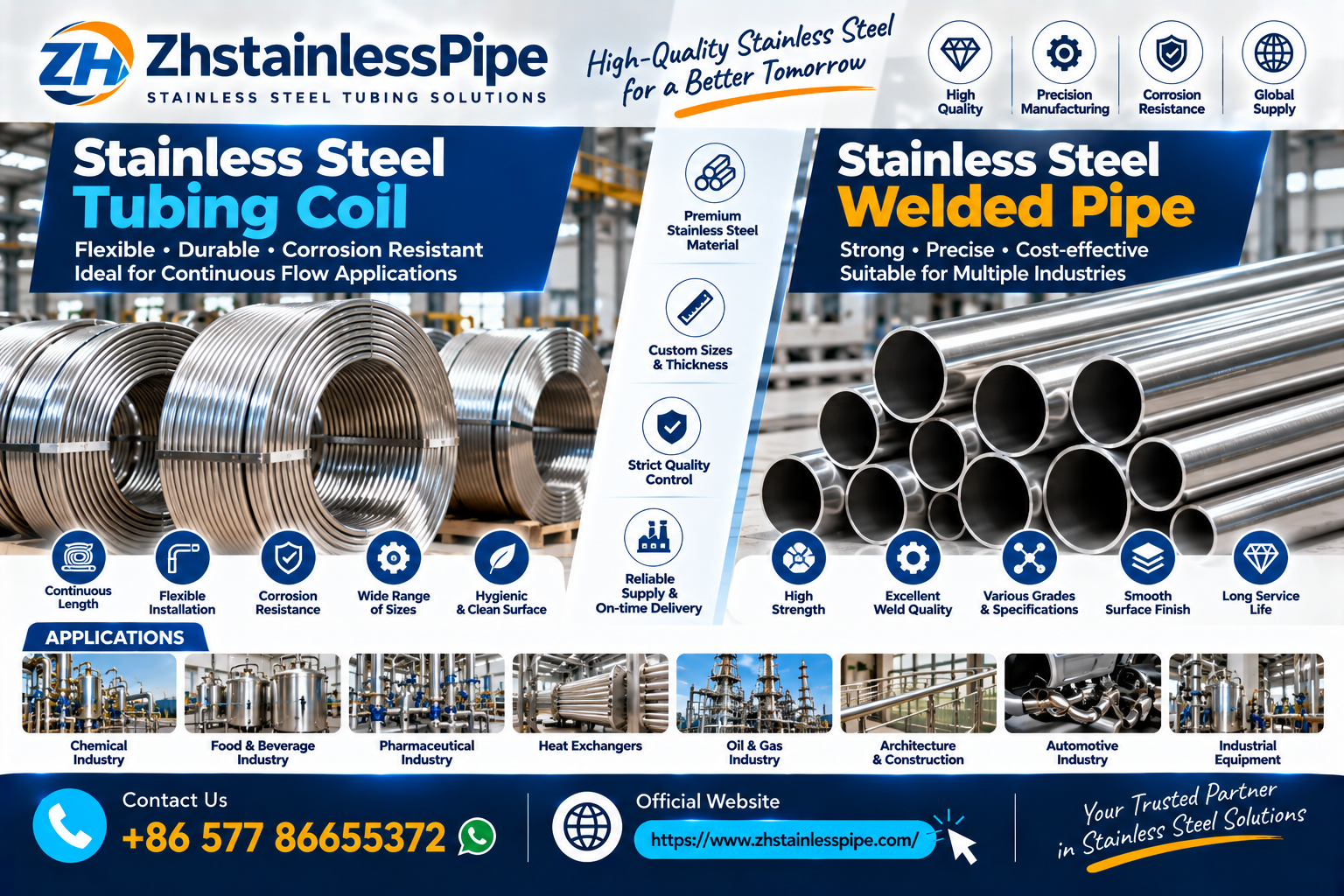
As industrial manufacturers, engineering companies, and infrastructure developers focus on material efficiency, corrosion resistance, and reliable fluid transportation, stainless steel piping solutions remain essential across multiple industries. The Stainless Steel Tubing Coil offers flexibility for continuous tubing installations, while Stainless Steel Welded Pipe provides a practical solution for fluid transportation, processing equipment, and structural applications.
From chemical processing and instrumentation to food manufacturing and industrial construction, these stainless steel products support diverse engineering requirements.
For industrial buyers, understanding manufacturing methods, material grades, dimensional specifications, and application suitability is important when selecting dependable piping solutions.
Growing Importance of Stainless Steel Tubing Coil in Modern Industries
A Stainless Steel Tubing Coil is a continuous length of stainless steel tubing supplied in a coiled configuration for suitable industrial applications.
Compared with short, straight tubing sections, coiled tubing can reduce the number of intermediate connections required in certain installations.
This configuration is useful when long tubing runs, compact transportation, and flexible routing are important.
Common applications include:
- Heat Exchangers: Supporting heat transfer through suitable tubing configurations.
- Instrumentation Systems: Providing tubing connections for compatible measurement and control equipment.
- Chemical Processing: Transporting appropriate fluids through corrosion-resistant systems.
- Industrial Refrigeration: Supporting selected cooling and refrigeration installations.
- Energy Equipment: Providing continuous tubing for approved industrial applications.
- Manufacturing Machinery: Supporting fluid transfer and other engineered tubing requirements.
Stainless Steel Welded Pipe: Supporting Industrial Infrastructure
Stainless Steel Welded Pipe is manufactured by forming stainless steel material into a tubular shape and joining its edges through a suitable welding process.
Manufacturing methods may include longitudinal welding processes selected according to the pipe’s dimensions, material grade, and intended application.
Welded stainless steel pipes are used in industries requiring corrosion resistance, consistent dimensions, and dependable fluid transportation.
Important applications include:
Water Treatment: Transporting compatible water and processing fluids through suitable piping systems.
Food and Beverage Processing: Supporting hygienic production systems when materials and finishes meet relevant requirements.
Chemical Manufacturing: Handling compatible chemicals in industrial processing facilities.
Construction: Providing suitable piping and structural components.
Industrial Equipment: Supporting manufacturing processes, machinery connections, and fluid distribution.
The suitability of welded pipe depends on its manufacturing specification, pressure rating, material grade, and operating environment.
Understanding the Difference Between Coiled Tubing and Welded Pipe
Although both products are manufactured from stainless steel, their descriptions refer to different characteristics.
| Feature | Stainless Steel Tubing Coil | Stainless Steel Welded Pipe |
| Main characteristic | Continuous coiled configuration | Welded manufacturing construction |
| Typical supply form | Coiled lengths | Commonly straight lengths |
| Main applications | Instrumentation, heat transfer, fluid lines | Process piping, water systems, industrial facilities |
| Manufacturing options | Seamless or welded, as specified | Welded |
| Key consideration | Bendability and installation routing | Weld integrity and service specifications |
A tubing coil may itself be manufactured using a welded process. Therefore, these product categories are not necessarily mutually exclusive.
Material Grades Used in Stainless Steel Products
Material selection significantly influences the performance of stainless steel tubing and piping.
Common stainless steel grades include:
304 Stainless Steel: Offers general corrosion resistance, good formability, and suitability for numerous industrial applications.
316 Stainless Steel: Contains molybdenum and generally provides improved resistance to certain chloride-containing environments compared with grade 304.
304L and 316L Stainless Steel: Low-carbon variants are commonly considered for suitable welded applications.
Selecting the appropriate grade requires evaluating chemical exposure, temperature, operating pressure, fabrication requirements, and applicable engineering standards.
Manufacturing Quality and Technical Specifications
The production of Stainless Steel Welded Pipe involves forming, welding, and finishing operations designed to achieve the required dimensions and performance.
Depending on the specification, manufacturing may also include heat treatment, weld evaluation, dimensional inspection, and pressure-related testing.
For Stainless Steel Tubing Coil, important considerations include wall thickness consistency, surface condition, bendability, and manufacturing quality.
Industrial buyers should review:
- Material grade and chemical composition
- Outside diameter and wall thickness
- Dimensional tolerances
- Surface finish and cleanliness
- Applicable working pressure and temperature
- Weld quality, where relevant
- Material certificates and traceability
- Applicable ASTM or other technical specifications
For example, ASTM A269 may apply to certain stainless steel tubing products, while ASTM A312 covers specified seamless and welded austenitic stainless steel pipe.
Buyers should confirm the exact applicable standard rather than assuming all stainless steel products meet identical specifications.
Why Stainless Steel Tubing Coils Support Installation Efficiency
One advantage of a Stainless Steel Tubing Coil is its ability to provide longer continuous tubing runs.
In suitable installations, this can reduce the number of intermediate fittings and joints.
Fewer connections may simplify installation planning and reduce potential leakage points when the complete system is properly designed.
However, coiled tubing must be handled according to the manufacturer’s bending, straightening, and installation recommendations.
Excessive bending or unsuitable handling can damage tubing and affect performance.
Choosing the Right Stainless Steel Supplier
Selecting a reliable supplier requires evaluating technical capabilities and manufacturing consistency.
Businesses purchasing Stainless Steel Welded Pipe should assess weld quality, dimensional accuracy, material certification, and suitability for the intended application.
For coiled tubing, buyers should additionally confirm coil dimensions, available lengths, surface finish, and handling requirements.
Sample evaluation, technical documentation, and clear communication can help reduce procurement errors.
Frequently Asked Questions (FAQs)
1. What is a Stainless Steel Tubing Coil?
It is a continuous length of stainless steel tubing supplied in a coil for applications involving instrumentation, heat transfer, and compatible fluid transportation.
2. What is Stainless Steel Welded Pipe?
It is stainless steel pipe manufactured by forming metal into a tubular shape and joining the edges through an appropriate welding process.
3. What industries use stainless steel tubing coils?
Common applications include chemical processing, instrumentation, heat exchangers, manufacturing, and selected energy systems.
4. Is welded stainless steel pipe suitable for industrial applications?
Yes. Properly specified welded stainless steel pipe is widely used in compatible industrial processing and fluid transportation systems.
5. What is the difference between seamless and welded stainless steel products?
Seamless products are manufactured without a longitudinal weld, while welded products contain a manufactured seam.
6. Which stainless steel grade is better, 304 or 316?
The choice depends on operating conditions. Grade 316 generally offers improved resistance in certain chloride-containing environments.
7. Can stainless steel tubing coils reduce installation connections?
Yes. Longer continuous tubing lengths can reduce intermediate joints in suitable installations.
8. Are stainless steel welded pipes corrosion-resistant?
They offer corrosion resistance according to their material grade, fabrication quality, and operating environment.
9. What factors affect stainless steel tubing prices?
Material grade, dimensions, manufacturing method, surface finish, order quantity, and market conditions influence pricing.
10. How can businesses select a reliable stainless steel supplier?
Buyers should evaluate technical specifications, product quality, inspection documentation, manufacturing consistency, and customer support.
Media Contact
Department: Stainless Steel Products and Business Communications
Email: sales@zhehengsteel.com
Contact: +86 577 86655372
Official Website: https://www.zhstainlesspipe.com/