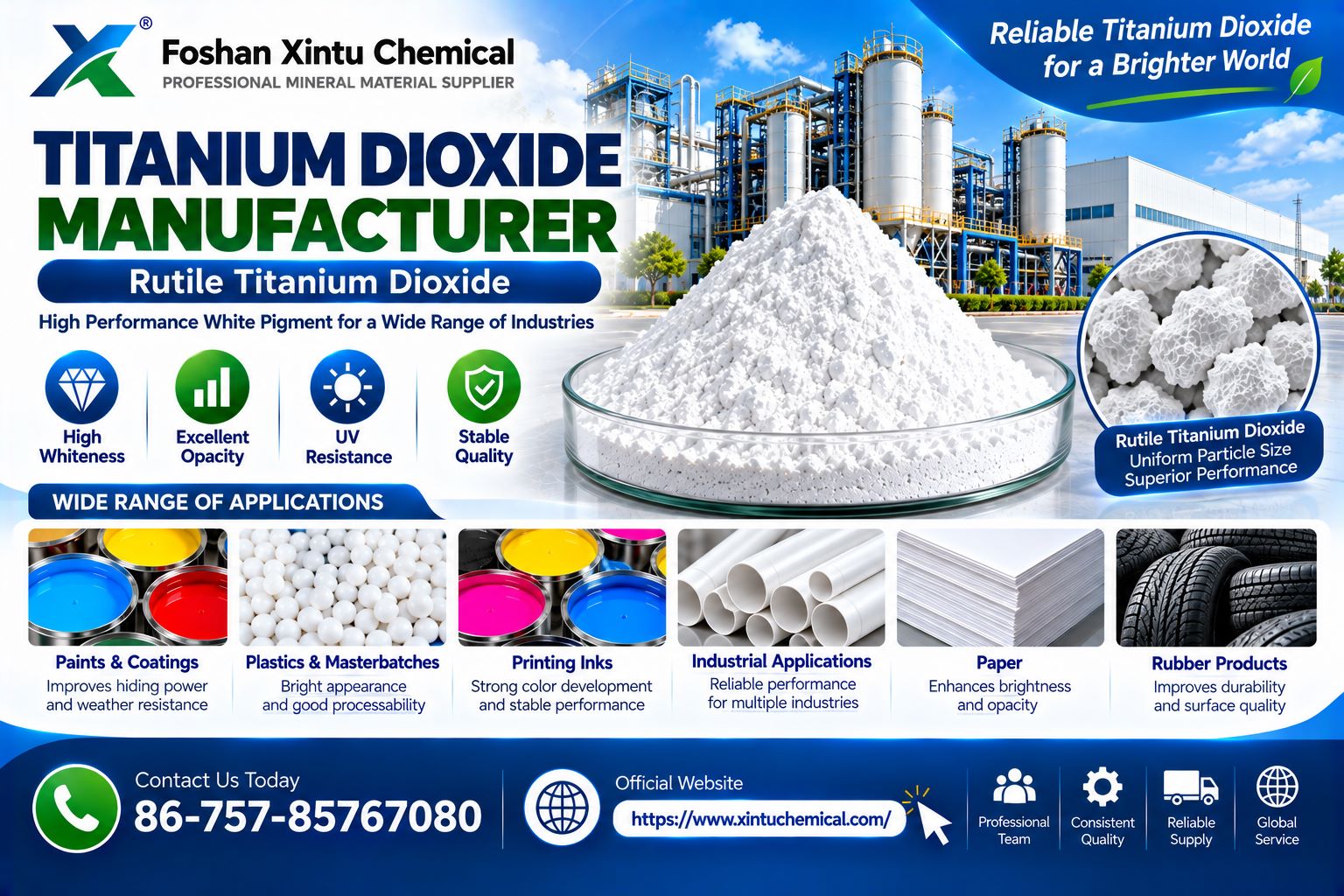
As industrial manufacturers focus on product durability, consistent pigmentation, and efficient raw material sourcing, titanium dioxide remains an essential ingredient across several manufacturing sectors. A reliable Titanium Dioxide Manufacturer plays an important role in supplying industrial pigments, while Rutile Titanium Dioxide supports the production of high-quality paints, coatings, plastics, printing inks, and specialized industrial materials.
Titanium dioxide, chemically represented as TiO₂, is valued for its whiteness, high refractive index, and excellent light-scattering ability.
With different pigment grades available, manufacturers must consider product specifications, surface treatments, dispersion behavior, and application requirements before selecting suitable materials.
Growing Importance of a Titanium Dioxide Manufacturer
A Titanium Dioxide Manufacturer produces titanium dioxide pigments for industrial applications requiring opacity, brightness, and consistent color appearance.
Titanium dioxide helps manufacturers achieve white coloration and hiding power without relying exclusively on large quantities of alternative pigments.
The material is used in architectural coatings, plastic compounds, industrial finishes, and selected printing applications.
Key Benefits of Titanium Dioxide Pigments
- High Whiteness: Supports bright and visually consistent finished products.
- Excellent Opacity: Provides effective hiding power in suitable formulations.
- Strong Light Scattering: Contributes to pigment efficiency.
- Application Versatility: Suitable grades serve coatings, plastics, and inks.
- Surface Treatment Options: Help improve compatibility with different formulation systems.
- Product Consistency: Controlled manufacturing supports predictable pigment performance.
What Is Rutile Titanium Dioxide?
Rutile Titanium Dioxide is a crystalline form of titanium dioxide widely used as a white pigment in industrial manufacturing.
Titanium dioxide commonly occurs in two commercially important crystalline forms: rutile and anatase.
Rutile has a higher refractive index than anatase, making it particularly effective for visible-light scattering.
Its optical properties contribute to excellent opacity in properly formulated products.
Many commercial rutile pigment grades also receive inorganic or organic surface treatments to improve dispersion, durability, and compatibility.
Important Characteristics of Rutile Grades
Optical Performance: Strong light scattering helps achieve whiteness and hiding power.
Weathering Performance: Suitable surface-treated grades are used in demanding outdoor coatings.
Chemical Stability: Provides compatibility with numerous industrial formulations.
Dispersion Characteristics: Appropriate treatments help pigments distribute consistently.
Processing Flexibility: Different grades are available for selected coating and polymer systems.
How Titanium Dioxide Is Manufactured
Industrial titanium dioxide production commonly uses two manufacturing routes.
Sulfate Process
The sulfate process uses suitable titanium-bearing materials and chemical treatment to produce titanium dioxide through several processing stages.
Chloride Process
The chloride process converts appropriate titanium-containing feedstocks into titanium tetrachloride, which is subsequently processed to produce titanium dioxide.
Both methods can manufacture commercial pigment products.
The final pigment’s quality depends on the complete manufacturing process, including particle control, crystal development, purification, and finishing.
A qualified Titanium Dioxide Manufacturer should provide appropriate documentation identifying product characteristics and intended industrial applications.
Rutile Titanium Dioxide in Paints and Coatings
The paints and coatings industry is an important market for Rutile Titanium Dioxide.
Pigment selection influences coating opacity, color appearance, gloss, and durability.
Architectural paints often require effective hiding power and consistent white coloration.
Industrial and automotive coating systems may also require pigments compatible with more demanding processing or weathering conditions.
Important formulation considerations include:
- Pigment concentration
- Particle-size distribution
- Binder compatibility
- Dispersion efficiency
- Surface treatment
- Intended indoor or outdoor application
Manufacturers should evaluate sample formulations before approving materials for large-scale production.
Applications in Plastic Manufacturing
Titanium dioxide pigments are incorporated into selected thermoplastic formulations to provide opacity and white coloration.
Common polymer systems include polypropylene, polyethylene, PVC, and certain engineering plastics.
Suitable pigment grades may be used in molded components, masterbatches, plastic films, and industrial sheets.
However, pigment selection must consider processing temperature, polymer compatibility, and the required appearance of the finished product.
Poor dispersion can create visible defects or inconsistent pigmentation.
Manufacturers should assess both optical performance and processing behavior when developing plastic formulations.
Rutile vs. Anatase Titanium Dioxide
Although both forms have the same chemical formula, they differ in crystal structure and performance characteristics.
| Feature | Rutile Titanium Dioxide | Anatase Titanium Dioxide |
| Chemical formula | TiO₂ | TiO₂ |
| Crystal form | Rutile | Anatase |
| Refractive index | Higher | Lower |
| Hiding power | Generally stronger in optimized pigments | Generally lower |
| Typical uses | Durable coatings, plastics, industrial pigments | Selected pigments and specialty materials |
| Selection criteria | Opacity, durability, dispersion | Application-specific characteristics |
Manufacturers should evaluate actual pigment grades rather than selecting materials based solely on crystal form.
Quality Standards and Supplier Evaluation
Industrial buyers purchasing titanium dioxide should request technical data sheets and relevant quality documentation.
Important parameters include TiO₂ content, rutile content, whiteness, tinting strength, particle characteristics, moisture, and surface treatment.
Reliable quality-control procedures help manufacturers identify variations between production batches.
Supplier selection should also consider packaging, material handling, product availability, and technical communication.
For specialized applications, manufacturers should verify relevant regulatory requirements rather than assuming every industrial pigment grade is interchangeable.
Responsible Manufacturing and Material Efficiency
Resource efficiency is another consideration in pigment selection.
Manufacturers can improve material utilization by optimizing pigment concentration, reducing processing losses, and maintaining consistent production procedures.
Appropriate storage and powder-handling practices are important for workplace safety and material quality.
Environmental performance should be assessed across the complete manufacturing process rather than attributed to the pigment alone.
Frequently Asked Questions (FAQs)
1. What does a Titanium Dioxide Manufacturer produce?
A manufacturer produces titanium dioxide materials and pigment grades for coatings, plastics, inks, and other industrial applications.
2. What is Rutile Titanium Dioxide?
It is a crystalline form of TiO₂ widely used for its whiteness, high refractive index, and strong opacity.
3. What is the chemical formula of titanium dioxide?
The chemical formula is TiO₂.
4. Why is rutile titanium dioxide preferred for many coatings?
Suitable rutile grades offer strong hiding power and can provide good durability when properly formulated.
5. What is the difference between rutile and anatase?
They have different crystal structures and optical characteristics, resulting in different industrial applications.
6. Can titanium dioxide be used in plastics?
Yes. Suitable grades are widely used to provide white pigmentation and opacity in plastic products.
7. What are the main titanium dioxide manufacturing processes?
The sulfate and chloride processes are the two principal industrial production routes.
8. Why is pigment surface treatment important?
Surface treatment can influence dispersion, compatibility, and durability in selected formulations.
9. What factors affect titanium dioxide prices?
Raw material costs, manufacturing processes, grade specifications, supply conditions, and order quantities influence pricing.
10. How should buyers choose a reliable titanium dioxide supplier?
Buyers should review product specifications, quality documentation, technical capabilities, consistency, and supply reliability.
Media Contact
Department: Industrial Chemicals and Business Communications
Email: sales@xintuchemical.com
Contact: +86-757-85767080
Official Website: https://www.xintuchemical.com/