
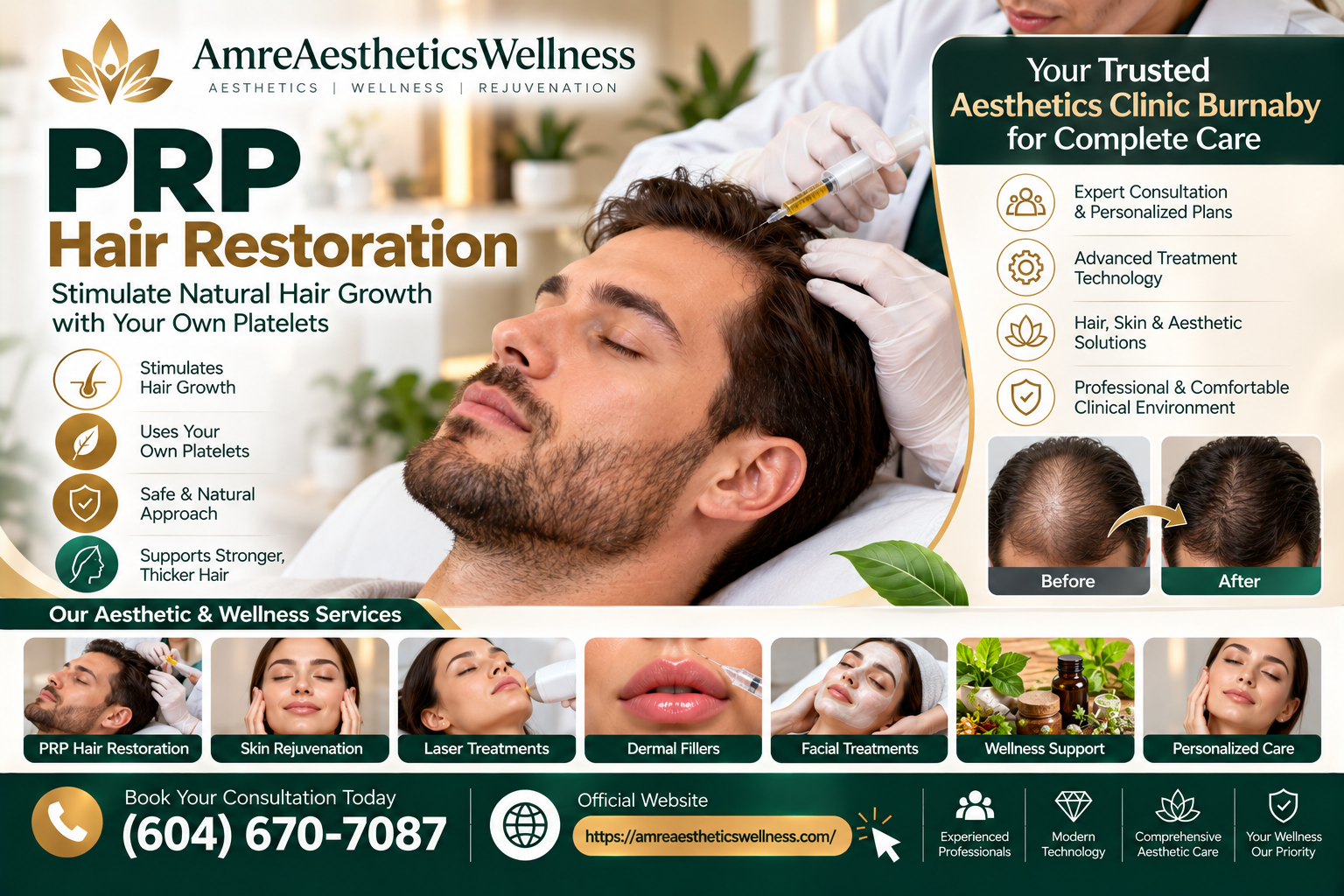
As interest in non-surgical aesthetic procedures continues to develop, individuals experiencing hair thinning and hair loss are exploring treatment options that may support scalp and hair health. PRP Hair restoration has become a topic of interest in regenerative aesthetic medicine, while choosing a professional Aesthetics Clinic Burnaby remains an important consideration for individuals seeking personalized hair and scalp consultations.
Platelet-rich plasma (PRP) treatment uses a concentrated preparation of platelets obtained from a patient’s own blood. When used for hair loss, the preparation is injected into selected areas of the scalp.
Although research suggests PRP may improve hair density in some people with certain types of hair loss, outcomes vary, and treatment is not guaranteed to restore hair.
Understanding the procedure, its limitations, and provider qualifications is essential before making a treatment decision.
Understanding PRP Hair Restoration
PRP Hair restoration is a procedure that involves processing a small blood sample to obtain platelet-rich plasma.
Platelets contain biologically active substances, including growth factors involved in tissue repair and cellular signaling.
The prepared plasma is administered through injections into targeted areas of the scalp.
Researchers have investigated whether these platelet-derived substances can influence hair follicle activity and support hair growth in certain conditions.
Why People Consider PRP Treatment
Common reasons include:
- Early-stage hereditary hair thinning
- Gradually decreasing hair density
- Interest in non-surgical treatment options
- Exploring complementary hair loss treatments
- Seeking professional assessment of scalp health
- Understanding available hair restoration procedures
PRP may be considered for selected cases of androgenetic alopecia, commonly known as pattern hair loss.
However, it is not an appropriate treatment for every cause of hair loss.
Why Hair Loss Assessment Matters Before Treatment
Hair loss can occur for different reasons, including genetics, hormonal changes, nutritional deficiencies, medications, autoimmune conditions, and certain scalp disorders.
Some causes are temporary, while others require ongoing medical management.
A qualified healthcare professional may evaluate hair loss patterns, scalp condition, relevant medical history, and symptoms before recommending treatment.
Common Types of Hair Loss
Androgenetic Alopecia: Hereditary hair thinning affecting people of different genders.
Telogen Effluvium: Increased hair shedding associated with factors such as illness, stress, or physiological changes.
Alopecia Areata: An autoimmune condition that may cause localized or extensive hair loss.
Scarring Alopecia: Conditions involving inflammation and permanent damage to hair follicles.
These conditions require different management approaches. PRP should not replace appropriate diagnosis or established treatment.
How PRP Hair Restoration Works
A professionally administered PRP procedure generally involves several steps.
- Initial Consultation: A qualified professional reviews the patient’s hair concerns and medical history.
- Scalp Evaluation: Hair density, distribution, and possible underlying conditions are assessed.
- Blood Collection: A small sample of the patient’s blood is collected.
- Plasma Preparation: The sample is processed using centrifugation to separate blood components.
- PRP Collection: The platelet-rich portion is prepared for administration.
- Scalp Injection: PRP is injected into selected treatment areas.
- Aftercare: The practitioner provides suitable recovery instructions.
- Follow-Up: Treatment response and further care requirements are reviewed.
PRP preparation methods differ, including platelet concentration and processing techniques, which can influence treatment consistency.
What Does Scientific Evidence Say About PRP for Hair Loss?
Research has reported improvements in hair density or thickness among some individuals receiving PRP for pattern hair loss.
However, studies vary in size, treatment protocols, follow-up periods, and outcome measurements.
These differences make it difficult to establish a universally effective treatment schedule.
PRP is not a guaranteed cure for baldness, and it cannot reliably regenerate follicles that have been permanently destroyed.
Patients should discuss the available evidence with a qualified practitioner before committing to multiple sessions.
Choosing an Aesthetics Clinic in Burnaby for PRP
When evaluating an Aesthetics Clinic Burnaby, individuals should prioritize professional competence, medical oversight, and transparent consultation practices.
Because PRP involves blood handling and scalp injections, it requires appropriate infection-control procedures and trained healthcare professionals.
Important Factors to Consider
- Professional Qualifications: Verify that the practitioner is appropriately licensed and trained.
- Medical Assessment: Confirm that the underlying cause of hair loss will be evaluated.
- Sterile Procedures: Ask about blood collection, preparation, and infection prevention.
- Equipment Standards: Understand how PRP is processed and administered.
- Treatment Transparency: Request information about expected benefits, risks, and alternatives.
- Follow-Up Care: Confirm how progress and adverse reactions are monitored.
Clients should also ask whether the proposed treatment and professional practices comply with applicable requirements in British Columbia.
PRP Hair Restoration vs. Other Hair Loss Treatments
Different hair restoration methods address different needs.
| Treatment | Main Approach | Important Consideration |
| PRP Therapy | Platelet-rich plasma scalp injections | Evidence and response vary |
| Topical Minoxidil | Medication applied to the scalp | Ongoing use may be required |
| Oral Hair Loss Medication | Prescription treatment for suitable patients | Medical assessment is necessary |
| Hair Transplantation | Surgical relocation of hair follicles | Requires suitable donor hair |
| Cosmetic Hair Systems | Conceals visible hair loss | Does not treat underlying causes |
The appropriate choice depends on diagnosis, personal goals, medical suitability, and professional recommendations.
Potential Side Effects and Safety Considerations
Although PRP uses components from the patient’s own blood, the procedure is not risk-free.
Possible adverse effects include temporary pain, tenderness, swelling, bruising, bleeding, and infection.
Certain medical conditions, blood disorders, or medications may affect suitability.
Patients should disclose relevant health information and discuss potential complications before treatment.
An experienced provider should explain when PRP is unlikely to be beneficial and when referral to a dermatologist or another medical specialist is appropriate.
Understanding PRP Treatment Costs and Expectations
The cost of PRP Hair restoration can vary depending on consultation requirements, treatment protocols, practitioner expertise, and the number of sessions proposed.
Some treatment plans involve multiple appointments and periodic reassessment.
However, no fixed number of sessions guarantees improvement.
Patients should request a clear quotation, understand additional charges, and discuss how outcomes will be monitored.
Standardized scalp photographs or other appropriate measurements may help document changes over time.
Frequently Asked Questions (FAQs)
1. What is PRP Hair restoration?
It is a procedure involving injections of platelet-rich plasma prepared from a patient’s own blood into selected scalp areas.
2. Can PRP help with hair thinning?
Some studies suggest benefits for certain individuals with pattern hair loss, although results vary.
3. Is PRP a permanent solution for hair loss?
No. PRP does not guarantee permanent hair restoration or prevent all future hair loss.
4. Is PRP treatment painful?
Scalp injections may cause discomfort. Pain levels vary between individuals.
5. How many PRP sessions are needed?
Treatment schedules differ, and the appropriate approach depends on clinical assessment and individual response.
6. Can PRP treat complete baldness?
It is unlikely to restore hair where viable follicles are absent or permanently damaged.
7. Is PRP suitable for everyone?
No. Medical conditions, medications, and the cause of hair loss may affect suitability.
8. What are the side effects of PRP?
Possible effects include tenderness, swelling, bruising, bleeding, and infection.
9. How should I choose an aesthetics clinic in Burnaby?
Review professional licensing, medical assessment procedures, infection-control practices, and treatment transparency.
10. Can PRP be combined with other hair loss treatments?
Sometimes. A qualified healthcare professional should assess whether combination treatment is appropriate.
Media Contact
Department: Hair Restoration, Aesthetics and Wellness Communications
Email: info@amreaw.com
Contact: (604) 670-7087
Official Website: https://amreaestheticswellness.com/