
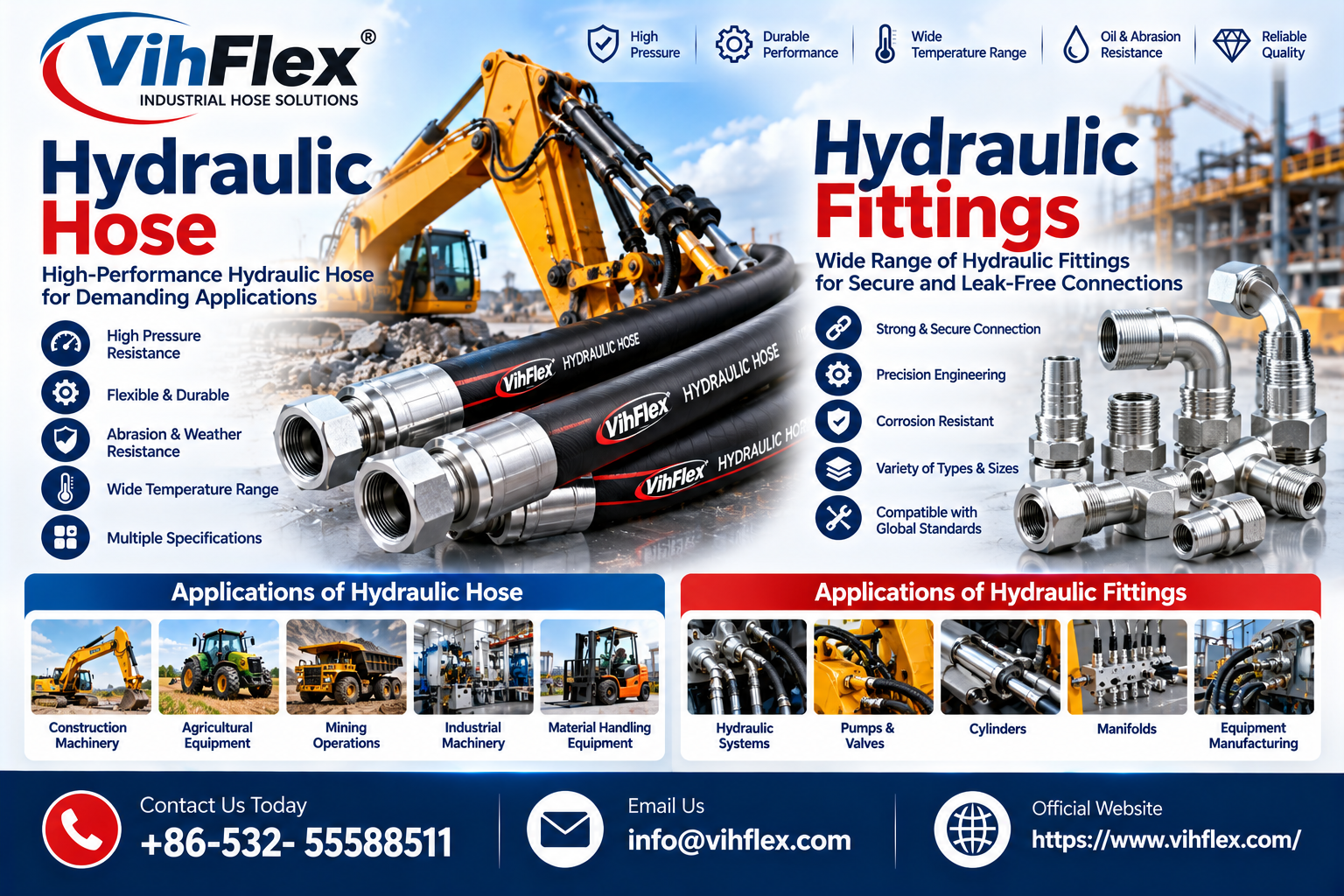
As construction companies, agricultural equipment manufacturers, mining operators, and industrial facilities focus on machinery reliability and operational efficiency, hydraulic systems remain essential to modern mechanical operations.
A high-quality Hydraulic Hose enables the safe transfer of pressurized hydraulic fluid between system components, while properly selected Hydraulic Fittings provide secure connections between hoses, pipes, valves, pumps, and actuators.
Together, these components support hydraulic power transmission across demanding industrial environments. Understanding material construction, pressure ratings, fitting compatibility, and maintenance requirements can help businesses improve equipment reliability and reduce operational risks.
What Is a Hydraulic Hose?
A Hydraulic Hose is a flexible tube designed to transport pressurized hydraulic fluid within a hydraulic system.
Unlike ordinary industrial hoses, hydraulic hoses are engineered to withstand specified pressures, fluid characteristics, temperatures, and mechanical stresses.
They commonly consist of multiple layers that contribute to flexibility, strength, and protection.
Main Components of a Hydraulic Hose
- Inner Tube: Carries hydraulic fluid and must resist the intended fluid.
- Reinforcement Layer: Uses steel wire or suitable textile materials to withstand pressure.
- Outer Cover: Protects against abrasion, environmental exposure, and mechanical damage.
- End Connections: Provide attachment points for compatible fittings.
- Protective Accessories: Selected applications use sleeves or guards to reduce external damage.
Understanding Hydraulic Fittings
Hydraulic Fittings are specialized connectors used to join hydraulic hoses with equipment ports, rigid tubing, and other hydraulic components.
They must provide secure connections under the system’s intended operating conditions.
Depending on the application, fittings may include threaded connections, flanges, adapters, and hose-end couplings.
Common Types of Hydraulic Fittings
Straight Fittings: Connect components where direct alignment is suitable.
Elbow Fittings: Allow connections at specified angles to accommodate routing.
Tee Fittings: Support branching connections within appropriately designed circuits.
Flange Fittings: Provide connections for selected industrial hydraulic systems.
Threaded Adapters: Connect compatible ports and hydraulic components.
Crimp Fittings: Attach to suitable hose assemblies using manufacturer-approved crimping specifications.
Correct fitting selection is essential because a physically similar connection may use a different sealing method or thread standard.
Major Applications of Hydraulic Hoses and Fittings
Hydraulic components are widely used in industrial machinery requiring controlled mechanical power.
Construction Equipment
Excavators, loaders, cranes, and other machines depend on hydraulic systems for movement and lifting functions.
Agricultural Machinery
Tractors, harvesters, and agricultural implements use hydraulic components to operate attachments and mechanisms.
Industrial Manufacturing
Hydraulic presses, production equipment, and automated machinery rely on suitable fluid-power systems.
Mining Equipment
Heavy-duty machinery operates under conditions involving vibration, abrasion, and demanding mechanical loads.
Material Handling
Forklifts and lifting equipment use hydraulic systems for controlled movement.
Each application requires hoses and fittings selected for its operating conditions.
Hydraulic Hose vs. Hydraulic Fittings: Key Differences
| Feature | Hydraulic Hose | Hydraulic Fittings |
| Primary function | Transfers hydraulic fluid | Connects hydraulic components |
| Construction | Flexible reinforced structure | Machined or formed metal components |
| Main selection factor | Pressure, fluid, temperature, flexibility | Connection type, pressure, sealing method |
| Common applications | Mobile and industrial machinery | Hose and equipment connections |
| Maintenance focus | Wear, leakage, bending, reinforcement | Seals, threads, corrosion, leakage |
Both components must operate as a compatible system rather than being selected independently.
Materials Used in Hydraulic System Components
Material selection influences service life and operating compatibility.
Synthetic Rubber
Suitable rubber compounds are commonly used for hydraulic hose inner tubes and outer covers.
Steel Wire Reinforcement
Braided or spiral steel wire helps hoses withstand specified working pressures.
Thermoplastic Materials
Selected hydraulic hoses use thermoplastic construction where appropriate for the application.
Carbon Steel and Stainless Steel
Hydraulic connectors may be produced using suitable steel grades, depending on strength and corrosion-resistance requirements.
Importance of Pressure Ratings and System Compatibility
Hydraulic equipment may experience pressure fluctuations during normal operation.
Hoses, fittings, and completed assemblies must therefore be selected according to the system’s maximum expected operating pressure, including relevant transient conditions.
The rated working pressure of the assembled hose system cannot exceed the rating of its lowest-rated component.
Temperature and fluid compatibility must also be verified.
Essential Selection Considerations
- Maximum system operating pressure.
- Hydraulic fluid compatibility.
- Operating temperature range.
- Required hose internal diameter.
- Minimum bend radius.
- Hose routing and movement.
- Fitting connection standards.
- Manufacturer-approved assembly procedures.
Improper component selection can cause leakage, equipment failure, or serious injury.
Manufacturing and Quality Testing
Professional hose assembly production requires controlled manufacturing procedures.
Manufacturers should verify material specifications, dimensions, reinforcement construction, fitting quality, and approved crimping requirements.
Relevant tests may include pressure testing, impulse testing, dimensional inspection, and leakage evaluation.
Testing should follow applicable specifications and manufacturer instructions.
Mixing hose and fitting brands without verified compatibility can create unreliable assemblies, even when the components appear to fit together.
Safety and Maintenance of Hydraulic Systems
Regular inspection is essential for maintaining hydraulic equipment.
Operators should look for damaged covers, exposed reinforcement, leakage, excessive bending, loose fittings, and corrosion.
High-pressure hydraulic fluid can penetrate the skin and cause severe injuries. Suspected injection injuries require immediate emergency medical attention.
Never search for a hydraulic leak using bare hands.
Before disconnecting or servicing components, equipment must be secured and hydraulic pressure safely released according to approved procedures.
Damaged assemblies should be replaced using appropriately specified components.
Choosing a Reliable Hydraulic Hose and Fittings Supplier
Businesses purchasing Hydraulic Hose assemblies should evaluate manufacturing capability, technical documentation, product consistency, and application knowledge.
For Hydraulic Fittings, buyers should confirm thread compatibility, sealing geometry, pressure ratings, and corrosion-protection requirements.
A dependable supplier should offer clear product specifications, suitable quality-control information, and reliable delivery arrangements.
Industrial buyers should also request assembly instructions and appropriate technical support.
Frequently Asked Questions (FAQs)
1. What is a Hydraulic Hose?
It is a reinforced flexible tube used to transport pressurized hydraulic fluid between system components.
2. What are Hydraulic Fittings?
They are connectors used to join hydraulic hoses, pipes, valves, and machinery components.
3. Where are hydraulic hoses commonly used?
They are used in construction equipment, agricultural machinery, mining systems, industrial presses, and material-handling equipment.
4. What materials are used in hydraulic hoses?
Common materials include synthetic rubber, thermoplastics, steel wire reinforcement, and protective outer coverings.
5. Why is hydraulic hose pressure rating important?
It indicates the intended operating pressure limit and helps prevent unsafe component selection.
6. Can different hydraulic fittings be interchanged?
Only when their dimensions, connection standards, sealing arrangements, and performance requirements are verified as compatible.
7. What causes hydraulic hose failure?
Possible causes include abrasion, excessive pressure, improper routing, aging, unsuitable fluids, and incorrect assembly.
8. How often should hydraulic hoses be inspected?
Inspection frequency depends on equipment use, operating conditions, manufacturer instructions, and applicable maintenance requirements.
9. What affects hydraulic hose and fitting prices?
Materials, dimensions, pressure ratings, reinforcement, connection types, and manufacturing specifications influence costs.
10. How should businesses choose a hydraulic components supplier?
Evaluate technical specifications, quality-control procedures, product compatibility, manufacturing expertise, and delivery reliability.
Media Contact
Department: Hydraulic Hose and Industrial Fluid Power Communications
Email: info@vihflex.com
Contact: +86-532-55588511
Official Website: https://www.vihflex.com/