
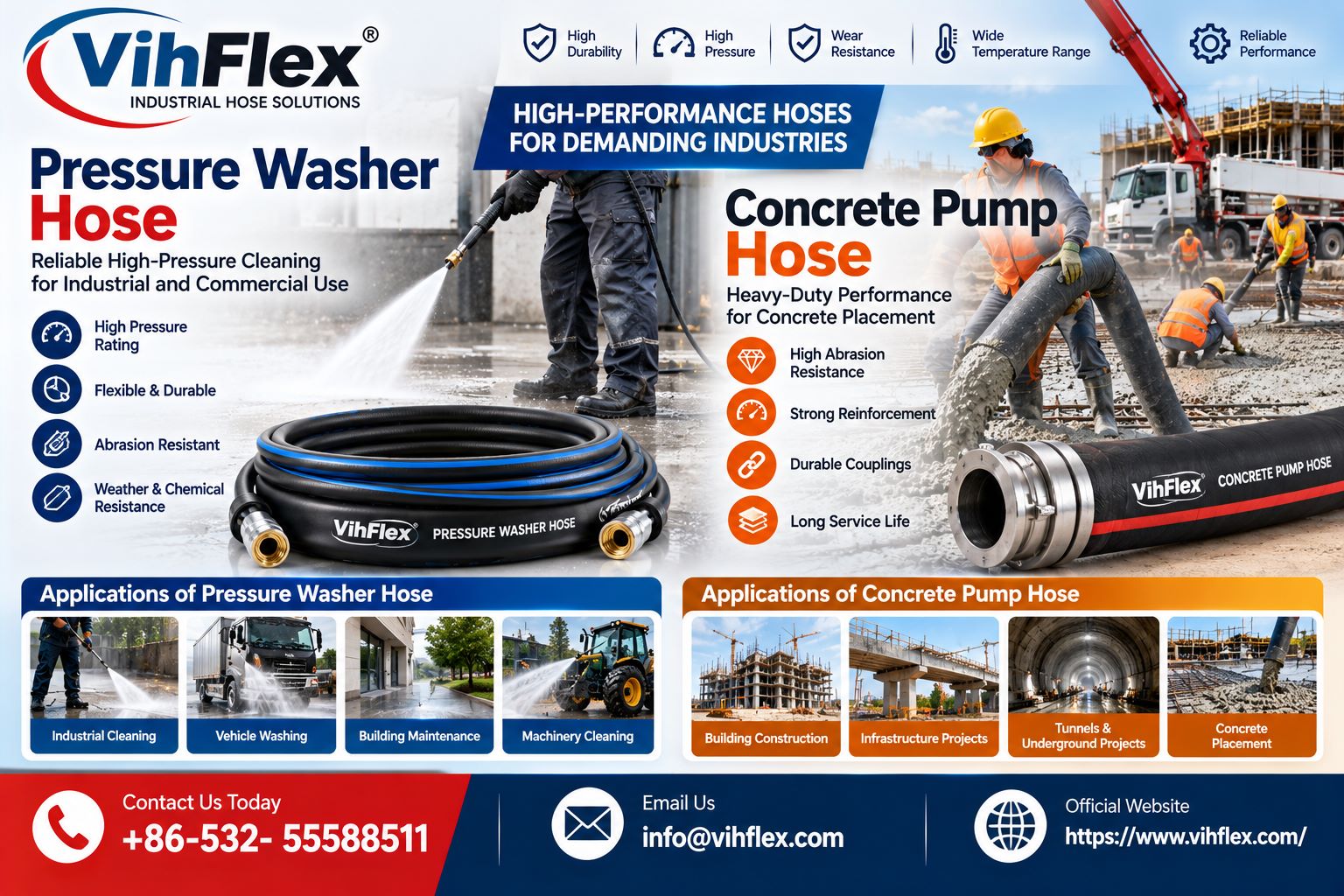
Industrial equipment performance depends on more than powerful machinery. The hoses connecting pumps, tools, and material delivery systems play a critical role in maintaining operational safety, productivity, and equipment reliability.
A Pressure Washer Hose is designed to carry pressurised cleaning fluids, while a Concrete Pump Hose must handle the demanding movement of abrasive concrete mixtures through construction pumping systems.
Although both products operate under pressure, they face different mechanical stresses, material compatibility requirements, and operating conditions.
For industrial buyers, contractors, and equipment operators, selecting the correct hose involves understanding its actual working environment rather than comparing products solely by appearance or price.
This distinction is particularly important for businesses seeking to reduce avoidable equipment failures, unexpected maintenance expenses, and operational interruptions.
Why Incorrect Hose Selection Creates Industrial Risks
A hose that appears suitable externally may not meet the requirements of a particular application.
Industrial hoses differ in reinforcement construction, inner tube materials, pressure capabilities, flexibility, and resistance to wear.
Using an unsuitable hose can contribute to leakage, premature deterioration, equipment damage, or hazardous failure.
In high-pressure systems, even a small defect may create a serious safety concern.
Responsible purchasing therefore involves understanding the system’s operating pressure, transported material, environmental conditions, and connection requirements.
Pressure Washer Hose: Designed for Demanding Cleaning Applications
A Pressure Washer Hose transfers pressurised water or compatible cleaning solutions between a pressure-washing system and its delivery equipment.
These hoses are used in suitable applications such as industrial equipment cleaning, vehicle washing, surface maintenance, and commercial cleaning operations.
Important product characteristics include:
- Working Pressure: The hose assembly must be rated for the equipment’s maximum operating conditions.
- Temperature Compatibility: Materials must suit the intended water temperature.
- Flexibility: Appropriate handling can improve access around equipment.
- Abrasion Resistance: The outer cover should withstand expected contact with working surfaces.
- Chemical Compatibility: Cleaning agents must be compatible with the hose materials.
- Connection Suitability: Couplings must match the equipment and intended pressure.
Manufacturers should specify the permitted operating conditions rather than encouraging buyers to assume all pressure-washing hoses are interchangeable.
Concrete Pump Hose: Built for Abrasive Material Transfer
A Concrete Pump Hose operates in a different industrial environment.
Instead of transferring relatively low-viscosity cleaning fluids, it carries abrasive concrete mixtures through pumping equipment.
These mixtures may contain cement, sand, aggregate, and other specified materials.
The movement of such material can place substantial mechanical demands on the hose’s inner lining and reinforcement.
Important considerations include abrasion resistance, pressure capability, resistance to movement-related stresses, and suitable end connections.
Pumping systems may also experience pressure fluctuations caused by equipment operation and material flow conditions.
Consequently, concrete transfer hoses require application-specific construction and proper integration with the complete pumping system.
A hose suitable for pressure washing cannot automatically be used for concrete pumping.
How Working Pressure and Burst Pressure Differ
Understanding pressure terminology is essential when evaluating industrial hoses.
Working pressure identifies the pressure limit under which the hose or assembly is designed to operate according to its specifications.
Burst pressure describes a destructive test characteristic and should not be treated as the permitted operating pressure.
The complete hose assembly must be evaluated, including fittings and couplings.
A high-pressure hose connected to an inadequately rated fitting may create a dangerous system weakness.
Buyers should confirm the manufacturer’s specifications and comply with the relevant equipment operating instructions.
Why Abrasion Resistance Matters in Construction
Concrete pumping exposes hose interiors to abrasive material movement.
The degree of wear depends on factors such as mixture composition, aggregate characteristics, material velocity, and operating conditions.
An unsuitable inner lining may deteriorate prematurely.
External abrasion can also occur when hoses contact construction surfaces or equipment.
However, an abrasion-resistant cover does not eliminate the need for inspection.
Contractors should examine hoses for visible damage, abnormal wear, deformation, and connection concerns.
Inspection and replacement decisions should follow the manufacturer’s requirements and the applicable worksite safety procedures.
The Hidden Cost of Hose Failure
Industrial hose purchasing decisions often emphasise initial price.
However, the actual cost of ownership includes additional factors.
An unsuitable hose may contribute to interrupted cleaning operations, delayed concrete placement, equipment servicing, or unplanned replacement purchases.
Failure can also introduce significant safety risks.
Purchasing teams should evaluate:
- Application Suitability: Whether the hose is designed for the transported material.
- Pressure Compatibility: Whether the assembly meets the equipment’s operating requirements.
- Material Durability: Whether the construction suits expected wear conditions.
- Connection Integrity: Whether fittings are compatible and correctly installed.
- Inspection Requirements: Whether maintenance instructions are available.
- Replacement Planning: Whether suitable spare assemblies can be sourced.
The objective is to balance purchasing cost with operational suitability and reliability.
Industrial Hose Comparison for Equipment Buyers
| Selection Factor | Pressure Washer Hose | Concrete Pump Hose |
| Transported Material | Water and compatible cleaning fluids | Concrete mixtures |
| Primary Operating Concern | Pressurised fluid delivery | Abrasive material transfer |
| Inner Tube Requirement | Fluid and temperature compatibility | Abrasion resistance and material compatibility |
| Mechanical Demands | Pressure, handling, bending | Pressure, abrasion, movement-related stresses |
| Common Applications | Industrial and commercial cleaning | Construction concrete placement |
| Main Safety Priority | Preventing leaks and high-pressure fluid injury | Preventing failures during pressurised concrete transfer |
The correct choice depends on verified equipment specifications and actual working conditions.
Why Proper Handling and Inspection Are Essential
Even a correctly selected hose requires appropriate handling.
Excessive bending, crushing, dragging across damaging surfaces, and unsuitable storage can contribute to deterioration.
Operators should follow manufacturer instructions regarding minimum bend radius, routing, and inspection.
High-pressure fluid leaks must never be checked by placing hands near suspected damage because fluid injection can cause serious injury.
Similarly, concrete pumping connections must never be loosened while the system remains pressurised.
Equipment should be isolated and pressure safely relieved according to approved procedures before maintenance.
Trained personnel should handle inspection, troubleshooting, and replacement activities.
Frequently Asked Questions (FAQs)
1. What is a Pressure Washer Hose used for?
It transfers pressurised water or compatible cleaning fluids in suitable commercial, industrial, and equipment-cleaning applications.
2. What is the purpose of a Concrete Pump Hose?
It transfers concrete mixtures through compatible pumping systems during construction activities and requires construction suited to abrasive material flow.
3. Can the same hose be used for pressure washing and concrete pumping?
Generally, no. These applications have different material, pressure, abrasion, and construction requirements. Suitability must be established by the manufacturer.
4. What should buyers check before purchasing an industrial hose?
They should verify working pressure, transported material compatibility, temperature limits, reinforcement construction, fitting specifications, and manufacturer recommendations.
5. How can businesses reduce industrial hose failures?
Appropriate hose selection, correct installation, operator training, regular inspection, suitable storage, and timely replacement can help reduce avoidable failures.
Media Contact
Department: Industrial Hose Products and Technical Enquiries
Contact: +86-532-55588511
Email: info@vihflex.com
Official Website: https://www.vihflex.com/