As industries embrace automation, artificial intelligence, and Industrial Internet of Things (IIoT), network connectivity has become one of the most valuable assets for modern businesses. Manufacturing plants, energy facilities, transportation systems, logistics hubs, and smart city projects all depend on fast, secure, and uninterrupted communication to keep operations running efficiently.
Traditional wired networks are no longer enough to meet today’s industrial demands. Businesses need networking solutions that deliver high-speed performance, support thousands of connected devices, and remain reliable even in harsh environments. This is why the industrial 5G router and 5G cellular router have become essential technologies for organizations investing in digital transformation.
In this blog, we’ll explore how these advanced networking devices are changing industrial communications, their key benefits, major applications, and why they are becoming the backbone of Industry 4.0.
Understanding an Industrial 5G Router
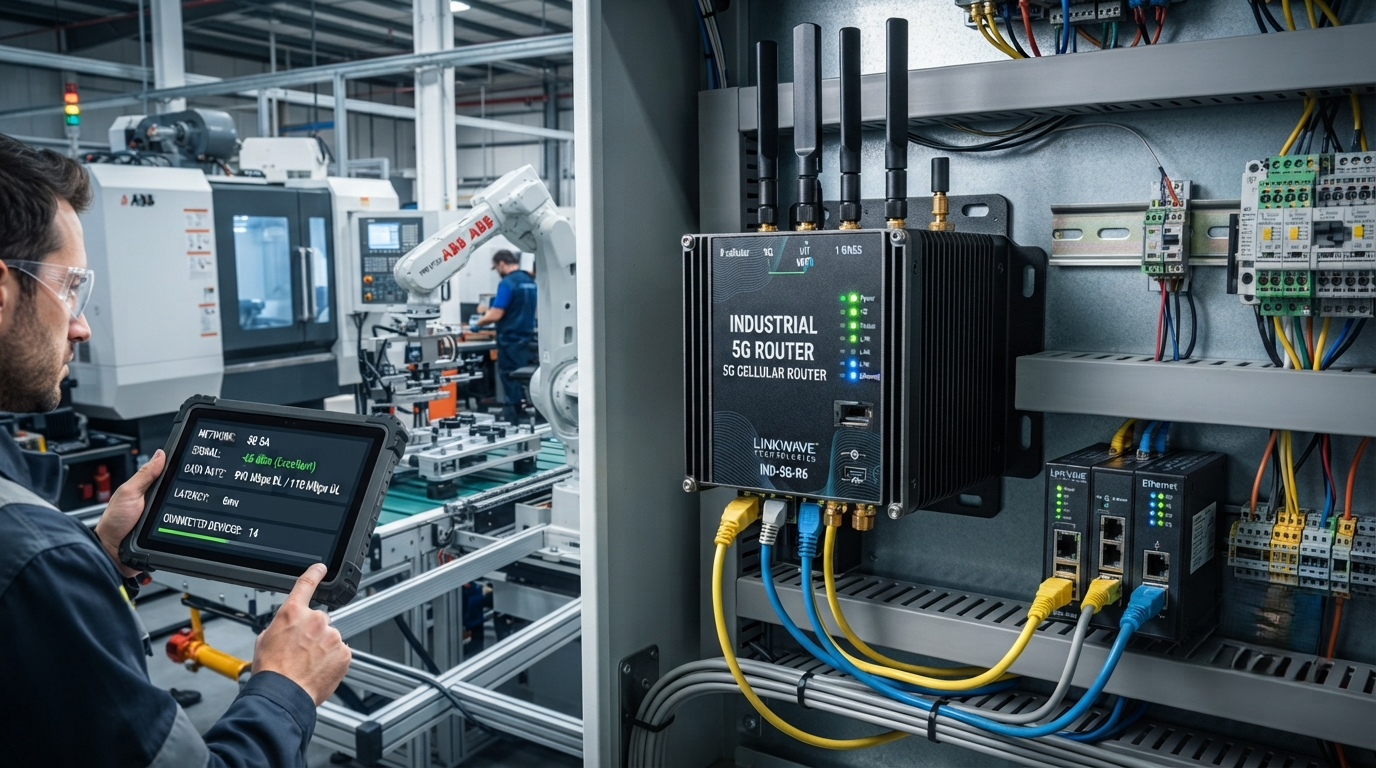
An industrial 5G router is a rugged networking device designed specifically for industrial applications. Unlike consumer-grade routers, it is built to withstand extreme temperatures, dust, vibration, moisture, and continuous operation.
Its primary purpose is to connect industrial equipment, machines, sensors, controllers, and cloud platforms using high-speed 5G connectivity. This ensures smooth communication between devices while supporting critical operations that require minimal latency and maximum reliability.
Industrial routers are commonly deployed in factories, warehouses, renewable energy sites, mining operations, transportation systems, and remote industrial facilities.
What Makes a 5G Cellular Router Different?
A 5G cellular router provides internet access through a 5G mobile network instead of relying solely on fiber, DSL, or cable connections. It offers businesses greater flexibility by enabling connectivity wherever a reliable cellular signal is available.
These routers are particularly valuable for remote locations, temporary job sites, mobile operations, and backup internet connections. Their ability to deliver high-speed wireless connectivity without extensive infrastructure makes deployment faster and more cost-effective.
As 5G coverage expands worldwide, cellular routers are becoming a preferred networking solution for organizations requiring mobility and business continuity.
Why Industries Are Choosing 5G Networking
Several factors are driving the widespread adoption of industrial wireless networking.
Faster Data Transmission
Industrial operations generate vast amounts of data every second. High-speed 5G networks allow this information to be transferred instantly, improving productivity and operational visibility.
Ultra-Low Latency
Applications such as robotics, autonomous vehicles, machine control, and automated production require immediate communication. Low latency ensures real-time responsiveness and greater precision.
Greater Reliability
Industrial routers are engineered for continuous operation, reducing downtime and maintaining stable network performance even in demanding environments.
Enhanced Security
Advanced encryption, VPN connectivity, secure authentication, and integrated firewalls help protect industrial data against cyber threats.
Flexible Installation
Wireless networking minimizes the need for expensive cabling and allows organizations to expand operations more quickly.
Industries Transforming with Industrial 5G Routers
The versatility of industrial networking solutions makes them suitable for a wide range of industries.
Manufacturing
Manufacturers use industrial routers to support:
- Smart factory automation
- Robotics
- Machine monitoring
- Predictive maintenance
- Quality assurance
Transportation and Logistics
Applications include:
- Fleet management
- Vehicle diagnostics
- Intelligent traffic systems
- Connected warehouses
- Cargo tracking
Energy and Utilities
Industrial networking improves:
- Smart grid management
- Wind and solar farms
- Oil and gas monitoring
- Remote substations
- Pipeline supervision
Agriculture
Modern farms utilize industrial connectivity for:
- Precision irrigation
- Smart sensors
- Automated equipment
- Livestock monitoring
- Weather data collection
Smart Infrastructure
Governments and municipalities deploy industrial networking for:
- Smart street lighting
- Environmental monitoring
- Traffic management
- Public safety
- Connected public services
Industrial 5G Router vs Consumer Router
| Feature | Industrial 5G Router | Consumer Router |
| Designed for Harsh Environments | ✔ | ✘ |
| Continuous 24/7 Operation | ✔ | Limited |
| Enterprise Security | ✔ | Basic |
| Dual SIM Failover | ✔ | Rare |
| Remote Device Management | ✔ | Limited |
| Industrial Certifications | ✔ | ✘ |
| Long Product Life Cycle | ✔ | Shorter |
Industrial routers are purpose-built to deliver dependable performance where downtime is not an option.
Key Features to Look For
When selecting an industrial networking solution, organizations should prioritize features such as:
- 5G NR compatibility
- Gigabit Ethernet ports
- Dual SIM functionality
- Wi-Fi 6 support
- VPN security
- Edge computing compatibility
- Cloud management
- Multiple WAN interfaces
- Industrial-grade housing
- Wide operating temperature range
These features ensure the router can support current requirements while remaining ready for future expansion.
Advantages of Investing in Industrial 5G Connectivity
Businesses adopting industrial 5G solutions often experience measurable improvements.
Some notable advantages include:
- Faster communication between industrial devices
- Improved automation efficiency
- Lower operational costs
- Reduced maintenance downtime
- Better remote monitoring
- Increased network reliability
- Simplified infrastructure deployment
- Enhanced cybersecurity
- Greater scalability
- Future-ready digital infrastructure
These benefits make industrial 5G networking a valuable long-term investment.
Future Outlook for Industrial Networking
The next generation of industrial communication will continue evolving alongside technologies such as artificial intelligence, machine learning, digital twins, edge computing, and autonomous robotics.
Private 5G networks are expected to become increasingly common, enabling organizations to gain greater control over network performance, security, and data privacy.
As Industrial IoT ecosystems expand, advanced networking devices will remain central to enabling intelligent factories, connected supply chains, and real-time decision-making.
Frequently Asked Questions
1. What is an industrial 5G router used for?
It provides secure, high-speed wireless connectivity for industrial equipment and mission-critical applications.
2. How does a 5G cellular router work?
It connects devices to the internet through a 5G mobile network instead of traditional wired broadband.
3. Which industries benefit from industrial routers?
Manufacturing, logistics, mining, healthcare, transportation, agriculture, utilities, and smart cities.
4. Can industrial routers withstand harsh environments?
Yes. They are specifically engineered for demanding industrial conditions.
5. Why is low latency important?
It enables real-time communication between machines, improving automation and operational efficiency.
6. Are industrial routers secure?
Yes. Most include VPNs, encryption, firewalls, and advanced authentication features.
7. Can these routers support cloud platforms?
Yes. They securely connect industrial devices to cloud-based applications and services.
8. What is Dual SIM functionality?
It provides automatic failover between mobile networks, improving connection reliability.
9. Can a 5G cellular router replace wired internet?
Yes. It can function as a primary or backup internet connection depending on deployment requirements.
10. Why should organizations upgrade to industrial 5G networking?
Because it improves speed, reliability, security, scalability, and supports long-term digital transformation initiatives.
Read more – https://newsgrow.blogspot.com/2026/08/5g-router-manufacturer-introduces.html
https://newsgrow.blogspot.com/2026/08/5g-modem-manufacturers-drive-next.html
https://newsgrow.blogspot.com/2026/08/industrial-5g-router-and-5g-cellular.html