As organizations rethink how employees, residents, contractors, and visitors move through controlled spaces, RFID cards for access control and RFID keyfobs are gaining attention as practical tools for modern physical security. The technology enables contactless entry while giving administrators greater flexibility over who can access specific doors, buildings, and restricted areas.
From corporate offices and factories to residential developments, educational campuses, warehouses, healthcare facilities, parking areas, and membership-based premises, RFID credentials are helping replace the limitations associated with traditional mechanical keys.
The significance of the transition goes beyond faster door entry. RFID-based access control can create a digital relationship between an individual, a credential, an access point, and a predefined security policy.
Organizations Look Beyond Conventional Keys
Traditional keys remain useful, but they provide limited intelligence.
A lock recognizes the correct physical key but generally cannot determine the identity of the person carrying it. It cannot automatically apply working-hour restrictions, create electronic access records, or immediately invalidate a missing key.
RFID-based systems approach the problem differently.
An electronic credential can be assigned to a particular user. When presented to a compatible reader, the access infrastructure determines whether that credential currently has authorization.
This creates a security model based on managed permissions rather than simply possession.
RFID Cards Bring Identity and Authorization Together
The growing use of RFID cards for access control is closely connected with their ability to perform multiple functions within one credential.
In a workplace, an RFID card can serve as an employee identification badge while simultaneously providing access to approved areas.
Organizations can print information such as:
- Employee name and photograph
- Department
- Employee identification number
- Job designation
- Company branding
- Card validity information
Behind the visible information is the electronic credential used by the access system.
This combination makes cards particularly relevant for organizations where security personnel need to visually identify individuals as well as electronically authenticate them.
RFID Keyfobs Respond to Demand for Smaller Credentials
Not every access-control environment requires an identification badge.
This is where RFID keyfobs provide a different user experience.
Their compact construction allows users to attach the credential to an everyday keyring. Rather than carrying a separate access card, residents, members, employees, or authorized contractors can keep their access credential alongside their normal keys.
Typical applications can include apartment entrances, parking gates, gyms, storage areas, staff entrances, gated communities, and shared facilities.
The difference between a card and keyfob is therefore often about usability rather than the basic purpose of access authentication.
A Simple Tap Activates a Complex Security Process
Although RFID entry appears simple from the user’s perspective, several processes may take place behind the reader.
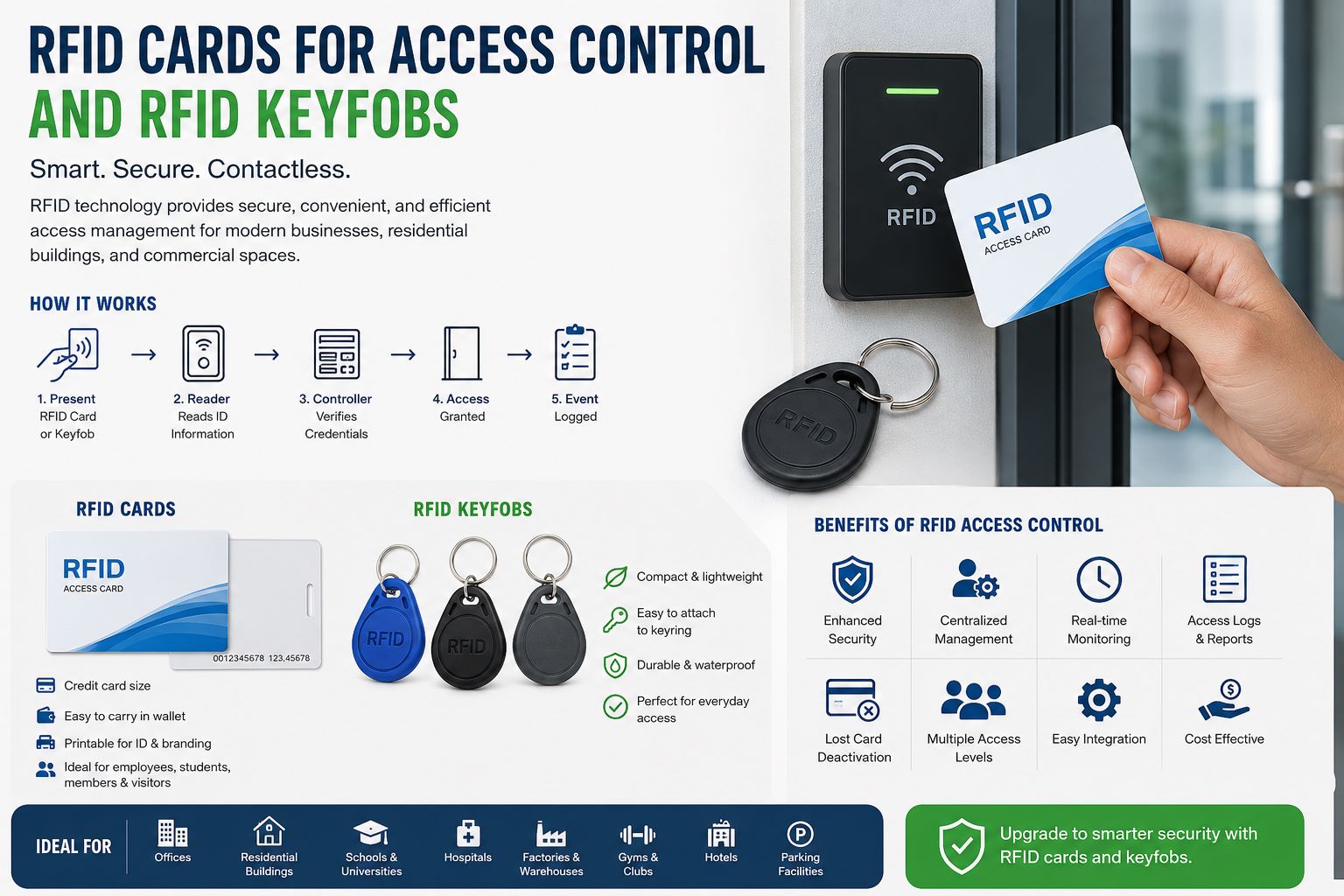
A typical transaction follows this sequence:
- The user presents the credential.
- The RFID reader detects a compatible technology.
- Credential information is exchanged or processed.
- The controller checks the credential against configured permissions.
- Door and schedule rules are evaluated.
- Access is granted or denied.
- The electronic locking mechanism responds.
- The event may be stored in the access system.
The process is designed to happen rapidly, allowing security decisions to occur without significantly interrupting movement through the facility.
RFID Frequency Becomes an Important Technical Consideration
As demand for RFID cards for access control increases, compatibility remains one of the most important considerations for buyers.
RFID is not a single technology.
Different credential families can operate at different frequencies and use different communication protocols, chip technologies, memory structures, and security mechanisms.
125 kHz Technology Supports Many Established Systems
Low-frequency 125 kHz credentials have long been used in proximity-based access-control environments.
Many existing facilities continue to operate this type of infrastructure, particularly where established readers and controllers remain functional.
However, organizations should evaluate the exact technology when upgrading because older credential architectures can differ considerably from newer smart credential systems.
13.56 MHz Credentials Support Advanced Applications
High-frequency 13.56 MHz technology is widely used across contactless smart-card applications.
Depending on the technology selected, credentials operating in this range may support more sophisticated authentication, data storage, or security functionality.
Frequency Alone Cannot Confirm Compatibility
This technical detail deserves particular attention.
Two RFID products can operate at the same frequency without being compatible.
A reader may require a particular credential technology, protocol, chip configuration, security key, or data format.
Organizations should therefore identify their installed reader specifications before ordering replacement RFID keyfobs or cards.
Permission-Based Access Changes How Facilities Are Managed
One of the most valuable features of electronic access control is the ability to separate users into different authorization levels.
Consider a manufacturing facility.
Production workers may need access to production floors and employee facilities. Administrative staff might need office access but not machinery areas. Engineers may require technical zones, while security personnel could receive broader authorization.
Temporary contractors could be restricted to specific areas for a defined project period.
This creates a structured access hierarchy.
Permissions may potentially be organized according to:
- User identity
- Job role
- Department
- Door
- Security zone
- Building
- Day
- Time
- Credential expiration
As personnel responsibilities change, administrators can modify permissions without necessarily replacing physical locks.
RFID Cards and Keyfobs Serve Different Operational Priorities
| Operational Factor | RFID Cards | RFID Keyfobs |
| Contactless entry | Strong | Strong |
| Visible identification | Excellent | Limited |
| Employee badge use | Excellent | Moderate |
| Compact carrying | Good | Excellent |
| Branding space | Excellent | Limited |
| Residential entry | Good | Excellent |
| Corporate environments | Excellent | Strong |
| Parking applications | Strong | Excellent |
| Access permissions | Configurable | Configurable |
| Compatibility | Technology-specific | Technology-specific |
For businesses requiring employee photographs and visible IDs, cards may offer greater value. For applications prioritizing portability, keyfobs can be more convenient.
Lost Credentials No Longer Have to Become a Lock-Replacement Problem
Credential loss is an unavoidable operational reality.
Mechanical keys can create significant concerns because possession of the key itself often provides authorization. If an important key disappears, organizations may need to determine whether affected locks should be changed.
With centrally administered RFID cards for access control, administrators can typically deactivate the authorization associated with the missing credential.
A replacement can then be assigned to the legitimate user.
Lost RFID keyfobs can be managed in a similar way.
This does not eliminate the need for strong security procedures. Employees and residents should still report missing credentials immediately so administrators can revoke them as quickly as possible.
Access Event Data Provides Better Operational Awareness
Another difference between traditional keys and electronic credentials is the possibility of maintaining access records.
Depending on system capabilities, an RFID access platform may record information about credential presentations and access decisions.
Security teams could potentially determine when a credential was used, where it was presented, and whether the request was approved or rejected.
Such information can support investigations, compliance reviews, facility administration, and security audits.
Organizations implementing these capabilities should also maintain suitable privacy and data-retention policies.
RFID Security Moves Toward Layered Protection
For general entrances, a single credential may satisfy the organization’s security policy. Higher-risk areas may require additional protection.
RFID can form one layer of a broader security architecture.
Multi-Factor Access Possibilities
Depending on the access-control platform, higher-security entry could combine:
- RFID card and PIN
- RFID credential and fingerprint
- RFID credential and facial verification
- Access credentials and security monitoring
The appropriate approach depends on the risk associated with the protected area.
Frequently Asked Questions
What are RFID cards for access control?
They are contactless electronic credentials that help compatible security systems identify users and determine access authorization.
What are RFID keyfobs primarily used for?
They provide compact contactless access for applications including residential entrances, offices, gyms, parking facilities, and restricted areas.
Do RFID credentials have to touch the reader?
Generally no. Compatible RFID credentials communicate wirelessly within the supported reading range.
Can an RFID card work with any reader?
No. The reader must support the credential’s frequency, technology, protocol, and configuration.
Can RFID access be limited to specific hours?
Many access-control platforms allow administrators to configure time-based authorization schedules.
What happens when an employee leaves?
Administrators can generally revoke the employee’s credential authorization through the access management system.
Can keyfobs provide the same access as cards?
Potentially yes, provided both credentials use technologies supported by the system and receive equivalent permissions.
Are RFID cards suitable for visitor management?
They can be used as temporary visitor credentials when supported by the organization’s access-control procedures and technology.
Can RFID systems record unsuccessful access attempts?
Many platforms can maintain records of both granted and denied credential transactions.
How should businesses choose an RFID credential?
They should evaluate reader compatibility, security level, environment, durability, usability, credential technology, and future system requirements.
https://newsgrow.blogspot.com/2026/08/from-pocket-sized-tools-to-digital.html
https://freeseobacklinks.online/why-nfc-tags-and-smart-wristbands-are-changing-the-future-of-events/
https://blogstream.net/event-technology-enters-a-new-phase-as-nfc-wristbands-gain-wider-attention/
https://newsgrow.blogspot.com/2026/08/nfc-tag-china-market-advances-as-nfc.html
https://bhoomijanatural.info/rfid-cards-and-keyfobs-move-to-the-center-of-modern-access-security/