
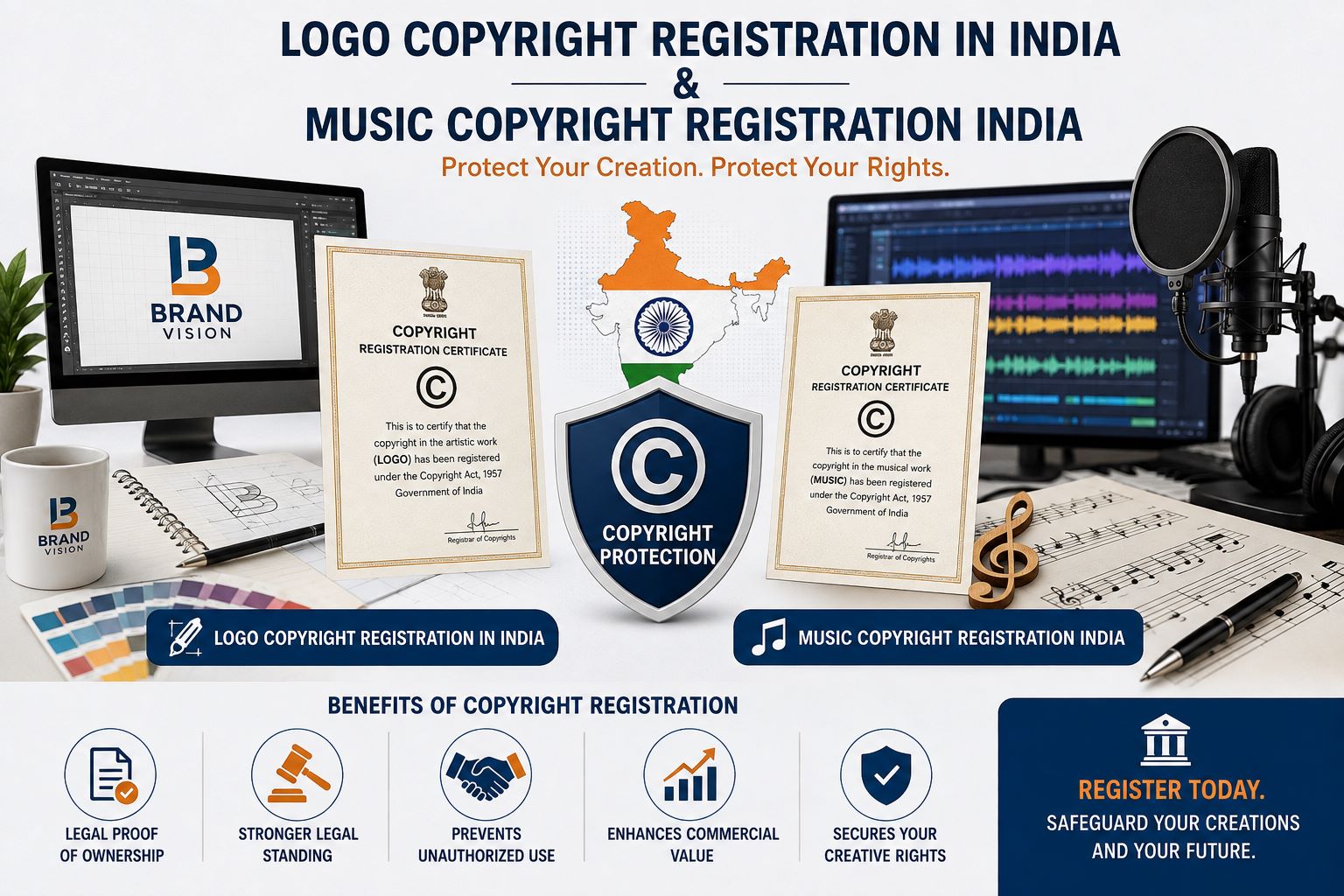
Intellectual property rights provide legal protection to original creations that may carry substantial artistic and commercial value. For businesses, designers, composers, musicians, producers and other creators, understanding copyright law is particularly important when creative assets are published, licensed, assigned or commercially exploited.
In India, copyright is principally governed by the Copyright Act, 1957 and the Copyright Rules, 2013, as amended from time to time. Within this framework, Logo Copyright Registration in India and Music Copyright Registration India can provide creators and rights holders with an official record relating to their works and claimed ownership.
Although registration is generally not a prerequisite for copyright to arise in an eligible original work, formal registration can have evidentiary significance and may assist in establishing particulars concerning ownership and authorship.
Legal Meaning of Copyright in India
Copyright is a statutory intellectual property right granted in respect of specified categories of original works. The Copyright Act recognises literary, dramatic, musical and artistic works, cinematograph films and sound recordings, subject to applicable statutory requirements.
Copyright does not protect an abstract idea merely because it is new or commercially valuable. The law principally protects the particular expression of an eligible work.
This distinction is fundamental when considering either Logo Copyright Registration in India or Music Copyright Registration India.
A business idea behind a logo is different from the artistic representation of that idea. Similarly, the general concept for a song is different from the musical composition, lyrics or resulting sound recording.
Legal Position of Logo Copyright Registration in India
A sufficiently original logo containing graphical, illustrative or other artistic elements may potentially fall within the statutory category of an artistic work.
Accordingly, Logo Copyright Registration in India may be considered where the logo contains copyrightable original artistic expression.
The copyright claim relates to the eligible artistic elements of the work rather than automatically creating exclusive copyright over every word, name, idea, colour combination or business concept appearing within the logo.
For commercial brands, this distinction has significant legal consequences.
Copyright Protection and Trademark Protection of Logos
Copyright registration should not be treated as a substitute for trademark registration.
The two systems have different legal objectives.
| Legal Issue | Copyright | Trademark |
| Subject matter | Original creative expression | Commercial brand identifiers |
| Logo application | Artistic elements | Source-identifying function |
| Governing statute | Copyright Act, 1957 | Trade Marks Act, 1999 |
| Principal concern | Unauthorised reproduction or exploitation | Confusing or unauthorised commercial brand use |
| Registration authority | Copyright Office | Trade Marks Registry |
Depending on the nature and use of the logo, a business may consider protection under both legal regimes.
Where an artistic work is used or capable of being used in relation to goods or services, specific statutory and procedural requirements concerning the Trade Marks Registry may also become relevant to a copyright application.
Legal Ownership of a Logo
Establishing ownership is a critical part of Logo Copyright Registration in India.
Businesses should not automatically assume that commissioning and paying for creative work resolves every copyright issue.
For example, where an independent graphic designer creates a logo, questions may arise regarding authorship, first ownership and subsequent assignment of rights.
A written agreement should clearly specify:
- Identity of the author
- Copyright ownership
- Nature of the assignment
- Rights being transferred
- Territorial extent where applicable
- Duration of assignment where applicable
- Consideration and contractual conditions
- Rights retained by the creator, if any
Clear contractual documentation can become particularly important when a logo is later licensed, sold as part of a business transaction or involved in an infringement dispute.
Procedure for Logo Copyright Registration in India
An application for registration is submitted under the prescribed copyright registration procedure.
The applicant should accurately disclose information concerning the work, author, copyright owner and publication status.
A typical process includes:
- Identifying the appropriate category of copyright work.
- Preparing the prescribed application and statements.
- Providing accurate authorship and ownership particulars.
- Uploading a copy of the artistic work.
- Submitting applicable declarations, permissions or supporting documents.
- Paying the prescribed government fee.
- Obtaining the Diary Number.
- Completing the statutory examination process.
- Responding to objections or discrepancies, where applicable.
Incorrect statements concerning ownership can create legal and procedural complications. Applicants should therefore verify all information before filing.
Documents Relevant to Logo Copyright Applications
Depending upon the facts of the case, supporting documentation may include:
- Copy of the artistic logo
- Author’s particulars
- Applicant’s particulars
- Copyright ownership documents
- Assignment deed
- No-objection certificate
- Power of Attorney where applicable
- Publication information
- Relevant Trade Marks Registry documentation
The required documents can vary according to authorship, ownership and commercial use of the work.
Legal Scope of Music Copyright Registration India
Music Copyright Registration India requires a more detailed understanding because a single commercially released song may contain several legally distinct rights.
The Copyright Act distinguishes a musical work from a sound recording. Lyrics may separately constitute a literary work.
Consequently, treating an entire song as one indivisible copyright can lead to incorrect assumptions about ownership.
Musical Work, Lyrics and Sound Recording
The legal distinction can be summarised as follows:
| Component | Potential Legal Classification |
| Musical composition | Musical work |
| Original lyrics | Literary work |
| Final recorded audio | Sound recording |
| Singer or musician’s performance | Performers’ rights may arise |
Consider a song in which Person A writes the lyrics, Person B composes the music and a production company produces the sound recording.
Different rights and ownership interests may exist within the finished song.
For this reason, Music Copyright Registration India should begin with identifying the precise work for which registration is sought.
Legal Rights Associated with Musical Works
Copyright ownership may provide various exclusive economic rights, subject to statutory provisions, exceptions and licensing arrangements.
Depending upon the category of work, rights may concern matters such as:
- Reproduction
- Issuing copies
- Public performance
- Communication to the public
- Adaptation
- Incorporation into other protected works
- Commercial licensing
The exact rights differ according to the nature of the copyrighted work.
Creators should therefore avoid assuming that ownership of one element of a song automatically provides ownership of every associated right.
Procedure for Music Copyright Registration India
The applicant must first determine the correct category of work.
Where multiple independent copyright works exist, separate applications may be necessary.
The broad registration procedure includes:
- Identifying whether registration concerns music, lyrics or sound recording.
- Establishing authorship.
- Establishing copyright ownership.
- Preparing the prescribed application.
- Providing publication details where applicable.
- Uploading the work in the prescribed format.
- Submitting agreements or NOCs where applicable.
- Paying the prescribed fee.
- Retaining the Diary Number.
- Responding to examination queries or objections where required.
Accurate classification is particularly important in Music Copyright Registration India because compositions and sound recordings constitute different categories.
Copyright Assignment and Licensing
Copyright ownership and permission to use copyright are legally different concepts.
An assignment generally involves transfer of copyright or specified copyright interests. A licence permits another party to exercise particular rights subject to agreed conditions without necessarily transferring ownership.
For example, a composer may retain copyright but license a company to use music in an advertisement.
A properly drafted agreement should address:
- Rights granted
- Permitted use
- Territory
- Duration
- Consideration or royalty
- Exclusivity or non-exclusivity
- Modification rights
- Digital exploitation
- Termination provisions
- Ownership of derivative material
Businesses acquiring creative assets should determine whether they require ownership through assignment or merely permission through licensing.
Copyright Infringement and Legal Remedies
Copyright infringement may arise when protected rights are exercised without the copyright owner’s permission, subject to statutory exceptions and limitations.
Depending upon the circumstances, copyright owners may have access to civil remedies and, for qualifying offences, criminal remedies under the applicable law.
Possible civil relief can include injunctions, damages or accounts of profits, subject to the facts and judicial determination.
Registration should not be misunderstood as an automatic enforcement mechanism. A registration certificate does not physically prevent another party from copying a work.
Rights must still be monitored and, where necessary, enforced through appropriate legal procedures.
Major Legal Mistakes to Avoid
Businesses and creators should avoid several common errors:
- Assuming copyright exists only after registration
- Treating copyright and trademark registration as identical
- Filing without confirming ownership
- Relying entirely on verbal agreements
- Confusing musical works with sound recordings
- Assuming one party owns every right in a song
- Failing to obtain appropriate assignments
- Providing inconsistent information in applications
- Ignoring Copyright Office objections or notices
- Using third-party creative material without appropriate permission
Preventive legal documentation is often significantly easier than resolving an ownership dispute after commercial exploitation has begun.
Frequently Asked Questions
1. Is Logo Copyright Registration in India legally mandatory?
No. Registration is generally not mandatory for copyright to subsist in an eligible original work.
2. Can a company register copyright in its logo?
A company may seek registration where it owns copyright in qualifying original artistic logo artwork.
3. Is logo copyright equivalent to trademark registration?
No. Copyright and trademark rights have different legal functions and statutory frameworks.
4. Can copyright and trademark rights exist in the same logo?
Potentially yes, provided the requirements of the respective laws are satisfied.
5. What is Music Copyright Registration India?
It concerns registration of eligible musical and related copyright works under India’s copyright framework.
6. Are lyrics protected separately from music?
Original lyrics may qualify as literary works independently of the musical composition.
7. Is a sound recording legally different from a musical work?
Yes. They are separate categories recognised under copyright law.
8. Can copyright ownership be transferred?
Yes. Copyright may be assigned subject to applicable statutory requirements.
9. Can copyright be licensed without transferring ownership?
Yes. A copyright owner may grant defined usage rights while retaining ownership.
10. Can unpublished works be registered?
Eligible unpublished works may be submitted for copyright registration.
https://newsgrow.blogspot.com/2026/08/logo-copyright-registration-in-india.html