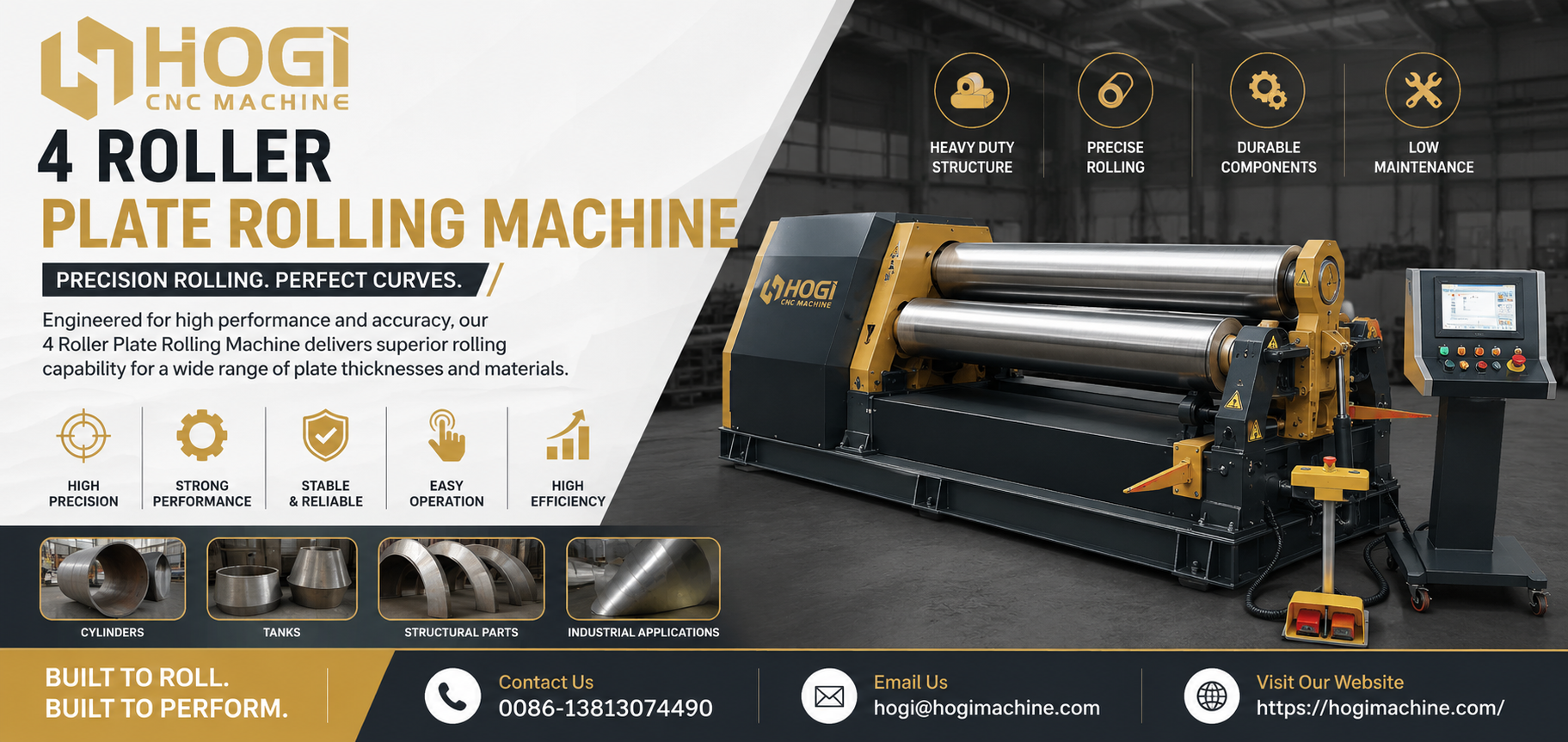
The demand for accurate and efficient metal fabrication equipment continues to grow as industries look for faster production, better consistency, and reduced material waste. Among the machines used for plate forming, the 4 roller plate rolling machine has become an important solution for manufacturers working with cylindrical, curved, and conical metal components. With improved plate control and integrated pre-bending capabilities, this machine can streamline several stages of the fabrication process.
What Is a 4 Roller Plate Rolling Machine?
A 4 roller plate rolling machine is industrial equipment designed to transform flat metal plates into cylindrical, curved, or conical shapes. It generally uses four rolls—an upper roll, lower roll, and two side rolls—to hold and progressively form the workpiece.
Unlike traditional plate rolling methods that may require multiple positioning steps, the four-roll arrangement provides better control over the plate throughout the forming process. This makes it suitable for workshops and manufacturing facilities producing tanks, pipes, pressure vessels, boilers, structural components, and other fabricated products.
For businesses handling repetitive production work, the combination of controlled plate movement and pre-bending can help improve productivity and dimensional consistency.
How Does a Four-Roller Plate Rolling Machine Work?
The operating principle is based on controlled movement of the four rolls. The exact procedure varies according to machine design, material, and required shape, but the general process involves the following steps:
1. Plate Positioning
The metal plate is placed between the upper and lower rolls. Accurate alignment at this stage is important for achieving a uniform finished shape.
2. Plate Clamping
The lower roll moves upward to secure the plate against the upper roll. This helps prevent unwanted movement while the plate is being formed.
3. Pre-Bending
One side roll is positioned to bend the leading edge of the plate. The opposite end can then be pre-bent before the main rolling operation.
4. Main Rolling
The rolls rotate while the side rolls are adjusted progressively. Pressure is applied in a controlled manner until the plate reaches the desired radius.
5. Final Forming
Additional rolling passes can be performed to achieve the required roundness and dimensional accuracy. The completed component is then removed from the machine.
Key Advantages of Four-Roller Plate Rolling Technology
The four-roll design offers several benefits for professional metal fabrication operations.
- Efficient pre-bending: Plate edges can be pre-bent with fewer handling operations.
- Improved plate stability: The workpiece remains securely positioned during forming.
- Higher production efficiency: Reduced repositioning can help shorten manufacturing cycles.
- Consistent results: Controlled roll movement supports repeatable production.
- Versatile forming: Suitable configurations can produce cylindrical, curved, and conical components.
- Automation potential: Advanced models can incorporate NC or CNC controls.
- Reduced operator intervention: Automated positioning can simplify repetitive production work.
These advantages can be particularly useful for manufacturers producing similar components in medium- or high-volume batches.
4 Roller vs. 3 Roller Plate Rolling Machine
Both three-roll and four-roll machines have their place in metal fabrication. However, their operating characteristics are different.
| Feature | 4 Roller Machine | 3 Roller Machine |
| Plate clamping | Strong and controlled | Depends on machine design |
| Pre-bending | Highly efficient | May require additional handling |
| Plate repositioning | Generally lower | Can be higher |
| Production efficiency | High | Moderate to high |
| Automation | Well suited | Available on selected models |
| Operator control | Relatively straightforward | Can require more experience |
| Typical investment | Higher | Often more economical |
A four-roll system may be a better option for businesses prioritizing productivity, repeatability, and efficient pre-bending. For simpler applications or lower production volumes, a three-roll machine may remain a practical choice.
Where Is a 4 Roller Plate Rolling Machine Used?
The technology is applicable across numerous industrial sectors where large metal plates need to be formed accurately.
Common Industrial Applications
- Pressure vessel manufacturing
- Storage tank fabrication
- Boiler production
- Pipe and tube manufacturing
- Petrochemical equipment
- Oil and gas fabrication
- Shipbuilding
- Wind tower manufacturing
- Steel structure production
- Industrial duct and enclosure fabrication
The machine can be especially valuable when manufacturers need repeatable curved components while maintaining efficient production cycles.
Factors to Consider Before Buying
Selecting the right machine requires more than comparing prices. The machine should match the actual requirements of the fabrication operation.
Plate Thickness and Working Width
Start by identifying the minimum and maximum plate thicknesses your workshop processes. The required working width should also be considered because the machine must accommodate your largest regular workpieces.
Material Strength
Different materials require different forming forces. Carbon steel, stainless steel, aluminum, and high-strength alloys should be evaluated according to their mechanical properties.
Minimum Rolling Diameter
The required finished diameter is another important consideration. A machine designed primarily for large-radius components may not be suitable for applications requiring smaller diameters.
Control System
For repetitive production, NC or CNC control can provide better repeatability and simplify roll-position adjustments. Manual or semi-automatic systems may be sufficient for job-shop applications with changing requirements.
Machine Construction
Frame rigidity, roll quality, hydraulic components, drive systems, safety mechanisms, and overall build quality can have a direct effect on long-term performance.
Other specifications to evaluate include:
- Maximum plate thickness
- Maximum working width
- Minimum rolling diameter
- Roll diameter
- Motor power
- Hydraulic capacity
- Cone-bending capability
- CNC/NC control options
- Safety and overload protection
- Maintenance requirements
- Availability of spare parts
- Technical and after-sales support
Why Four-Roll Technology Is Becoming Important
Modern fabrication companies are under constant pressure to produce higher-quality components while controlling production costs. Manual adjustments, excessive plate handling, and inconsistent forming can affect both productivity and profitability.
A four-roll configuration addresses several of these challenges by combining plate clamping, pre-bending, and rolling in one integrated process. When properly specified and operated, the machine can help manufacturers establish a more streamlined production workflow.
For companies planning long-term production expansion, automation and repeatability are also becoming increasingly important. Advanced four-roll machines can be configured with digital controls and automated positioning features to reduce operator-dependent variations.
Choosing the Right Manufacturing Partner
The quality of the machine is only one part of a successful investment. Buyers should also consider whether the manufacturer understands their application and can recommend an appropriate configuration.
HogiMachine provides industrial plate rolling solutions designed for fabrication requirements involving controlled bending, pre-bending, and efficient plate forming. Before purchasing, manufacturers should provide details such as plate material, thickness, width, required diameter, production quantity, and desired automation level.
This information allows the machine configuration to be evaluated according to the actual application rather than relying only on standard specifications.
Frequently Asked Questions
1. What is a 4 roller plate rolling machine?
It is a plate-forming machine that uses four rolls to clamp, pre-bend, and roll metal plates into cylindrical, conical, or curved shapes.
2. What is the main advantage of a four-roll machine?
Its main advantage is the combination of secure plate clamping and efficient pre-bending, which can reduce handling and improve production consistency.
3. Can it roll stainless steel?
Yes, provided the machine is appropriately designed and rated for the thickness, grade, and strength of the stainless steel being processed.
4. Can it produce conical shapes?
Many four-roll machines support cone bending, although the exact capability depends on the machine’s design and control system.
5. Is a four-roll machine suitable for pressure vessels?
Yes. Four-roll machines are commonly considered for applications involving cylindrical shells and other components used in pressure vessel fabrication.
6. Is CNC control necessary?
Not always. CNC becomes particularly beneficial when the workshop handles repetitive production or requires accurate, repeatable roll positioning.
7. What plate thickness can the machine handle?
Capacity varies by model. Buyers should select the machine based on their required thickness, working width, material strength, and rolling diameter.
8. What industries use four-roll plate rolling equipment?
Industries include tank manufacturing, pressure vessel production, shipbuilding, petrochemical fabrication, oil and gas, structural steel, and renewable-energy equipment manufacturing.
9. How can the right machine improve production?
It can reduce plate handling, simplify pre-bending, improve repeatability, and help establish a more efficient manufacturing workflow.
10. What information should I provide when requesting a quotation?
Provide plate material, maximum thickness, working width, minimum and maximum diameter, production volume, and whether manual, NC, or CNC operation is preferred.
Final Thoughts
A 4 roller plate rolling machine offers a practical combination of plate stability, pre-bending efficiency, forming flexibility, and production repeatability. For manufacturers working with tanks, pipes, pressure vessels, structural components, and other curved metal products, the technology can become an important part of a modern fabrication setup.
However, the right machine should always be selected according to the actual application. Capacity, material strength, plate dimensions, rolling diameter, automation requirements, and long-term service support should all be considered before making an investment.
If your business is looking to improve plate-forming efficiency and achieve more consistent results, connect with HogiMachine to discuss your application and find a suitable four-roll plate rolling solution for your production requirements.
Contact – 0086-13813074490
Email ID – hogi@hogimachine.com
Website – https://hogimachine.com/