
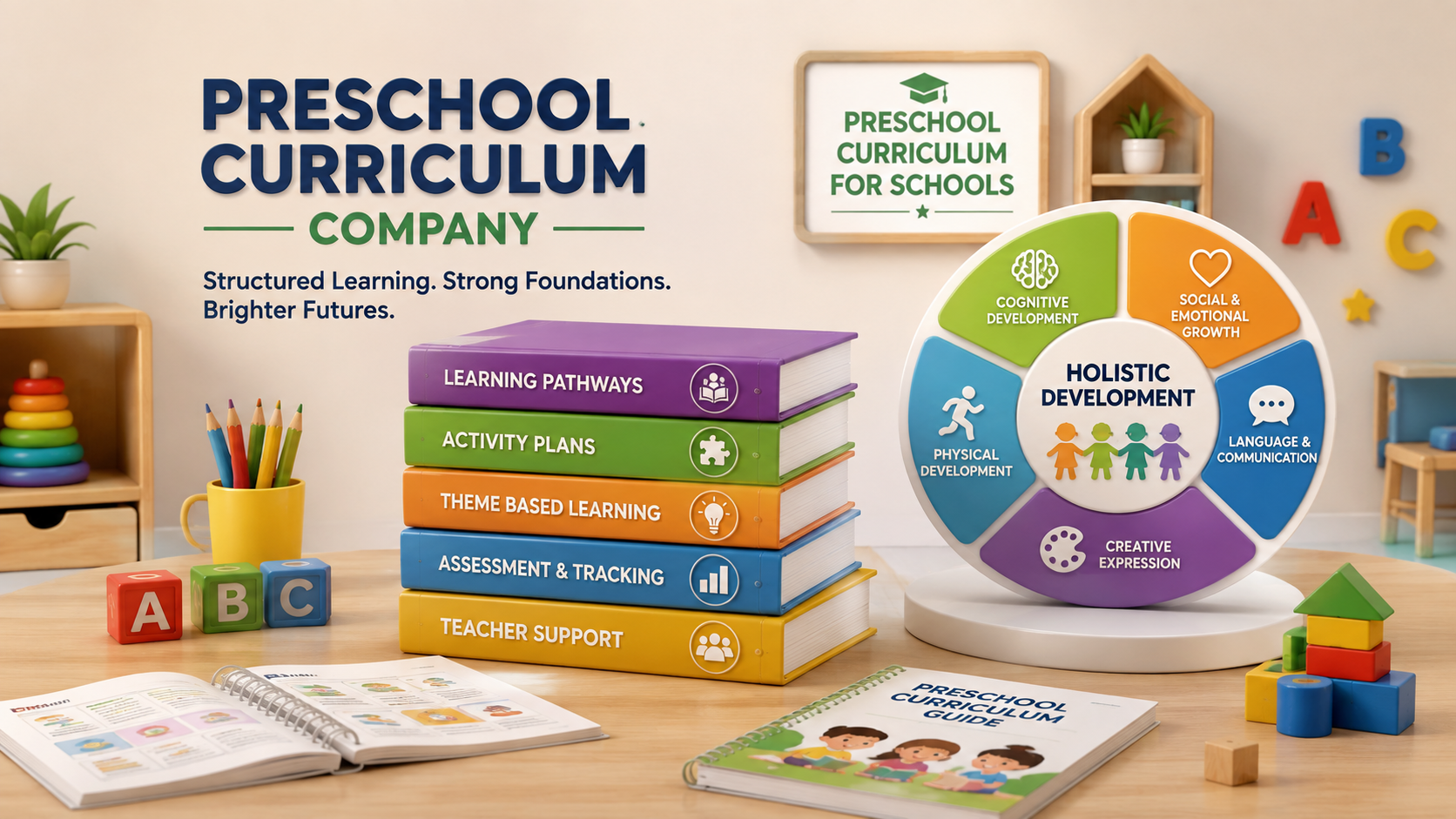
The quality of early education depends on much more than colourful books, worksheets and classroom activities. A strong preschool programme should help young children develop communication, confidence, curiosity, social skills, physical abilities and early academic foundations in an age-appropriate way.
For school owners, educators and early-years administrators, this makes choosing the right preschool curriculum company an important academic and operational decision. The right curriculum partner provides a structured learning framework while giving teachers enough flexibility to respond to different abilities, interests and classroom situations.
A well-designed preschool curriculum for schools should ultimately answer one question: How does this activity contribute to the child’s overall development?
What Is a Preschool Curriculum Company?
A preschool curriculum company develops structured educational programmes, teaching resources and learning frameworks specifically for early-years education.
Depending on the provider, a complete solution may include:
· Year-wise or age-wise curriculum plans
· Teacher manuals and lesson plans
· Student books and activity resources
· Classroom activities
· Assessment frameworks
· Learning outcomes
· Theme-based teaching plans
· Art, music and movement activities
· Early literacy and numeracy resources
· Teacher training and implementation support
· Digital learning resources
The company’s role should therefore extend beyond supplying books. A capable curriculum partner helps schools translate developmental goals into practical classroom experiences.
What Should a Good Preschool Curriculum for Schools Include?
A high-quality preschool curriculum for schools should support holistic development rather than concentrate exclusively on reading, writing and mathematics.
An effective programme generally covers several interconnected developmental areas.
Language and Communication
Young children need frequent opportunities to listen, speak, describe, question and communicate.
Activities may include storytelling, picture conversations, rhymes, phonological awareness, vocabulary-building exercises and early writing experiences.
The objective is not simply to teach letters. It is to build the language foundation children need for future learning.
Early Numeracy
Mathematical understanding begins through real experiences.
Children can learn concepts such as numbers, shapes, patterns, comparison, sorting, sequencing and measurement through objects, games and everyday classroom situations.
For example, instead of completing several worksheets about “big and small”, children might sort classroom objects according to size. This makes an abstract concept visible and meaningful.
Cognitive Development
Preschool education should encourage children to observe, investigate, remember, classify and solve simple problems.
Puzzles, matching exercises, sequencing activities, construction play and age-appropriate experiments can develop thinking skills without making learning unnecessarily formal.
Social and Emotional Development
Learning how to participate in a group is an important part of preschool.
A balanced programme should provide opportunities for children to practise sharing, cooperation, emotional expression, independence and respect for others.
These experiences prepare children not only for primary school but also for everyday social situations.
Physical and Motor Development
Fine and gross motor development should have a defined place within the curriculum.
Drawing, colouring, threading, clay activities and paper work can strengthen fine motor control, while jumping, balancing, dancing and outdoor games develop larger muscle groups and coordination.
Play-Based Learning Should Have a Clear Purpose
Play and learning should not be treated as competing approaches.
Purposeful play allows children to explore ideas naturally while teachers introduce carefully selected learning opportunities.
Imagine a pretend grocery shop inside a classroom. Children can practise counting products, recognising colours, communicating with classmates, taking turns and understanding everyday situations within one activity.
An experienced preschool curriculum company should therefore design activities where learning objectives are clear without turning every classroom experience into formal instruction.
How to Evaluate a Preschool Curriculum Company
Schools should look beyond attractive sample books when comparing curriculum providers.
The underlying educational structure is considerably more important.
Check Age Appropriateness
Activities suitable for a five-year-old may be frustrating or developmentally unsuitable for a three-year-old.
Ask the provider how learning outcomes, activities and classroom expectations change across different age groups.
Progression should be visible from one level to another.
Examine the Balance Between Books and Activities
Workbooks can support learning, but they should not dominate the preschool day.
A strong preschool curriculum for schools combines teacher-led instruction with stories, conversation, movement, games, art, exploration and hands-on activities.
If most learning depends on children sitting and completing worksheets, schools should examine whether the programme genuinely reflects early-years teaching principles.
Review Teacher Guidance
Even an excellent curriculum can produce inconsistent results when teachers are unsure how to deliver it.
Teacher manuals should clearly explain:
· Learning objectives
· Materials required
· Classroom preparation
· Activity procedures
· Suggested questions
· Expected learning outcomes
· Assessment opportunities
· Adaptation ideas
Clear guidance can be particularly valuable for schools operating multiple preschool classrooms or branches.
Ask About Teacher Training
Implementation support is one of the most important factors when selecting a curriculum partner.
Ask whether teachers receive orientation before implementation and whether ongoing academic support is available.
Training should help educators understand why activities are included rather than merely telling them which page to complete.
Internal link opportunity: Link to your teacher-development page using the anchor text preschool teacher training programmes.
Curriculum Should Allow Classroom Flexibility
A curriculum provides direction; it should not make teaching mechanical.
Children develop at different speeds, and classrooms differ in size, resources, language backgrounds and learning requirements.
Teachers should therefore be able to adapt activities while maintaining the intended learning outcome.
For example, a lesson about colours could involve classroom objects in one school, outdoor exploration in another and art materials in another. The learning objective remains consistent even though the teaching method changes.
A practical curriculum gives teachers structure without removing professional judgement.
How Assessment Should Work in Preschool
Assessment at preschool level should help educators understand development rather than create unnecessary academic pressure.
Teachers can observe children during everyday activities and record progress across areas such as:
· Communication
· Early literacy
· Numeracy
· Motor skills
· Social interaction
· Independence
· Problem-solving
· Creative expression
A good curriculum provider should make assessment manageable for teachers and understandable for parents.
Schools should ask prospective providers to demonstrate how progress is documented and how those observations influence future teaching.
Internal link opportunity: Use early childhood assessment methods to link to a detailed resource about preschool assessment.
Local Support Matters When Choosing a Curriculum Partner
For schools searching locally for a preschool curriculum company, service capability deserves as much attention as curriculum content.
Ask practical questions before committing:
Is training available in your city or region?
How quickly can academic queries be resolved?
Are books and classroom resources supplied reliably?
Can the programme accommodate local language or cultural requirements?
Will support continue after implementation?
Local or regional accessibility can be especially useful when schools require teacher workshops, classroom observations or regular academic coordination.
For local SEO, curriculum providers should also create genuine location-specific information explaining service coverage rather than publishing near-identical city pages with only the location name changed.
Questions Schools Should Ask Before Selecting a Provider
Before signing an agreement with a preschool curriculum company, school management should ask:
1. What educational philosophy guides the curriculum?
2. Which age groups does the programme cover?
3. What are the learning outcomes for each level?
4. How much classroom time involves worksheets?
5. How is play-based learning incorporated?
6. What resources are provided to teachers?
7. Is teacher training included?
8. How is student progress assessed?
9. How frequently is the curriculum reviewed?
10. What academic support is available after implementation?
11. Can teachers adapt activities for different learners?
12. Can we review complete sample materials before making a decision?
The answers can reveal considerably more about a provider than a sales presentation alone.
Benefits of a Structured Preschool Curriculum for Schools
A thoughtfully developed curriculum can create consistency across classrooms while reducing unnecessary planning pressure on teachers.
For school management, it provides clearer academic direction. Teachers receive defined learning objectives and classroom resources. Parents can better understand what children are learning, while students experience a more balanced progression from one developmental stage to another.
This becomes particularly important for schools operating several sections or multiple branches, where consistency needs to be maintained without making every classroom identical.
Internal link opportunity: Link to your programme page with preschool curriculum solutions for schools.
Curriculum Provider vs Individual Classroom Planning
| Area | Structured Curriculum Provider | Individual Teacher Planning |
| Learning progression | Pre-planned across levels | Depends on individual planning |
| Teacher resources | Usually structured | Created independently |
| Assessment framework | Can be standardised | May vary by classroom |
| Training support | Available with some providers | Usually school-managed |
| Consistency | Easier across multiple classes | Can vary significantly |
| Flexibility | Depends on programme design | Generally high |
Neither structure nor flexibility should exist in isolation. The strongest approach provides a clear educational framework while allowing skilled teachers to adjust delivery according to children’s needs.
Frequently Asked Questions
What does a preschool curriculum company provide?
A preschool curriculum company develops early-years learning programmes and may provide books, lesson plans, teacher resources, assessments, training and implementation support.
How do I choose the best preschool curriculum for my school?
Evaluate developmental appropriateness, teaching methodology, learning outcomes, teacher support, assessment methods, flexibility, training and long-term academic assistance.
What is a play-based preschool curriculum?
It is an approach where children develop knowledge and skills through purposeful play, exploration, conversation and hands-on experiences.
Should preschool children use worksheets?
Worksheets can be used selectively, but they should complement rather than replace play, movement, conversation, exploration and practical activities.
What subjects should a preschool curriculum cover?
A balanced curriculum usually includes language, early numeracy, environmental awareness, creativity, physical development, cognitive development and social-emotional learning.
Is teacher training important when implementing a new curriculum?
Yes. Training helps teachers understand learning objectives, classroom strategies, assessment methods and the educational reasoning behind activities.
How should preschool students be assessed?
Observation, classroom participation, activity-based evidence and developmental records are generally more appropriate than relying heavily on formal testing.
Can one preschool curriculum work for every school?
The underlying developmental framework may be transferable, but implementation should allow adaptation for language, classroom resources, learner needs and local context.
How often should a preschool curriculum be reviewed?
Schools should review curriculum effectiveness regularly and examine whether learning resources, teaching practices and developmental goals remain appropriate.
What should schools request before purchasing a curriculum?
Ask for sample curriculum plans, teacher manuals, student materials, assessment examples, training details and a clear explanation of ongoing academic support.