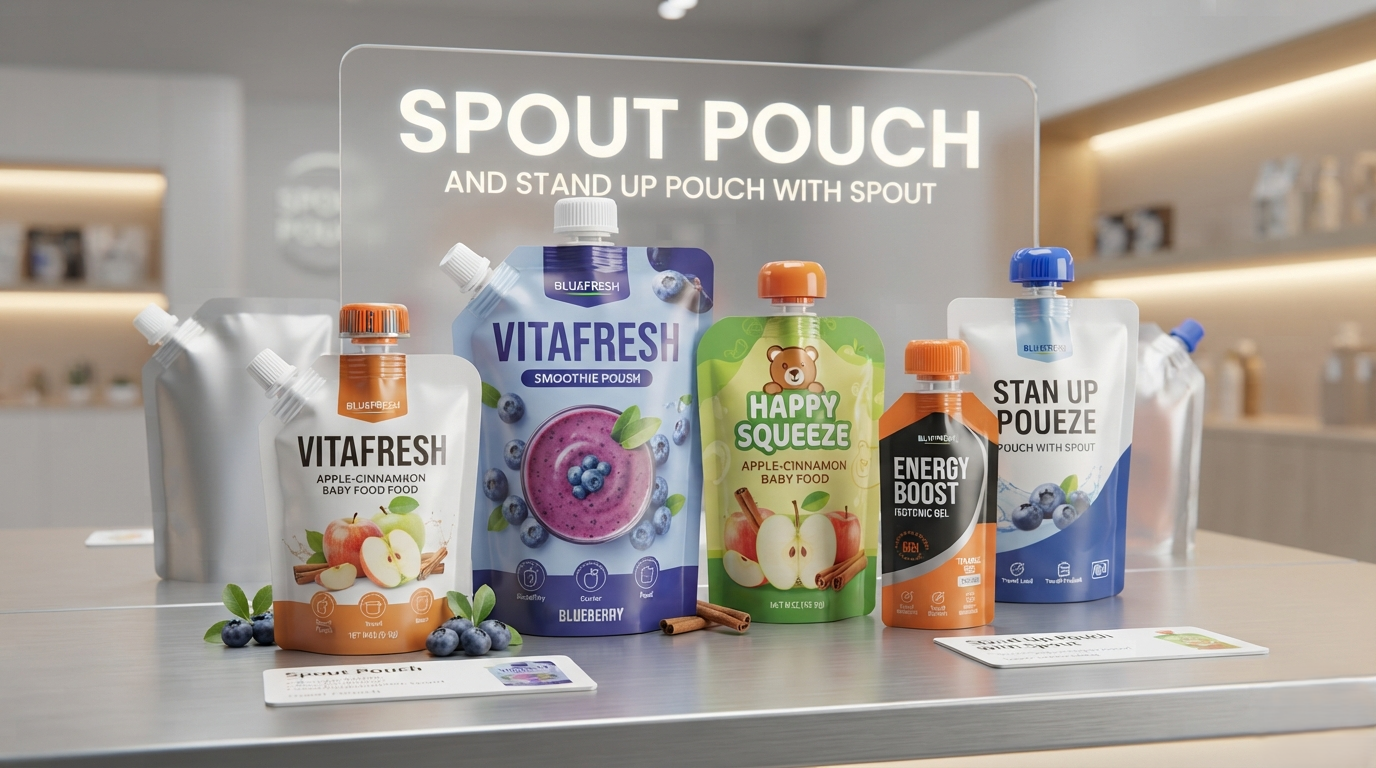
Flexible packaging is entering a new phase as manufacturers look beyond conventional bottles, jars and basic sachets. The Spout Pouch and stand up pouch with spout are becoming notable options for companies seeking packaging that combines controlled dispensing, resealability, product visibility and efficient handling.
The development is particularly relevant for brands operating in food, beverages, personal care, household products and refill categories. Instead of simply replacing a bottle with a flexible pack, businesses are examining how spouted packaging can improve the complete journey from filling and transportation to retail display and consumer use.
Changing Consumer Habits Influence Packaging Design
Convenience has become an important consideration in packaging development. Consumers increasingly encounter products that are designed to be opened, used in controlled quantities and stored for later use.
This is where a Spout Pouch differs from a conventional sachet.
The integrated spout allows the user to pour or squeeze the contents through a defined opening. A cap can then be replaced to close the package.
For manufacturers, this creates possibilities for products including:
- Juices and liquid foods
- Sauces and purees
- Cooking oils
- Liquid detergents
- Handwash
- Shampoo and conditioner
- Cosmetic refills
- Cleaning concentrates
- Selected industrial liquids
However, packaging specialists emphasise that the same pouch specification cannot automatically be used across all these categories.
Stand Up Pouch with Spout Brings Shelf Display Into Focus
While standard spouted pouches offer dispensing convenience, the stand up pouch with spout addresses another commercial priority: presentation.
Its bottom gusset expands as the package is filled, creating a base that supports the pouch in an upright position.
This gives manufacturers an opportunity to use the front and rear surfaces for branding and consumer information while maintaining a flexible package structure.
Retail-oriented designs can feature product names, logos, ingredients, instructions, nutritional information, barcodes, QR codes and mandatory declarations directly within the printed design.
For emerging brands in particular, packaging can therefore serve as both a functional container and an important communication platform.
Packaging Engineers Focus on What Consumers Cannot See
The visual design attracts attention, but much of the performance of a Spout Pouch comes from its internal construction.
Flexible pouches can contain multiple laminated layers, each selected for a particular function.
PET is commonly considered where print quality and mechanical properties are required. Polyethylene may serve as a sealing layer, while nylon can provide additional resistance to punctures. Metallised films or aluminium foil may be incorporated when a product requires stronger protection against factors such as light, moisture or oxygen.
Product Characteristics Determine the Structure
Selecting a laminate involves analysing:
- Product chemistry
- Viscosity
- Moisture sensitivity
- Oxygen sensitivity
- Light sensitivity
- Filling temperature
- Storage period
- Distribution conditions
Shelf Life Cannot Be Separated From Packaging
A product’s expected shelf life should be considered during packaging development rather than after the pouch has been manufactured.
Barrier requirements for juice, for example, can differ considerably from those of household cleaner. Actual product compatibility and appropriate testing therefore remain important parts of specification development.
Spout Size Can Change the Consumer Experience
One of the smallest components of the package can have a major effect on usability.
A spout that is too narrow for a thick product may make dispensing frustrating. An unnecessarily large opening for a free-flowing liquid can make portion control more difficult.
Manufacturers therefore need to match the spout opening with product viscosity and intended use.
Thin beverages, oils, sauces, gels and concentrates can require different dispensing configurations.
Positioning also varies. Corner spouts provide directional pouring, while centrally positioned spouts can create a symmetrical package and suit certain direct-dispensing applications.
Spout Pouch Compared with Common Packaging Formats
The choice between a pouch and rigid packaging should be based on practical requirements rather than packaging trends.
| Consideration | Spout Pouch | Bottle | Basic Sachet |
| Resealable | Usually | Yes | Usually no |
| Flexible construction | Yes | No | Yes |
| Controlled pouring | High | High | Low |
| Empty storage requirement | Low | Higher | Low |
| Refill applications | Strong | Possible | Possible |
| Large printing area | Yes | Label dependent | Yes |
| Multiple-use convenience | High | High | Limited |
Rigid bottles remain appropriate for many applications. The growing role of flexible packaging simply gives brands another option when evaluating cost, functionality, logistics and consumer convenience.
Refill Packaging Creates New Opportunities
Refill formats represent one of the areas where a stand up pouch with spout can offer practical advantages.
Products such as liquid soap, shampoo, detergent and household cleaners can potentially be sold in pouches that consumers use to refill existing containers.
This can reduce the need to package every purchase in the same type of rigid container.
However, environmental claims require care. A lighter package does not automatically mean a product is environmentally superior in every situation.
Material composition, transportation, manufacturing, product-to-packaging ratio, recycling systems and end-of-life treatment all influence overall environmental performance.
Filling Lines Adapt to Spouted Formats
Behind every consumer pouch is a filling operation that needs to handle the package reliably.
Depending on production requirements, the process may include:
- Empty pouch feeding
- Pouch positioning
- Product dosing
- Filling
- Capping
- Seal inspection
- Leak testing
- Batch coding
- Final packing
Production speed is only one consideration.
Product temperature, viscosity, particles, foaming characteristics and hygiene requirements can all influence the type of filling equipment required.
Companies switching from bottles to a Spout Pouch should therefore evaluate both packaging and filling technology as part of the same project.
Quality Control Becomes a Business Priority
Packaging failure can result in leakage, damaged cartons, product loss and dissatisfied customers. For this reason, quality assessment should extend beyond visual inspection.
Important tests can include:
- Seal-strength testing
- Leakage checks
- Drop tests
- Cap-fit inspection
- Spout-weld assessment
- Lamination checks
- Puncture testing
- Dimensional verification
- Transportation trials
- Product compatibility testing
Testing filled samples under realistic conditions can provide more meaningful information than assessing empty pouches alone.
Custom Printing Gives Brands More Creative Freedom
Another reason businesses consider a stand up pouch with spout is its branding potential.
Depending on manufacturing capabilities, flexible packaging may use digital, flexographic or rotogravure printing.
Businesses can develop designs incorporating colours, photography, illustrations, instructions, promotional information and scannable codes.
The printing method should be selected according to order quantity, design complexity, colour expectations, repeat production requirements and commercial feasibility.
Frequently Asked Questions
What exactly is a Spout Pouch?
It is a flexible package fitted with a dispensing spout and closure for pouring and resealing suitable products.
Why is spouted packaging becoming important?
It combines flexible construction with convenient dispensing, making it relevant to beverages, food, personal care and refill products.
What makes a stand-up pouch different?
A bottom gusset allows the filled package to form a base and remain upright.
Can a stand up pouch with spout package liquids?
Yes. It can package many suitable liquids when the film, seals, spout and closure are correctly specified.
Can it package thick products?
Yes, but thicker products may require a wider spout and appropriate filling equipment.
Are spouted pouches suitable for hot filling?
Certain structures may be designed for hot-fill applications. Materials and fitments must be selected for the intended filling temperature.
Can brands customise the pouch?
Yes. Size, shape, laminate, graphics, spout location and closures can generally be customised within the manufacturer’s capabilities.
Is a corner spout better than a centre spout?
It depends on the application. Corner spouts favour directional pouring, while centre spouts suit other dispensing and presentation requirements.
What industries can use these pouches?
Food, beverages, personal care, household cleaning and selected industrial sectors can consider spouted flexible packaging.
What should be tested before mass production?
Product compatibility, leakage, seals, dispensing, drop resistance, filling performance and transportation behaviour should be evaluated.
Is a Spout Pouch automatically recyclable?
No. Recyclability depends on material construction and the collection and recycling infrastructure available in the target market.
Read more – https://newsgrow.blogspot.com/2026/08/foil-lid-and-stand-up-pouch.html
https://newsgrow.blogspot.com/2026/08/spout-pouch-and-stand-up-pouch-with.html