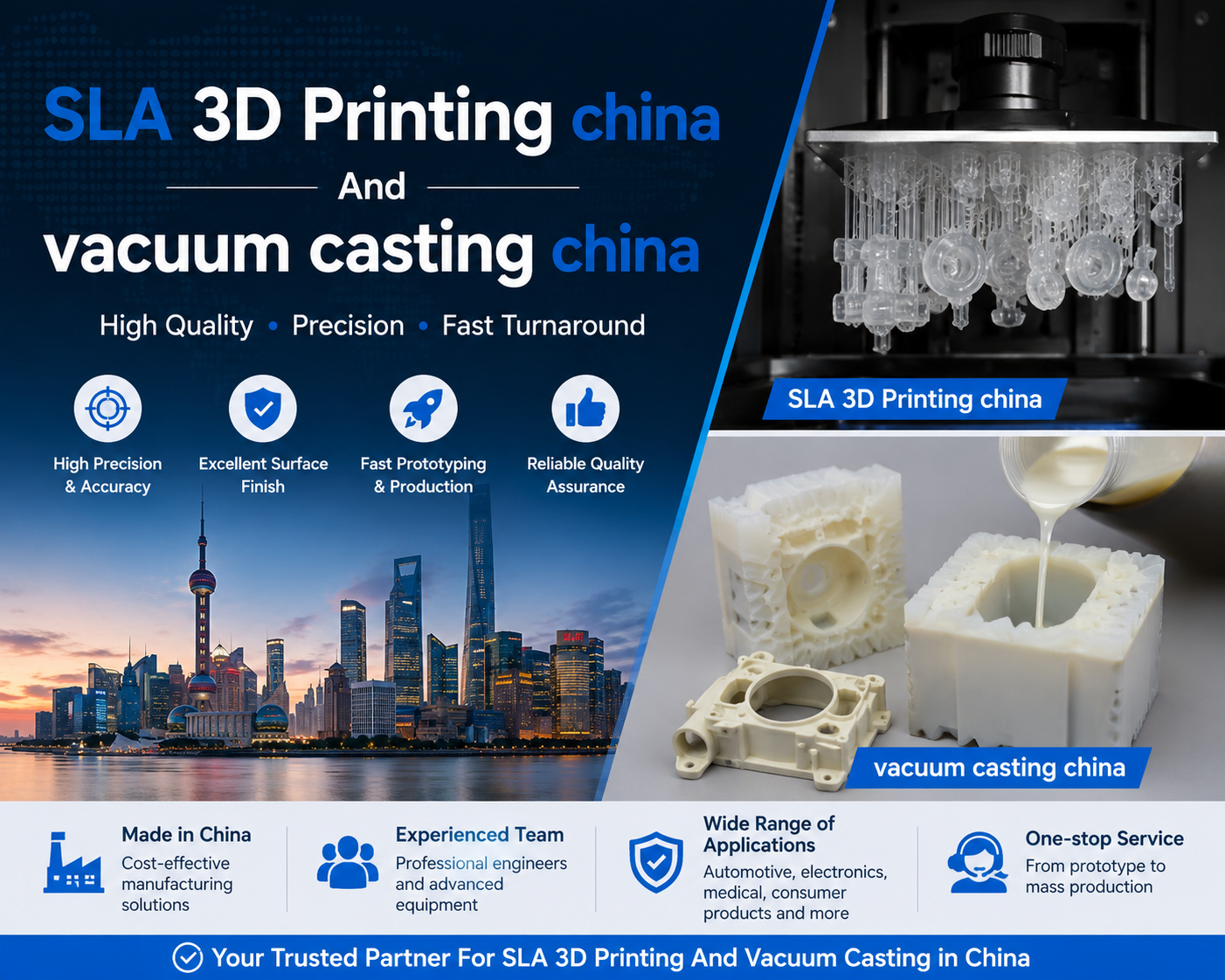
Developing a new product is rarely a straight journey from an idea to mass production. Before investing in tooling, manufacturers often need physical samples to evaluate shape, assembly, usability, surface quality and overall design performance. Producing these samples efficiently is where SLA 3D Printing China and vacuum casting China can play an important role.
SLA 3D printing is particularly valuable when engineers need detailed prototypes quickly and expect the design to change. Vacuum casting becomes useful when the design is more mature and several similar plastic-like components are required.
Used individually or together, these processes can create a flexible bridge between digital product design and commercial manufacturing.
Why Is SLA 3D Printing China Popular for New Product Development?
SLA 3D Printing China is based on stereolithography, an additive manufacturing process that transforms three-dimensional CAD data into physical resin components.
Instead of machining a shape from a larger block, an SLA machine selectively cures liquid photopolymer resin. The component develops progressively in thin layers until the required geometry has been created.
After printing, parts typically undergo cleaning, support removal, post-curing and, when required, additional surface finishing.
One reason product developers choose SLA is its ability to manufacture complicated shapes without requiring conventional production tooling.
Important advantages include:
- Detailed feature reproduction
- Smooth surface appearance
- Rapid prototype manufacturing
- Freedom to create complex geometries
- No hard mould requirement
- Multiple resin categories
- Convenient design revisions
- Excellent suitability for visual prototypes
These characteristics are particularly valuable when engineering teams are still improving the design.
How SLA Can Reduce Expensive Design Mistakes
A CAD model may appear perfect on a computer screen but behave differently once converted into a physical product.
Imagine developing a new electronic controller. The CAD dimensions may technically be correct, but after producing an SLA prototype, engineers might discover that a button is difficult to reach or two housing sections do not align as expected.
With SLA 3D Printing China, the CAD model can be modified and another prototype produced without redesigning expensive production tooling.
This iterative process can help identify problems involving:
- Component fit
- Assembly clearance
- Ergonomics
- External appearance
- Fastener positioning
- Connector openings
- Internal component space
- Product dimensions
Prototypes therefore become engineering tools rather than simply presentation models.
Which Products Are Suitable for SLA 3D Printing?
SLA can support prototype development across many sectors.
Common applications include:
- Consumer electronics housings
- Automotive interior components
- Medical equipment prototypes
- Industrial control enclosures
- Appliance components
- Product presentation models
- Transparent covers
- Engineering test components
- Architectural models
- Master patterns for silicone moulding
However, selecting SLA 3D Printing China should depend on the intended use of the prototype. A photopolymer component designed for appearance evaluation may not necessarily reproduce all the mechanical characteristics of the eventual production thermoplastic.
What Happens When You Need More Than a Few Prototypes?
Direct 3D printing is highly convenient for individual prototypes, but printing every component separately may not always be the preferred strategy when several similar parts are required.
This is where vacuum casting China enters the development process.
Vacuum casting is commonly used for small-batch manufacturing. Rather than printing each component independently, manufacturers first produce a high-quality master pattern.
A flexible silicone mould is created around this master. Casting resin is then used to reproduce the original component.
The process is especially useful for pilot batches, customer samples, exhibition components and pre-production evaluation.
Inside the Vacuum Casting China Manufacturing Process
Producing good vacuum-cast parts depends heavily on the quality of the master and mould.
Creating an Accurate Master
The process begins with a master model representing the desired final geometry.
SLA 3D printing is frequently used for this purpose because it can provide detailed surfaces and complicated shapes.
The master can be carefully sanded, polished, painted or textured before mould production.
Producing the Silicone Mould
The prepared master is positioned inside a moulding box and surrounded with liquid silicone.
After the silicone cures, technicians carefully separate the mould and remove the master.
The resulting cavity reproduces the geometry and surface characteristics of the original component.
Casting the Material
A selected polyurethane or similar casting material is prepared and introduced into the mould.
Vacuum conditions help reduce trapped air, supporting consistent filling and detailed reproduction.
Finishing the Component
After curing, the component is removed and excess material is trimmed.
Further finishing may include:
- Sanding
- Painting
- Polishing
- Colour matching
- Texturing
- Pad printing
- Insert installation
- Assembly
The exact finishing process depends on whether the component is intended for engineering testing, customer evaluation or visual presentation.
Why Combine SLA 3D Printing China with Vacuum Casting China?
The real value becomes clearer when the technologies are considered as complementary manufacturing processes.
For example, suppose a company is developing a new handheld medical device enclosure.
The initial CAD model can be manufactured using SLA 3D Printing China. Engineers can evaluate the enclosure and identify necessary changes.
After several design iterations, the approved SLA model can be professionally finished and used as the master pattern.
A silicone mould is then manufactured from this master, allowing vacuum casting China to produce multiple similar components.
A simplified development route looks like this:
Product Idea → CAD Model → SLA Prototype → Testing → Design Improvement → Final SLA Master → Silicone Mould → Vacuum Casting → Pre-Production Evaluation
This workflow allows product development to progress gradually without moving immediately into high-cost tooling.
SLA 3D Printing vs Vacuum Casting: Which Is Right for You?
| Requirement | SLA 3D Printing | Vacuum Casting |
| One prototype | Excellent choice | Usually unnecessary |
| Frequent design changes | Highly suitable | Less convenient |
| Small production batch | Possible | Highly suitable |
| Complex geometry | Excellent | Good with suitable mould design |
| Hard tooling | Not required | Not required |
| Silicone mould | Not required | Required |
| Typical material | Photopolymer resin | Polyurethane |
| Master pattern | Not necessary | Necessary |
| Surface appearance | Very smooth | Replicates master closely |
| Best stage | Design development | Pre-production |
A project does not always need to choose one process permanently. The manufacturing method can change as the product moves through development.
Choosing the Correct Material for Your Prototype
Materials should be selected according to the question the prototype needs to answer.
For SLA 3D Printing China, available resin categories may include standard, tough, clear, flexible and heat-resistant materials.
If the purpose is appearance validation, surface quality may be the priority. For assembly testing, dimensional stability and toughness may be more important.
With vacuum casting China, polyurethane materials can be formulated to provide different degrees of rigidity, flexibility, transparency and hardness.
Some materials are marketed as:
- ABS-like
- PP-like
- Rubber-like
- Clear
- Rigid
- Flexible
- Heat-resistant
These descriptions are useful for preliminary selection, but buyers should request technical data when precise mechanical properties are important.
What Information Should You Send to a China Manufacturer?
Simply emailing a CAD file and asking “How much?” rarely provides the most useful quotation.
A professional request should include:
- 3D CAD model
- 2D engineering drawing
- Required quantity
- Preferred material
- Critical dimensions
- Dimensional tolerances
- Surface finish
- Colour requirements
- Intended component application
- Required delivery schedule
If you are uncertain about the manufacturing method, explain how the component will be used and ask the supplier for a design-for-manufacturing review.
What Affects the Cost of SLA 3D Printing China?
The cost of SLA 3D Printing China is influenced by more than physical dimensions.
Important factors include resin consumption, build orientation, geometry, support requirements, material type, post-processing, quantity and cosmetic finishing.
A large hollow component and a similarly sized solid component, for example, may have significantly different material requirements.
Likewise, a basic engineering prototype will usually require less finishing work than a polished and painted presentation model.
What Affects the Cost of Vacuum Casting China?
For vacuum casting China, the cost structure normally includes the master pattern, silicone mould, casting material, individual casting operations and finishing.
Part complexity, dimensions, mould design, colour requirements, quantity and secondary finishing all influence the final quotation.
Although creating a silicone mould introduces an initial setup cost, producing several components from the same mould can distribute that cost across the batch.
How to Evaluate a Rapid Prototyping Supplier
Price should be only one part of supplier selection.
A capable supplier should understand both manufacturing technology and engineering communication.
Evaluate potential manufacturers based on:
- SLA machine capabilities
- Available resin materials
- Vacuum-casting experience
- Silicone mould quality
- Surface-finishing capabilities
- Dimensional inspection
- DFM support
- Quality documentation
- Communication responsiveness
- Packaging and export experience
Most importantly, ensure that your critical specifications are agreed upon before manufacturing begins.
Frequently Asked Questions
What is SLA 3D printing used for?
SLA is commonly used for detailed prototypes, appearance models, engineering samples and master patterns.
Does SLA require a mould?
No. Components are produced directly from digital CAD data without conventional mould tooling.
What is vacuum casting China best suited for?
It is particularly useful for small batches of plastic-like components during pre-production and product evaluation.
Does vacuum casting require tooling?
It requires a silicone mould rather than the hard metal tooling commonly associated with injection moulding.
Can SLA parts be painted?
Yes. SLA prototypes can undergo sanding, priming, painting and other cosmetic finishing processes.
Can SLA create transparent components?
Yes. Clear photopolymer resins are available, although finishing requirements depend on the desired level of transparency.
Can SLA models be used as vacuum-casting masters?
Yes. This is a common way to combine the two manufacturing technologies.
Is vacuum casting suitable for flexible parts?
Yes. Flexible and rubber-like casting materials can be available depending on supplier capabilities.
Is vacuum casting suitable for mass production?
It is generally intended for low-volume manufacturing. Higher production quantities may justify injection moulding or another scalable manufacturing process.
Which process should I choose first?
If the product design is still changing, SLA is usually the more flexible starting point. Once the design stabilises and multiple parts are required, vacuum casting can become a practical next step.
Read more – https://shopnets.com/china-cnc-custom-machining-how-to-choose-the-right-manufacturing-partner/
https://newsgrow.blogspot.com/2026/08/china-cnc-custom-machining-practical.html
https://newsgrow.blogspot.com/2026/08/china-cnc-machining-suppliers-and.html
https://newsgrow.blogspot.com/2026/08/sla-3d-printing-china-and-vacuum.html