Most quality problems do not announce themselves immediately. Water can remain colourless despite containing unwanted substances, while an industrial raw material can look exactly like an approved batch even when its chemical characteristics have changed.
This creates an important challenge for households, manufacturers, commercial facilities and institutions: how can you verify quality when appearance tells only part of the story?
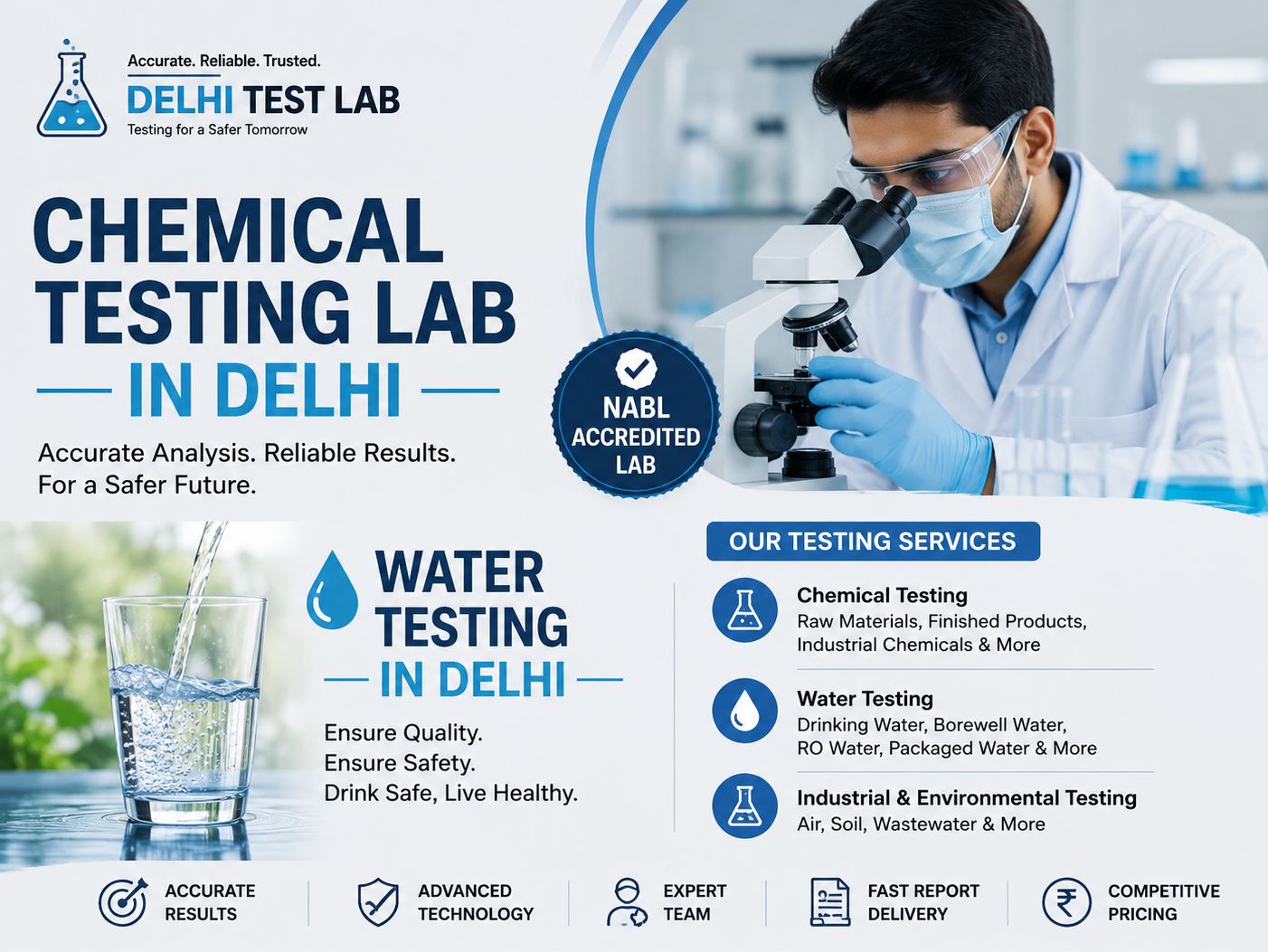
Scientific testing provides the answer. Services offered by a professional chemical testing lab in Delhi allow samples to be evaluated through established analytical methods. Similarly, water testing in Delhi provides useful data about drinking water, groundwater, treated water and water used for industrial purposes.
As Delhi continues to grow as a residential, commercial and industrial centre, understanding the role of laboratory analysis has become increasingly important.
The Invisible Side of Material Quality
A material has characteristics that cannot always be identified through physical inspection.
Imagine two containers holding apparently identical industrial chemicals. Both may have the same colour and consistency, yet differences in composition, concentration or impurities could potentially influence their performance.
This is where laboratory testing becomes valuable.
Depending on its capabilities, a chemical testing lab in Delhi may analyse:
- Raw materials
- Industrial chemicals
- Metals
- Water
- Soil
- Paint and coatings
- Construction materials
- Petroleum products
- Food-related samples
- Cosmetics
- Packaging materials
- Environmental samples
The testing requirements vary significantly between products, which is why selecting appropriate parameters is as important as performing the analysis itself.
When Does a Business Need Chemical Testing?
There is a misconception that chemical testing is required only when regulations demand it. In practice, businesses can use laboratory analysis at several stages of their operations.
Before Production
Incoming materials can be evaluated against purchasing specifications or other defined quality requirements.
During Manufacturing
Testing can help monitor selected characteristics that may influence process consistency.
After Production
Finished materials can be evaluated against specified quality parameters before further use or distribution.
During Problem Investigation
When a product suddenly behaves differently despite apparently unchanged production conditions, analysis may help identify whether material characteristics have changed.
A reliable chemical testing lab in Delhi therefore becomes part of a broader quality-assurance process rather than simply a place where samples are sent for reports.
Why Water Deserves More Attention
Water is one of the most commonly used resources in homes, offices, hospitals, restaurants, schools, factories and commercial buildings.
Yet water quality is frequently assessed through three observations: Does it look clear? Does it smell normal? Does it taste acceptable?
These observations cannot provide a complete assessment.
Professional water testing in Delhi uses laboratory analysis to measure selected characteristics of a sample and provide objective results.
What Can Be Found Through Water Analysis?
The parameters selected depend on the source and intended use of the water.
| Water Parameter | What It Indicates |
| pH | Acidic or alkaline nature |
| TDS | Overall dissolved solids |
| Hardness | Concentration associated mainly with calcium and magnesium |
| Turbidity | Presence of suspended particles |
| Chloride | Chloride concentration |
| Nitrate | Nitrate concentration |
| Fluoride | Fluoride concentration |
| Iron | Amount of iron present |
| Alkalinity | Water’s acid-neutralising capacity |
| Microbiological indicators | Information about microbiological quality |
Testing may include additional parameters when required by the intended use, source, applicable specification or previous results.
One Water Sample Does Not Tell Every Story
The phrase “water testing” sounds straightforward, but there is no universal test package suitable for every water source.
Municipal and Drinking Water
Testing may focus on parameters relevant to drinking-water quality, including physical, chemical and microbiological characteristics.
Borewell Water
Groundwater may require analysis for hardness, dissolved solids, nitrate, fluoride, iron and other relevant parameters.
RO-Treated Water
Comparing untreated and treated samples can help evaluate changes produced by the treatment system.
Industrial Process Water
Industrial users may be particularly concerned about hardness, dissolved substances and other characteristics capable of influencing manufacturing processes or equipment.
Wastewater
Wastewater testing serves a different purpose and can be used to evaluate treatment performance or specified environmental parameters.
This is why anyone requesting water testing in Delhi should explain both the water source and its intended application.
A Test Result Is Only as Good as the Sample
Laboratory instruments can provide highly precise measurements, but the analysis still begins with the sample submitted for testing.
Suppose someone needs to investigate the water quality of an overhead tank but collects the sample from a different supply point. Even if the laboratory analyses that bottle correctly, the result may not answer the original question.
Good sampling therefore involves:
- Selecting a representative collection point.
- Using the appropriate container.
- Preventing contamination during collection.
- Recording sample details correctly.
- Following preservation requirements.
- Transporting the sample appropriately.
- Submitting time-sensitive samples without unnecessary delay.
Special care may be necessary for microbiological and certain chemical parameters.
Laboratory Testing and Industrial Quality Control
Chemical testing can provide value throughout the supply chain.
Consider a manufacturer purchasing the same raw material regularly. Supplier documentation may remain consistent, but periodic independent testing can provide additional information about specified characteristics.
This can support:
- Supplier evaluation
- Batch comparison
- Raw-material verification
- Process troubleshooting
- Product development
- Quality documentation
- Investigation of customer complaints
A technically capable chemical testing lab in Delhi can therefore contribute to evidence-based quality management.
How to Identify a Suitable Testing Laboratory
Choosing a laboratory based solely on price may create problems if the required testing capability or method is unavailable.
Start With the Sample
Explain exactly what material needs testing.
Define the Objective
Are you testing for internal quality control, customer requirements, environmental monitoring, research or another purpose?
Identify Required Parameters
Avoid requesting a generic “full test.” Discuss the relevant parameters with the laboratory.
Verify Testing Capability
Confirm that the laboratory has the necessary facilities and expertise for the required analysis.
Check Accreditation Requirements
Where accreditation is required, verify whether the specific test or parameter is covered by the laboratory’s current accreditation scope.
Review the Report Format
A useful laboratory report should clearly present sample identification, tested parameters, measurement units and results, along with relevant method information where appropriate.
Common Mistakes People Make With Water Testing
Several avoidable mistakes can reduce the usefulness of water testing in Delhi:
- Checking only TDS and assuming the water has been fully evaluated
- Using an unsuitable sampling bottle
- Collecting from an unrepresentative point
- Keeping samples too long before testing
- Requesting the wrong parameters
- Failing to mention whether the water is for drinking or industrial use
- Assuming clear water requires no testing
Understanding these issues before sample collection can make laboratory results far more meaningful.
Frequently Asked Questions
1. What is the main purpose of chemical testing?
It provides measurable information about selected chemical properties, composition, concentration or contaminants in a sample.
2. Who may require a chemical testing lab?
Manufacturers, construction companies, institutions, environmental organisations, product suppliers and other businesses may require laboratory analysis.
3. Is water testing useful for households?
Yes. Testing can provide information about relevant characteristics of water used for drinking and other household purposes.
4. Can borewell water be analysed?
Yes. Water testing in Delhi can be performed on groundwater and borewell samples.
5. Does high TDS automatically mean water is unsafe?
TDS alone is not sufficient to determine overall water quality. Individual chemical and microbiological parameters may also need evaluation.
6. Can a chemical laboratory test construction materials?
Some laboratories can perform chemical analysis of construction-related materials. Specific capabilities should be confirmed before submitting samples.
7. Can treated water be compared with untreated water?
Yes. Before-and-after testing can provide useful information about changes resulting from a treatment process.
8. Can industrial effluent be tested?
Yes, provided the laboratory has appropriate wastewater-testing capabilities.
9. Why is laboratory accreditation important?
For applications requiring accredited results, accreditation provides formal recognition of competence for activities covered within the laboratory’s defined scope.
10. How do I choose between different laboratories?
Compare technical capabilities, relevant methods, accreditation scope where necessary, sampling guidance, reporting quality and turnaround time rather than price alone.
https://newsgrow.blogspot.com/2026/08/chemical-testing-lab-in-delhi-and-water.html