The foodservice industry is placing greater emphasis on kitchen efficiency, hygiene management, and equipment reliability as restaurants, cafés, dessert shops, and hospitality businesses seek to improve their operations.
Maintaining consistent food quality requires more than skilled preparation. Businesses must also manage cleaning procedures, equipment performance, workflow planning, and safe food handling.
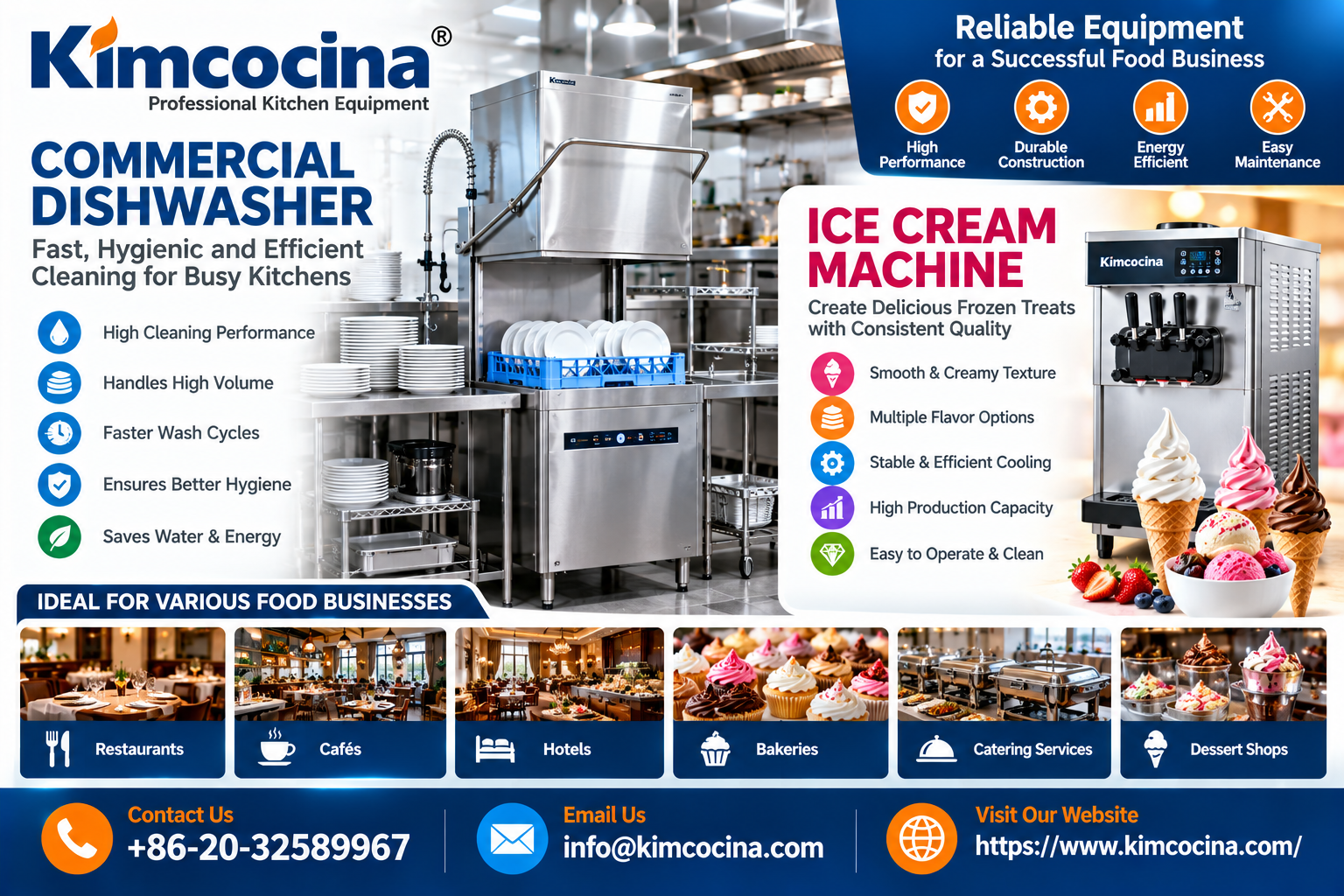
A professional Commercial Dishwasher helps foodservice operators clean and sanitise suitable kitchen utensils, dishes, and service equipment through controlled washing processes.
Meanwhile, an ice cream machine supports the preparation of frozen desserts by combining ingredients, cooling, and mixing according to the equipment’s design.
Although these machines perform different functions, both contribute to organised foodservice operations.
For restaurant owners, dessert businesses, and commercial kitchen managers, understanding the relationship between equipment performance and operational planning can support better purchasing decisions.
Why Commercial Kitchen Efficiency Matters
Foodservice environments involve several interconnected activities, including ingredient preparation, cooking, serving, equipment cleaning, and waste management.
When these operations are poorly coordinated, unnecessary movement, equipment congestion, and inconsistent cleaning practices can affect workflow.
Professional kitchen equipment should therefore be selected according to actual operational requirements.
A restaurant serving numerous meals may need different dishwashing capabilities from a small dessert café.
Similarly, a frozen dessert business should select production equipment according to its menu, product specifications, and expected demand.
What Is a Commercial Dishwasher?
A Commercial Dishwasher is specialised equipment designed to wash and, where appropriately configured and operated, sanitise dishes, utensils, glasses, and selected foodservice items.
Unlike typical household dishwashers, commercial models are designed for professional environments with different washing capacities and operating requirements.
Common configurations include undercounter, hood-type, and conveyor dishwashers.
Each type supports a different kitchen layout and volume of washable items.
The correct selection depends on available space, utility connections, rack capacity, and applicable sanitation requirements.
Operators should also confirm that their dishes and utensils are compatible with the selected washing process.
Understanding the Role of an Ice Cream Machine
An ice cream machine is equipment used to prepare frozen desserts by controlling mixing and cooling processes.
Depending on the model, it may be designed for soft-serve products, batch-frozen ice cream, or other suitable frozen desserts.
Different machines offer different production capacities, operating features, and cleaning requirements.
The finished product depends on ingredient formulation, machine settings, and appropriate food handling procedures.
For cafés and dessert shops, choosing the correct machine can help maintain product consistency.
However, operators must understand the equipment’s specifications rather than assuming every model can produce identical frozen desserts.
Why Clean and Dirty Zones Should Remain Separate
Commercial kitchen planning should consider the movement of soiled utensils, cleaned equipment, ingredients, and finished products.
Poorly arranged work areas may increase the risk of cross-contamination.
Dishwashing stations should support a logical flow from collecting dirty items to washing, sanitising, and storing cleaned equipment.
Frozen dessert preparation areas should remain protected from contamination originating in dirty utensil zones.
Suitable layout planning can support safer handling practices and more organised operations.
Comparing Equipment Requirements
| Equipment Feature | Commercial Dishwasher | Ice Cream Machine |
| Primary Function | Washing and sanitising suitable items | Preparing frozen desserts |
| Main Application | Restaurants, hotels and cafés | Dessert shops, cafés and restaurants |
| Key Performance Factor | Cleaning capacity and sanitisation | Product consistency and freezing performance |
| Cleaning Requirement | Routine machine maintenance | Product-contact cleaning and sanitisation |
| Utility Considerations | Water, drainage and electricity | Electricity and model-specific cooling requirements |
| Selection Priority | Kitchen workload | Menu and expected production demand |
Both machines should be evaluated according to actual business requirements.
How Dishwashing Quality Supports Food Safety
Cleaning and sanitisation are important but distinct activities.
Cleaning removes food residues and visible contamination, while sanitisation reduces microorganisms through an appropriate validated process.
Commercial dishwashing equipment may use heat, approved chemicals, or other specified methods.
The correct process depends on machine design and relevant food safety requirements.
Operators should use appropriate detergents, follow manufacturer instructions, and verify that the equipment is functioning correctly.
A machine completing its washing cycle does not automatically prove that every item has been adequately cleaned.
Proper loading and routine checks remain essential.
Why Frozen Dessert Temperature Control Matters
Frozen dessert production requires suitable control of ingredient handling and product temperatures.
Different formulations may respond differently to freezing and mixing conditions.
Temperature management also influences food safety, particularly when products contain dairy ingredients.
Operators should follow validated food handling procedures and the machine manufacturer’s instructions.
A refrigeration fault or unsuitable operating setting may affect product quality.
However, a machine’s freezing performance should not be treated as a substitute for proper ingredient storage and food safety controls.
Cleaning Requirements for Ice Cream Equipment
Frozen dessert machines contain surfaces that contact food ingredients.
These areas require cleaning and sanitisation according to approved equipment procedures.
Some machines contain removable parts that need separate attention.
Operators should understand which components require disassembly and how cleaning chemicals must be used.
Inadequate cleaning may allow residues to accumulate in difficult-to-access areas.
Maintenance instructions should be followed carefully, especially for seals, dispensing components, and mixing assemblies.
Consistent hygiene procedures are essential for safe commercial operation.
Managing Water and Energy Requirements
Kitchen utilities influence equipment suitability and operating expenses.
Commercial dishwashers may require appropriate water pressure, drainage, electrical capacity, and water treatment depending on the model.
Frozen dessert equipment requires suitable electrical connections and adequate ventilation or other cooling arrangements.
Operators should also consider available installation space.
Energy-efficient equipment may help manage operating costs, but actual consumption depends on machine specifications and usage patterns.
Businesses should compare documented utility requirements before purchasing.
Why Equipment Maintenance Should Be Planned
Mechanical equipment requires appropriate maintenance to remain dependable.
Dishwashing systems may need inspection of spray arms, filters, seals, and water-related components.
Ice cream equipment may require checks of seals, mixing mechanisms, refrigeration components, and dispensing assemblies.
Maintenance requirements differ between manufacturers and models.
Staff should follow approved instructions and report unusual sounds, leaks, or inconsistent operation.
Professional servicing may be necessary for technical repairs.
Preventive maintenance can help identify developing problems before they cause more extensive equipment damage.
Choosing Equipment for a Growing Food Business
Restaurant and dessert business owners should consider several factors before purchasing commercial equipment:
- Business Capacity: Select equipment suited to realistic workloads.
- Product Requirements: Confirm compatibility with the intended menu.
- Hygiene Features: Review cleaning access and sanitisation procedures.
- Installation Needs: Check available space and utility connections.
- Maintenance Support: Understand servicing and replacement-part arrangements.
- Operating Costs: Evaluate energy, water, cleaning materials, and maintenance expenses.
The most suitable equipment is not necessarily the largest or most expensive model.
Frequently Asked Questions (FAQs)
1. What is a Commercial Dishwasher?
A commercial dishwasher is professional equipment designed to clean and, when properly configured and operated, sanitise suitable dishes, glasses, utensils, and other foodservice items.
2. What does an ice cream machine do?
An ice cream machine mixes and cools suitable ingredients to produce frozen desserts according to its design and operating settings.
3. Which businesses commonly use commercial dishwashers?
Restaurants, hotels, cafés, catering facilities, and other foodservice businesses use commercial dishwashers for professional cleaning operations.
4. How should an ice cream machine be cleaned?
Operators should follow manufacturer-approved procedures for cleaning, sanitising, component handling, and maintenance.
5. What should businesses consider when purchasing kitchen equipment?
Important considerations include production capacity, cleaning requirements, installation conditions, utility consumption, maintenance support, and total operating costs.
Media Contact
Department: Commercial Kitchen Equipment and Foodservice Machinery Enquiries
Emai : info@kimcocina.com
Contact : +86-20-32589967
Official Website : https://www.kimcocina.com/