
The advanced materials industry is exploring improved approaches to experimental alloy development as researchers seek greater control over composition, thermal processing, and material performance.
Developing a new metallic alloy requires more than combining different elements. Researchers must consider melting conditions, chemical reactions, temperature distribution, and the materials used in processing equipment.
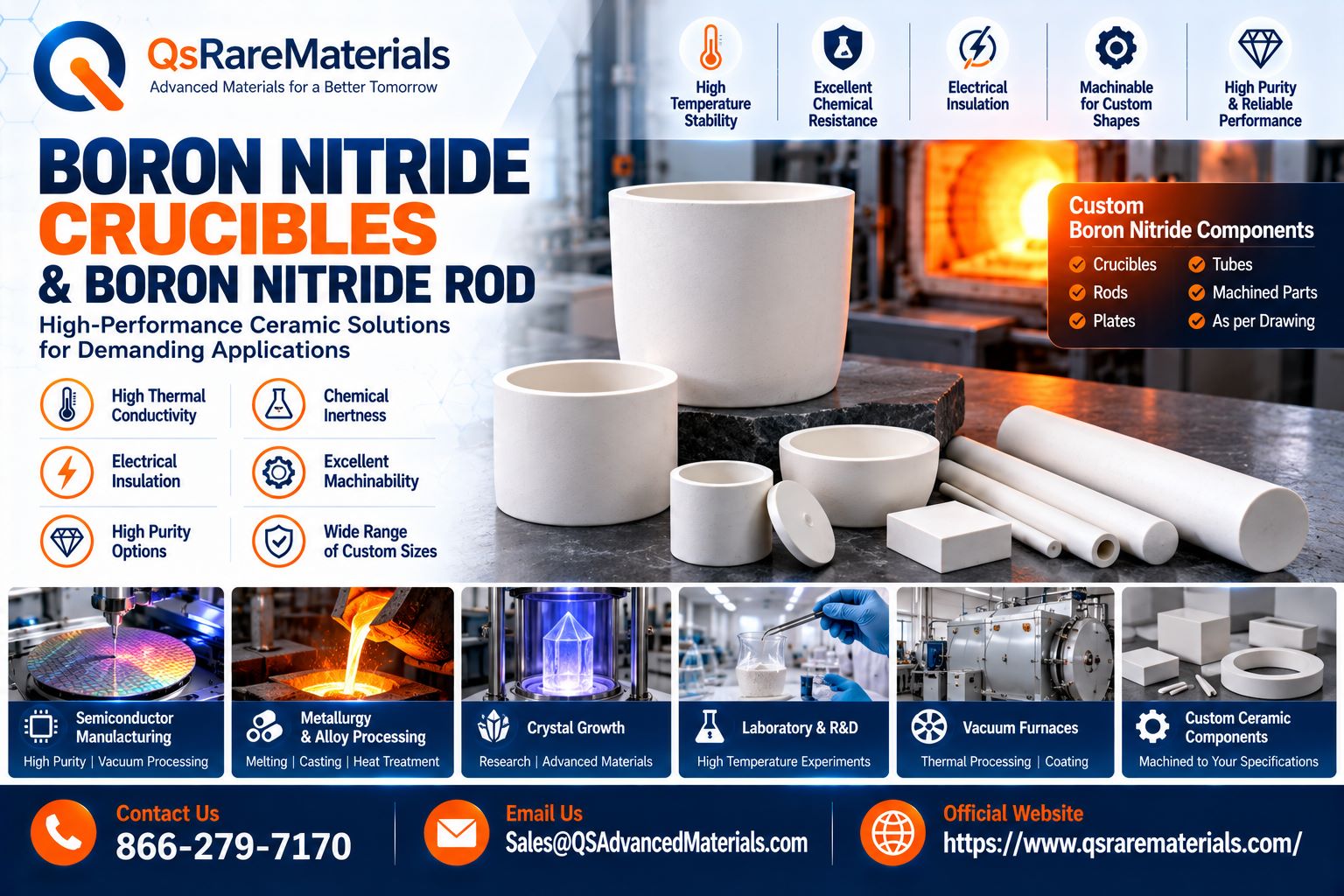
Boron Nitride Crucibles provide specialised ceramic containment options for selected alloy research and thermal processing applications.
Meanwhile, a Boron Nitride Rod can be machined into suitable insulating components, positioning fixtures, and supporting elements for experimental equipment.
These products offer different engineering functions, but both may contribute to reliable material development when their properties match the intended processing conditions.
For metallurgical laboratories, industrial researchers, and advanced materials manufacturers, selecting appropriate ceramic components is an important part of experimental process design.
Why Experimental Alloy Development Requires Specialised Equipment
Alloy development involves studying how combinations of metallic elements influence properties such as strength, corrosion resistance, hardness, and thermal behaviour.
Laboratories may prepare small experimental batches before evaluating whether a composition is suitable for further development.
However, the processing environment can influence experimental results.
Unwanted reactions between molten materials and containment vessels may alter the intended composition.
Inconsistent heating or cooling can also affect the resulting microstructure.
This makes suitable laboratory equipment and processing materials essential.
What Are Boron Nitride Crucibles?
Boron Nitride Crucibles are specialised ceramic containers manufactured using appropriate boron nitride materials.
Depending on their grade and construction, they may provide useful thermal characteristics and chemical compatibility for selected laboratory applications.
Hexagonal boron nitride is recognised for electrical insulation and distinctive thermal properties.
Certain grades may also offer limited wetting by particular molten materials.
However, compatibility varies significantly with alloy composition, temperature, and processing atmosphere.
Researchers should therefore verify whether the selected crucible is appropriate for the specific metal system under investigation.
Understanding the Purpose of a Boron Nitride Rod
A Boron Nitride Rod is a solid technical ceramic component available for direct use or machining into specialised parts.
Depending on its grade, it may be used to manufacture spacers, insulating supports, locating features, and compatible thermal processing fixtures.
These components can help researchers organise equipment assemblies and maintain appropriate separation between selected parts.
However, boron nitride ceramics are generally brittle compared with metals.
Mechanical loads, component dimensions, and operating temperatures must be considered during design.
Crucible Selection and Alloy Composition
Experimental alloy development often requires precise control over the elements included in a sample.
A containment material that reacts with the molten alloy may introduce impurities or affect the composition.
This can interfere with subsequent testing.
Researchers should evaluate the chemical behaviour of the crucible under actual processing conditions.
The presence of reactive alloying elements, elevated temperatures, or certain atmospheres can influence compatibility.
Representative compatibility trials help identify potential problems before critical experiments.
How Thermal Conditions Influence Alloy Research
Temperature control is essential during experimental melting and solidification.
Different alloy compositions may have different melting ranges and cooling characteristics.
Crucible geometry can affect how materials receive and release heat.
For example, wall thickness and container dimensions may influence the thermal response of an experimental batch.
Ceramic supports can also affect component positioning within a furnace.
However, these components do not replace appropriate temperature measurement and process control.
Researchers should verify the thermal conditions experienced by the material being studied.
Comparing Ceramic Components for Alloy Research
| Evaluation Factor | Boron Nitride Crucibles | Boron Nitride Rod |
| Main Function | Containing compatible experimental materials | Supporting or insulating suitable equipment parts |
| Product Geometry | Hollow ceramic vessel | Solid ceramic stock |
| Important Requirement | Chemical compatibility | Mechanical and thermal suitability |
| Engineering Consideration | Capacity and wall dimensions | Diameter, length, and positioning |
| Typical Limitation | Reactions with incompatible materials | Brittleness under mechanical loading |
| Quality Priority | Material purity and surface integrity | Grade consistency and dimensional accuracy |
The appropriate component depends on the intended function within the experimental assembly.
Why Controlled Atmospheres Matter
Alloy processing may require vacuum, inert gas, or another specifically controlled atmosphere.
The atmosphere can influence oxidation, chemical reactions, and material behaviour.
Boron nitride performance also depends on environmental conditions.
In particular, elevated-temperature exposure to oxygen can limit the suitability of certain boron nitride grades.
Researchers should confirm material specifications for the actual furnace atmosphere.
A ceramic component that performs acceptably under one set of conditions may not provide the same results in another.
Maintaining Consistency Across Experimental Batches
Reliable alloy development often requires comparison between different experimental samples.
If containment geometry, loading arrangements, or processing conditions vary, interpreting results can become more difficult.
Laboratories should document relevant material grades, crucible dimensions, sample quantities, and approved operating conditions.
Where appropriate, consistent ceramic fixtures may help maintain repeatable component positioning.
However, controlled procedures should always be supported by suitable analytical measurements.
Clear documentation helps researchers distinguish genuine material differences from experimental variation.
Evaluating Solidified Alloy Samples
After thermal processing, researchers may examine the physical and chemical characteristics of the resulting material.
Suitable evaluation methods can include chemical composition analysis, microscopy, hardness testing, or other application-specific measurements.
The selection of testing methods depends on the research objective.
Researchers should also inspect the processing container for unexpected reactions, cracking, or deposits.
These observations may reveal whether the ceramic component remains appropriate for further experiments.
Sample results and container condition should be considered together.
Custom Components for Metallurgical Equipment
Standard laboratory ceramic dimensions may not suit every experimental furnace.
Some researchers require crucibles with specific capacities or internal geometries.
Others may need customised ceramic spacers or fixture components.
Suitable boron nitride grades may offer manufacturing flexibility, subject to material and machining limitations.
However, complex shapes and narrow sections can introduce structural weaknesses.
Clear technical drawings, dimensional tolerances, and operating requirements are important when ordering customised products.
Choosing a Reliable Technical Ceramic Supplier
Industrial buyers and research institutions should evaluate:
- Material Grade: Confirm composition, purity, and relevant properties.
- Chemical Compatibility: Consider the intended alloy and processing atmosphere.
- Component Dimensions: Verify capacity, geometry, and machining tolerances.
- Thermal Requirements: Review operating temperatures and relevant limitations.
- Quality Inspection: Establish acceptable surface and dimensional conditions.
- Technical Documentation: Request appropriate material specifications and product information.
A supplier evaluation should focus on engineering suitability rather than general material descriptions.
Frequently Asked Questions (FAQs)
1. What are Boron Nitride Crucibles used for?
They are specialised ceramic containers used in selected laboratory experiments, thermal processing operations, and advanced materials research.
2. What is a Boron Nitride Rod?
It is a solid technical ceramic product that may be machined into insulating components, spacers, supporting fixtures, and other engineering parts.
3. Can boron nitride crucibles be used for alloy melting?
Certain grades may be suitable for selected alloy systems, depending on chemical compatibility, temperature, and atmosphere.
4. Why is crucible material important in metallurgical research?
Unsuitable containment materials can react with experimental substances or introduce contamination, potentially influencing research results.
5. How should laboratories select boron nitride components?
They should evaluate material grade, purity, geometry, thermal conditions, chemical compatibility, and relevant supplier documentation.
Media Contact
Department: Advanced Ceramic Materials and Metallurgical Research Enquiries
Phone: 866-279-7170
Email: Sales@QSAdvancedMaterials.com
Official Website: https://www.qsrarematerials.com/