Advanced materials laboratories are placing greater emphasis on sample recovery as researchers work with valuable substances that require careful handling during thermal processing.
In semiconductor material development, crystal growth experiments, and specialised chemical research, successful processing involves more than achieving the required temperature. Researchers must also consider how materials are contained, protected, and recovered after processing.
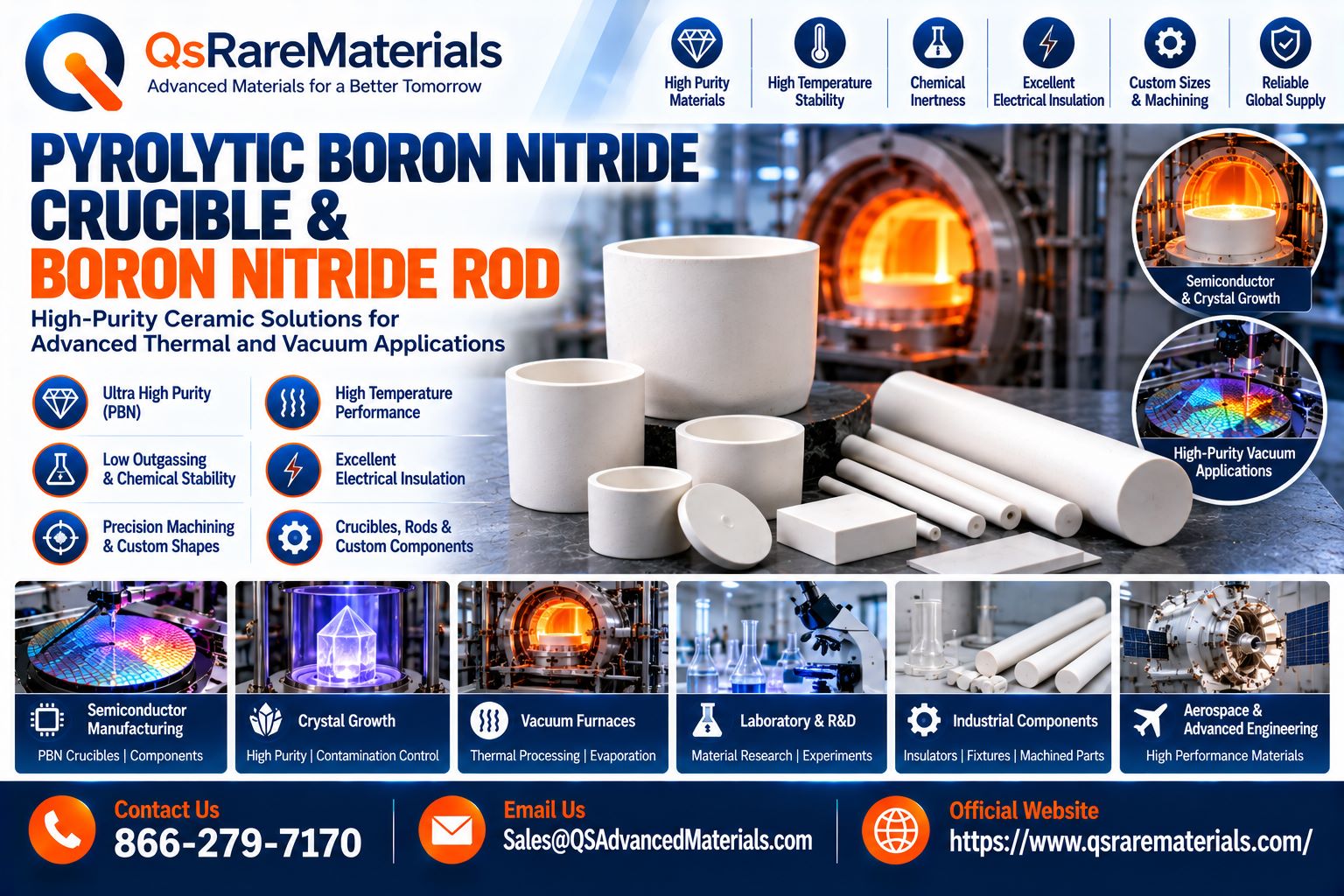
A Pyrolytic Boron Nitride Crucible provides a specialised ceramic container for selected high-purity thermal applications where its material properties are compatible with the process.
Meanwhile, a Boron Nitride Rod can be machined into suitable ceramic supports, spacers, and positioning components for technical equipment.
Together, these products offer opportunities for improving laboratory handling arrangements, minimising avoidable material damage, and supporting consistent experimental procedures.
Why Sample Recovery Matters in Advanced Materials Research
Specialised research materials may be expensive, difficult to prepare, or available only in limited quantities.
Losing material during processing or removal can therefore affect project costs and experimental progress.
Sample recovery depends on several factors, including container geometry, chemical compatibility, processing atmosphere, and handling procedures.
An unsuitable container may allow unwanted reactions or make material removal unnecessarily difficult.
Researchers should consider sample recovery requirements during equipment design rather than treating them as an afterthought.
What Is a Pyrolytic Boron Nitride Crucible?
A Pyrolytic Boron Nitride Crucible is a specialised ceramic container generally manufactured using chemical vapour deposition technology.
Pyrolytic boron nitride, commonly known as PBN, is valued for its high purity, electrical insulation characteristics, and distinctive thermal properties.
Its layered structure creates anisotropic behaviour, meaning certain physical properties vary according to material direction.
PBN crucibles may be considered for compatible thermal processing applications involving controlled atmospheres or vacuum equipment.
However, suitability depends on temperature, chemical exposure, geometry, and operating conditions.
No crucible material should be considered universally resistant to every molten substance.
Understanding the Function of a Boron Nitride Rod
A Boron Nitride Rod is a solid technical ceramic component available for specialised engineering applications.
Depending on its grade, the material can be machined into spacers, insulating elements, positioning fixtures, and custom support components.
These parts may help maintain the intended arrangement of equipment within compatible processing systems.
However, boron nitride rods are not necessarily manufactured using the same process as pyrolytic ceramic crucibles.
Material composition, density, additives, and mechanical characteristics can differ.
Engineers should therefore assess each component independently.
How Crucible Design Influences Material Recovery
Container geometry can affect how processed samples are accessed and removed.
A narrow opening may limit access to the contents, while a broader design may offer different handling possibilities.
Internal wall geometry, capacity, and component stability also require evaluation.
For certain material systems, appropriate ceramic surfaces may reduce unwanted interaction between the sample and its container.
However, non-wetting or release behaviour must be verified for the actual material and processing conditions.
A carefully specified crucible can help researchers plan suitable recovery procedures without assuming that every sample will separate easily.
Reducing Cross-Contamination During Sample Handling
Cross-contamination occurs when unwanted material from another source enters a sample or processing environment.
Potential sources include handling tools, previous processing residues, storage conditions, and damaged equipment surfaces.
High-purity ceramic components may help reduce selected contamination risks when their chemistry is compatible with the application.
However, material purity alone cannot guarantee a contamination-free experiment.
Laboratories should establish suitable cleaning and handling practices according to the substances involved.
Comparing Ceramic Components in Sample Processing
| Evaluation Factor | Pyrolytic Boron Nitride Crucible | Boron Nitride Rod |
| Main Function | Material containment | Support and positioning |
| Typical Form | Hollow ceramic vessel | Solid ceramic stock |
| Design Priority | Internal geometry and purity | Dimensions and mechanical suitability |
| Sample Handling Role | Holds compatible processing materials | Supports suitable fixture arrangements |
| Important Limitation | Chemical and atmosphere compatibility | Brittle mechanical behaviour |
| Quality Requirement | Surface integrity | Dimensional and structural accuracy |
Both components can contribute to a carefully engineered processing arrangement, although their functions remain different.
Why Cooling Conditions Affect Sample Integrity
Cooling is an important part of many thermal processing operations.
Different materials contract at different rates as temperature decreases.
When a processed sample and its container experience incompatible dimensional changes, mechanical stresses may develop.
These stresses can contribute to cracking or difficulties during sample recovery.
Researchers should evaluate thermal expansion behaviour, component geometry, and approved cooling requirements.
Rapid temperature changes may also affect ceramic integrity, depending on the material and conditions.
Suitable process validation helps determine whether a recovery method preserves the sample and equipment.
Designing Fixtures for Stable Processing
Positioning fixtures can support containers and related components during specialised thermal operations.
Suitable ceramic spacers or supports may help maintain clearances and prevent unintended contact between compatible equipment parts.
Machined boron nitride rods can provide options for selected insulating or positioning requirements.
However, ceramic supports should not be subjected to mechanical loads beyond their design capabilities.
Engineers must consider contact pressure, thermal expansion, and fixture stability.
Careful design helps avoid component displacement and unnecessary mechanical damage.
Improving Laboratory Workflow Consistency
Repeatable experiments depend on consistent preparation and handling.
Researchers should document approved container dimensions, material specifications, loading arrangements, and sample recovery procedures.
Visual inspection can help identify chipped surfaces, cracks, contamination, or other concerns before equipment use.
Where necessary, recovered samples should undergo appropriate analytical evaluation to confirm whether processing requirements were achieved.
Consistent documentation also makes it easier to investigate unexpected results.
Standardised procedures support better communication between laboratory teams without replacing scientific judgement.
Custom Ceramic Components for Specialised Research
Standard ceramic products may not satisfy every experimental requirement.
Some laboratories need crucibles with specific cavity dimensions, while others require machined supports designed around existing equipment.
Customisation can address these requirements where manufacturing methods permit.
However, complex geometries can introduce fabrication challenges and mechanical limitations.
Buyers should communicate drawings, tolerances, operating atmospheres, and relevant chemical conditions before ordering specialised components.
Representative samples can help verify suitability before broader use.
Frequently Asked Questions (FAQs)
1. What is a Pyrolytic Boron Nitride Crucible?
It is a high-purity technical ceramic container generally manufactured through chemical vapour deposition for selected specialised thermal processing applications.
2. What is a Boron Nitride Rod used for?
It may be machined into ceramic spacers, supports, insulating components, and specialised fixtures for compatible engineering applications.
3. Can PBN crucibles help with sample recovery?
They may offer useful containment and surface properties for certain materials, but actual recovery performance depends on chemical compatibility and processing conditions.
4. Are boron nitride ceramics suitable for every high-temperature environment?
No. Temperature, atmosphere, material grade, and chemical exposure determine suitability.
5. How should laboratories select boron nitride components?
They should evaluate material purity, component dimensions, thermal requirements, chemical compatibility, mechanical loading, and supplier documentation.
Media Contact
Department: Advanced Ceramic Materials and Technical Product Enquiries
Phone: 866-279-7170
Email: Sales@QSAdvancedMaterials.com
Official Website: https://www.qsrarematerials.com/