
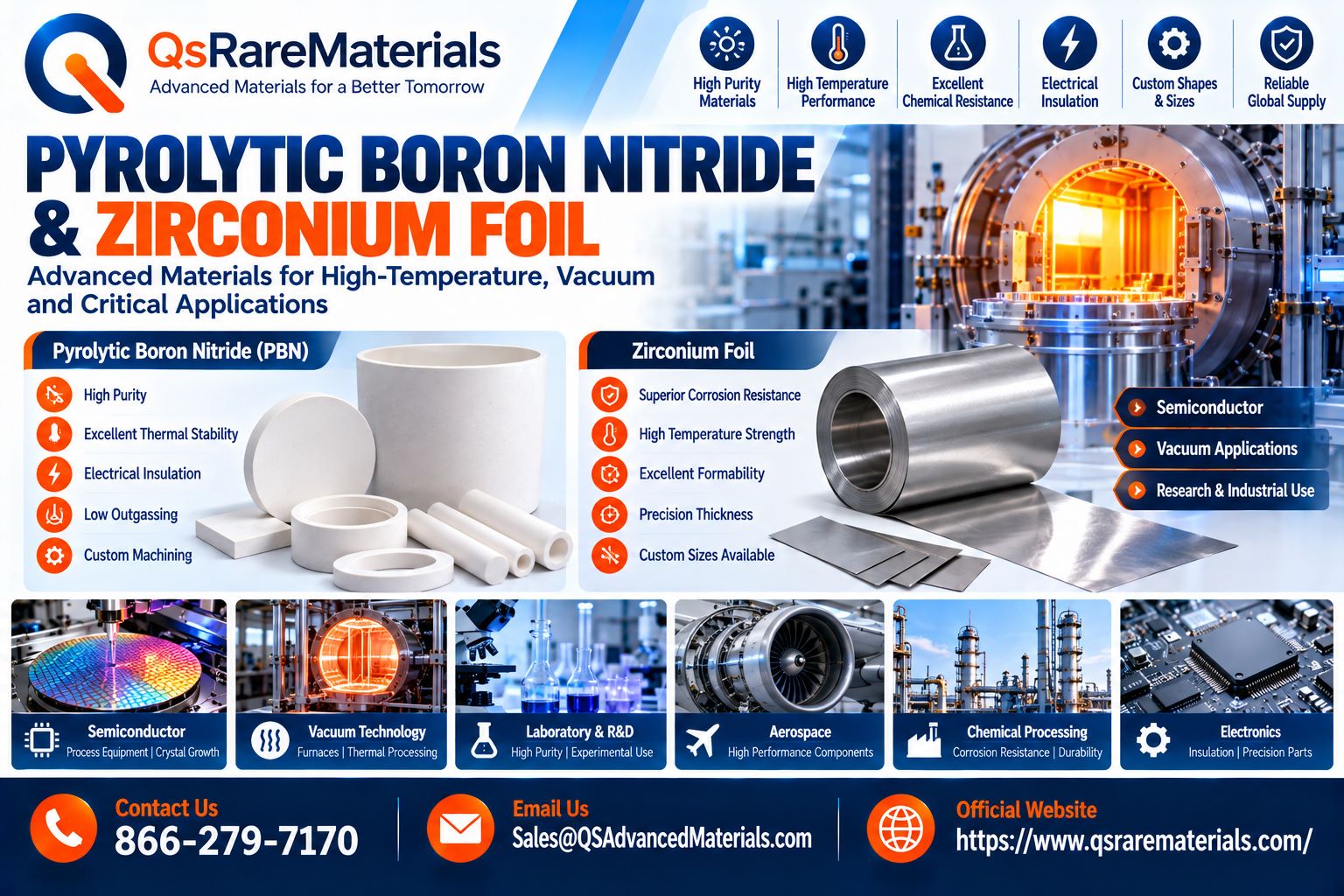
Chemical processing equipment, specialised sensors, research instruments, and experimental material systems require careful evaluation before new materials enter practical applications.
Pyrolytic Boron Nitride offers distinctive electrical insulation and thermal properties that may be useful in selected laboratory fixtures and specialised equipment assemblies.
Meanwhile, Zirconium Foil provides a thin metallic material suitable for certain experimental investigations involving corrosion behaviour, surface chemistry, and material compatibility.
Although these materials have different characteristics, both can contribute to well-designed materials testing programmes when their properties match the intended operating conditions.
For laboratory researchers, equipment manufacturers, and industrial engineering teams, understanding their applications can support more accurate testing and informed material selection.
Why Corrosion Testing Matters in Industrial Engineering
Industrial components frequently operate in environments containing moisture, chemicals, elevated temperatures, or other challenging conditions.
These factors can influence material stability and component performance.
Corrosion testing helps engineers understand how selected materials respond to specific environments.
However, reliable results depend on more than the material specimen itself.
Test fixtures, electrical contacts, containers, and handling procedures can influence experimental outcomes.
Carefully selected testing components can help researchers distinguish material behaviour from unwanted experimental interference.
What Is Pyrolytic Boron Nitride?
Pyrolytic Boron Nitride, commonly known as PBN, is a high-purity technical ceramic generally manufactured using chemical vapour deposition.
Its layered structure gives the material distinctive thermal and electrical properties.
PBN is generally electrically insulating and exhibits anisotropic thermal behaviour, meaning some properties vary according to material direction.
These characteristics may support applications involving specialised insulating components, processing vessels, and precision laboratory assemblies.
However, performance depends on temperature, atmosphere, chemical exposure, and component geometry.
PBN should not be considered universally resistant to every corrosive or reactive substance.
Understanding Zirconium Foil
Zirconium Foil is a thin metallic sheet manufactured from zirconium or an appropriately specified zirconium-based material.
Zirconium is recognised for its useful corrosion resistance in certain chemical environments.
However, its behaviour varies substantially depending on the substances involved, temperature, and surface condition.
Thin foil specimens can be useful in controlled laboratory investigations because their geometry allows researchers to examine selected material characteristics.
Depending on experimental requirements, these investigations may involve oxidation, chemical compatibility, or surface changes.
Researchers should use appropriate testing procedures to determine whether zirconium meets the intended application requirements.
The Importance of Electrical Isolation in Testing Equipment
Some materials experiments require electrical isolation between particular components.
An unintended conductive connection can interfere with measurements or create operational problems.
Suitable ceramic insulators may help separate electrically active parts in carefully engineered laboratory fixtures.
PBN can be considered for certain specialised insulation requirements where its physical and chemical properties are appropriate.
Zirconium foil, by contrast, is electrically conductive.
This difference illustrates why the two materials serve separate engineering functions.
Fixture design should therefore account for electrical requirements alongside mechanical and chemical compatibility.
Comparing Their Engineering Characteristics
| Evaluation Factor | Pyrolytic Boron Nitride | Zirconium Foil |
| Material Category | Technical ceramic | Metallic foil |
| Electrical Behaviour | Generally insulating | Conductive |
| Main Engineering Interest | Insulation and thermal properties | Corrosion and surface behaviour |
| Typical Form | Shaped ceramic components | Thin metallic sheets |
| Mechanical Consideration | Brittle characteristics | Thin-sheet deformation |
| Application Limitation | Atmosphere and chemical compatibility | Environment-dependent corrosion and oxidation |
Neither material should be selected solely on the basis of its general material category.
How Specimen Preparation Affects Corrosion Results
Surface preparation is an important part of corrosion testing.
Contamination, scratches, residues, and differences in surface condition can influence experimental results.
When zirconium foil is used as a test specimen, researchers should establish consistent procedures for specimen dimensions, handling, and cleaning.
The prepared surface should reflect the intended experimental method.
PBN components used within a test assembly also require suitable cleanliness and inspection.
Damaged ceramic surfaces or inappropriate fixture materials may introduce unwanted variables.
Consistent specimen preparation supports more reliable comparisons between experimental results.
Evaluating Chemical Compatibility Before Testing
Different chemicals interact with materials in different ways.
A material that performs well in one solution may behave poorly in another.
Zirconium can offer useful corrosion resistance in selected environments, but it is unsuitable to assume resistance across all chemical conditions.
Likewise, PBN’s compatibility depends on the ceramic’s specific operating environment.
Engineers should review chemical concentrations, temperature, exposure conditions, and relevant material specifications.
For critical applications, representative compatibility testing should be performed before approving components for industrial use.
Why Thin Material Geometry Requires Special Attention
Foil thickness influences handling, mechanical stability, and experimental design.
Thin metallic specimens may be vulnerable to bending, scratching, or unintended deformation.
These problems can complicate measurement and specimen positioning.
Researchers should establish appropriate thickness tolerances and handling procedures.
For ceramic fixtures, component geometry also influences mechanical performance.
Sharp corners, narrow sections, and concentrated contact forces may increase the risk of damage.
Careful dimensional planning helps ensure that both metallic specimens and ceramic components remain suitable for their intended tasks.
Material Traceability and Quality Documentation
Reliable research requires confidence that the materials being tested match their stated specifications.
Suppliers may provide relevant information concerning composition, purity, dimensions, and other technical characteristics.
For zirconium foil, grade identification and thickness accuracy may be particularly important.
For PBN, purity, manufacturing method, and component geometry may influence suitability.
Researchers should maintain appropriate identification records for experimental materials.
This helps teams investigate unexpected results and compare different material batches.
Clear documentation also improves communication between research laboratories and industrial suppliers.
Choosing Materials for Specialised Test Fixtures
Before selecting components for experimental equipment, engineers should evaluate:
- Electrical Requirements: Determine whether insulation or conductivity is needed.
- Chemical Compatibility: Assess the intended testing environment.
- Temperature Conditions: Review relevant thermal limitations.
- Dimensional Accuracy: Specify component geometry and tolerances.
- Mechanical Suitability: Consider specimen handling and fixture stresses.
- Material Documentation: Request relevant specifications and inspection information.
A practical engineering review can help prevent unsuitable material combinations.
Frequently Asked Questions (FAQs)
1. What is Pyrolytic Boron Nitride?
Pyrolytic boron nitride is a high-purity technical ceramic generally produced through chemical vapour deposition and used in selected thermal and electrical applications.
2. What is Zirconium Foil used for?
Zirconium foil may be used in specialised research involving metallic properties, corrosion behaviour, surface chemistry, and experimental material development.
3. Is pyrolytic boron nitride electrically insulating?
Yes. PBN generally offers electrical insulation, although performance must be evaluated under the intended operating conditions.
4. Is zirconium foil resistant to corrosion?
Zirconium can provide useful corrosion resistance in certain environments, but compatibility depends on specific chemicals, temperatures, and exposure conditions.
5. How should laboratories select advanced ceramic and metallic materials?
Laboratories should evaluate composition, purity, dimensions, electrical properties, chemical compatibility, safety requirements, and supplier documentation.
Media Contact
Department: Advanced Ceramics and Specialty Metal Materials Enquiries
Phone: 866-279-7170
Email: Sales@QSAdvancedMaterials.com
Official Website: https://www.qsrarematerials.com/