
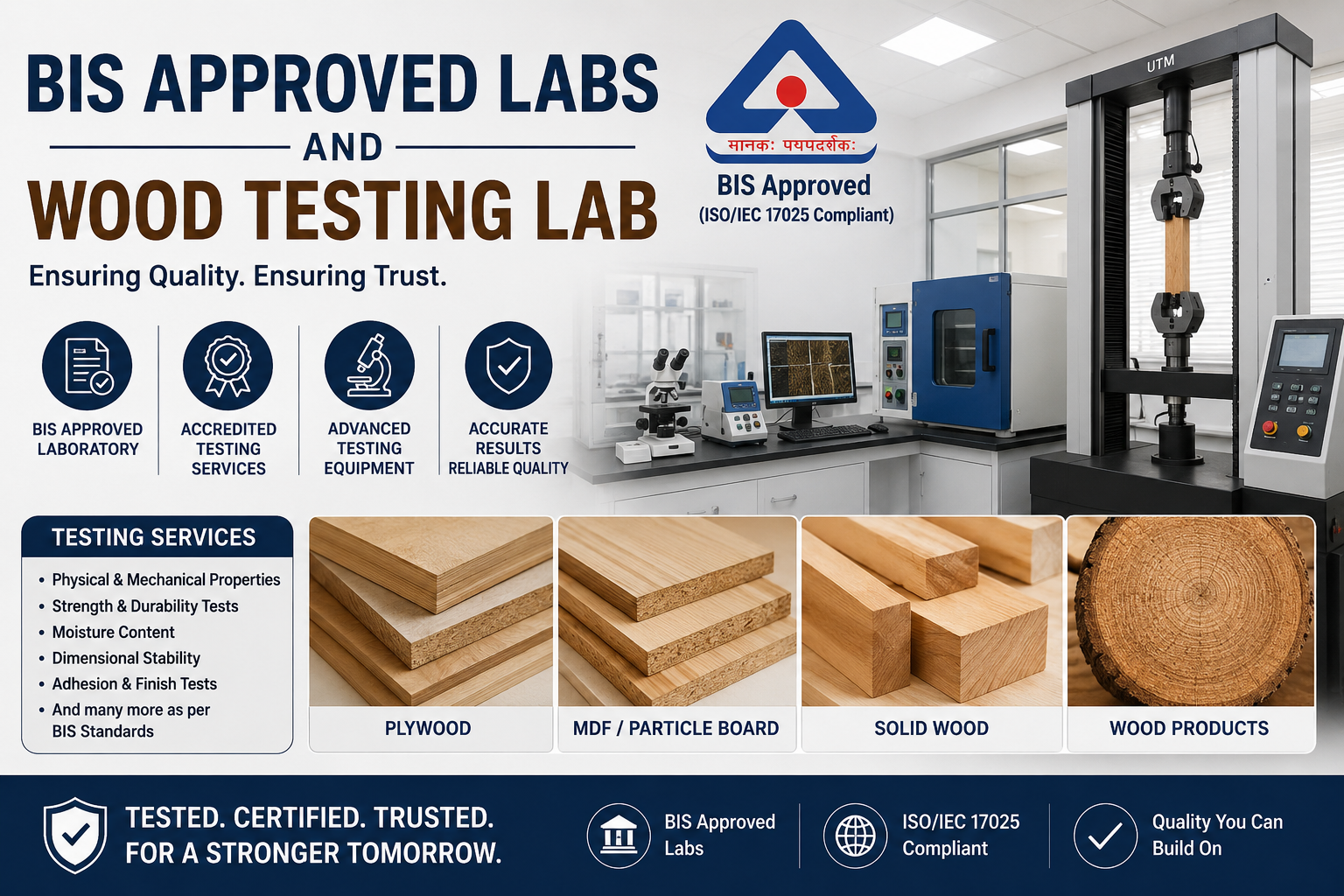
A wooden product can have a smooth finish, attractive grain and premium appearance and still fail to deliver the expected performance. Hidden moisture, inconsistent density, weak bonding or insufficient mechanical strength may not become apparent until the product has already been manufactured, installed or sold.
For manufacturers and buyers, discovering these problems at a later stage can mean rejected materials, production delays, customer complaints and replacement costs.
This is where scientific testing makes a difference. BIS approved Labs and a competent Wood Testing lab provide measurable information that helps businesses understand the actual quality and performance of timber and wood-based products before important decisions are made.
The Hidden Quality Challenges in Wood Products
Unlike a highly uniform manufactured material, natural wood can vary considerably from one piece to another. Its properties are influenced by species, moisture, grain orientation, storage conditions, processing and environmental exposure.
Engineered products introduce additional factors. Plywood, block board, particle board and fibreboard depend on manufacturing processes, adhesives, pressure, temperature and raw material consistency.
Common quality concerns can include:
- Excessive moisture
- Dimensional changes
- Low mechanical strength
- Poor bonding
- Excessive water absorption
- Thickness variation
- Swelling
- Inconsistent density
- Surface or internal defects
Some problems are visible. Others require controlled laboratory testing to identify.
Where Do BIS Approved Labs Fit Into Quality Assessment?
When products are manufactured according to an Indian Standard or are involved in an applicable BIS conformity assessment process, laboratory testing can become an important requirement.
The phrase BIS approved Labs is commonly used when businesses search for facilities capable of BIS-related testing. However, manufacturers should not select a laboratory based solely on this description.
The important question is whether the laboratory has the appropriate current recognition and scope for the particular product and Indian Standard.
For example, the fact that a laboratory can test one type of wood-based board does not automatically mean that it can perform every test required for another type of plywood, timber or door.
Scope verification should therefore be completed before samples are dispatched.
What Can a Wood Testing Lab Tell You About Your Material?
A professional Wood Testing lab provides objective technical data about wood and wood-based products.
Depending on the product and applicable testing method, laboratory analysis may examine several characteristics.
Moisture Behaviour
Wood interacts naturally with moisture in its surroundings. If moisture conditions change, wood can expand, contract or experience dimensional movement.
Moisture testing can therefore be important for manufacturers of furniture, timber products, doors, flooring and other applications where dimensional consistency matters.
Density and Physical Properties
Density can provide useful information about material consistency and physical characteristics.
Laboratories may also assess:
- Dimensions
- Thickness
- Water absorption
- Thickness swelling
- Dimensional stability
- Other product-specific physical characteristics
Results can be compared against relevant specifications or used for internal quality-control purposes.
Mechanical Performance
Wood products may experience bending, compression, tension, impact or shear during their service life.
Depending on the product, a Wood Testing lab may evaluate parameters such as:
- Bending strength
- Compression strength
- Tensile characteristics
- Shear strength
- Modulus of rupture
- Modulus of elasticity
- Impact performance
- Fastener holding characteristics
Testing Should Match Real Product Requirements
More testing is not automatically better.
The right approach is to identify the product’s intended use and applicable specification, then determine which tests provide meaningful information.
Why Plywood and Boards Need Special Attention
Engineered wood products are manufactured rather than simply cut from natural timber.
Consider plywood. Multiple veneers are arranged and bonded together to create a panel. The performance of the finished product therefore depends on raw material quality as well as manufacturing and bonding.
Particle boards and fibreboards have their own manufacturing processes and performance characteristics.
A suitable laboratory may evaluate parameters related to dimensions, moisture, density, strength, swelling, bonding or other characteristics specified for the product.
This is why one generic test report cannot represent every wood-based material.
Testing Before Purchase vs Testing After a Problem
There are two ways businesses often approach laboratory testing.
| Reactive Approach | Preventive Approach |
| Test after receiving complaints | Test before large-scale supply |
| Investigate rejected products | Verify incoming materials |
| Identify reasons for failure | Monitor production consistency |
| Test after customer disputes | Establish internal quality benchmarks |
| Higher disruption potential | Better opportunity for early correction |
Preventive testing generally provides businesses with more useful information because corrective action can be taken before problematic materials move further through the supply chain.
How Wood Testing Supports Manufacturers
Manufacturers can use laboratory results for much more than regulatory documentation.
Suppose a plywood company receives veneers or raw materials from multiple suppliers. Production appears consistent, but finished boards from certain batches show different performance.
Laboratory comparison can help determine whether measurable differences exist between those batches.
The manufacturer can then investigate areas such as:
- Raw material variation
- Moisture control
- Storage conditions
- Supplier consistency
- Manufacturing parameters
- Finished-product quality
Testing creates a factual basis for quality decisions instead of depending entirely on assumptions.
How Buyers Can Benefit from Independent Testing
Wood testing is equally useful for procurement teams, contractors, furniture companies and institutional buyers.
Large purchases may involve significant quantities of timber, plywood, boards or finished components. Product specifications can be incorporated into purchasing requirements, followed by appropriate inspection and testing where necessary.
Independent evaluation can help buyers determine whether supplied materials match agreed technical requirements.
For procurement purposes, testing can support:
- Supplier qualification.
- Pre-dispatch inspection programmes.
- Incoming material verification.
- Batch comparison.
- Investigation of disputed materials.
- Performance-based purchasing decisions.
BIS Approved Labs or General Wood Testing Lab: Which One Is Needed?
| Requirement | Preferred Approach |
| BIS-related conformity testing | Verify suitable BIS approved Labs/recognised laboratory |
| Routine factory quality control | Competent Wood Testing lab |
| Supplier comparison | Wood/material testing laboratory |
| Product development | Laboratory with relevant technical facilities |
| Customer specification testing | Laboratory covering specified test method |
| Indian Standard testing | Verify laboratory scope for relevant IS |
The purpose of testing should therefore be established first.
What to Ask Before Sending Wood Samples
Choosing the correct laboratory can prevent unnecessary delays and repeated testing.
Ask the laboratory:
- Do you test this specific wood product?
- Which standards are covered?
- Is the required Indian Standard within your current scope?
- Which parameters can you test?
- How many specimens are required?
- What sample dimensions are needed?
- Does the sample require conditioning?
- What information must accompany the sample?
- What will appear in the final test report?
- What is the expected testing period?
Never Assume Recognition Covers Everything
Recognition or accreditation generally applies to defined scopes. Always verify that the exact testing requirement is covered.
FAQs About BIS Approved Labs and Wood Testing Lab
1. Why should wood products be laboratory tested?
Laboratory testing provides measurable information about physical, mechanical and performance characteristics that may not be apparent through visual inspection.
2. What is a Wood Testing lab?
A Wood Testing lab is a specialised facility that evaluates timber and wood-based products according to specified testing procedures.
3. What are BIS approved Labs?
BIS approved Labs is a commonly used search term for laboratories associated with BIS-related testing. Their exact recognition and testing scope should be verified before use.
4. Can solid timber be tested?
Yes. Depending on requirements, timber can be evaluated for moisture, density, mechanical characteristics and other relevant properties.
5. Is plywood testing different from timber testing?
Yes. Plywood is an engineered product, so applicable testing can include characteristics associated with the manufactured panel and bonding in addition to physical and mechanical properties.
6. Can particle board be laboratory tested?
Yes. Particle boards and other engineered boards can be evaluated according to relevant specifications and available laboratory capabilities.
7. Why is moisture content important?
Moisture can affect dimensions and performance, making moisture control an important consideration for many wood products.
8. Are all Wood Testing labs recognised by BIS?
No. Testing capability and BIS recognition are different. Current laboratory recognition and scope should be independently confirmed where BIS-related testing is required.
9. Can laboratory testing help compare suppliers?
Yes. Testing equivalent samples using consistent methods can provide objective data that supports supplier evaluation.
10. What samples should be submitted?
Sample dimensions, quantity and preparation depend on the product and test method. Requirements should be confirmed with the laboratory beforehand.
https://newsgrow.blogspot.com/2026/08/chemical-testing-lab-in-delhi-and-water.html
https://newsgrow.blogspot.com/2026/08/bis-approved-labs-and-wood-testing-lab.html