
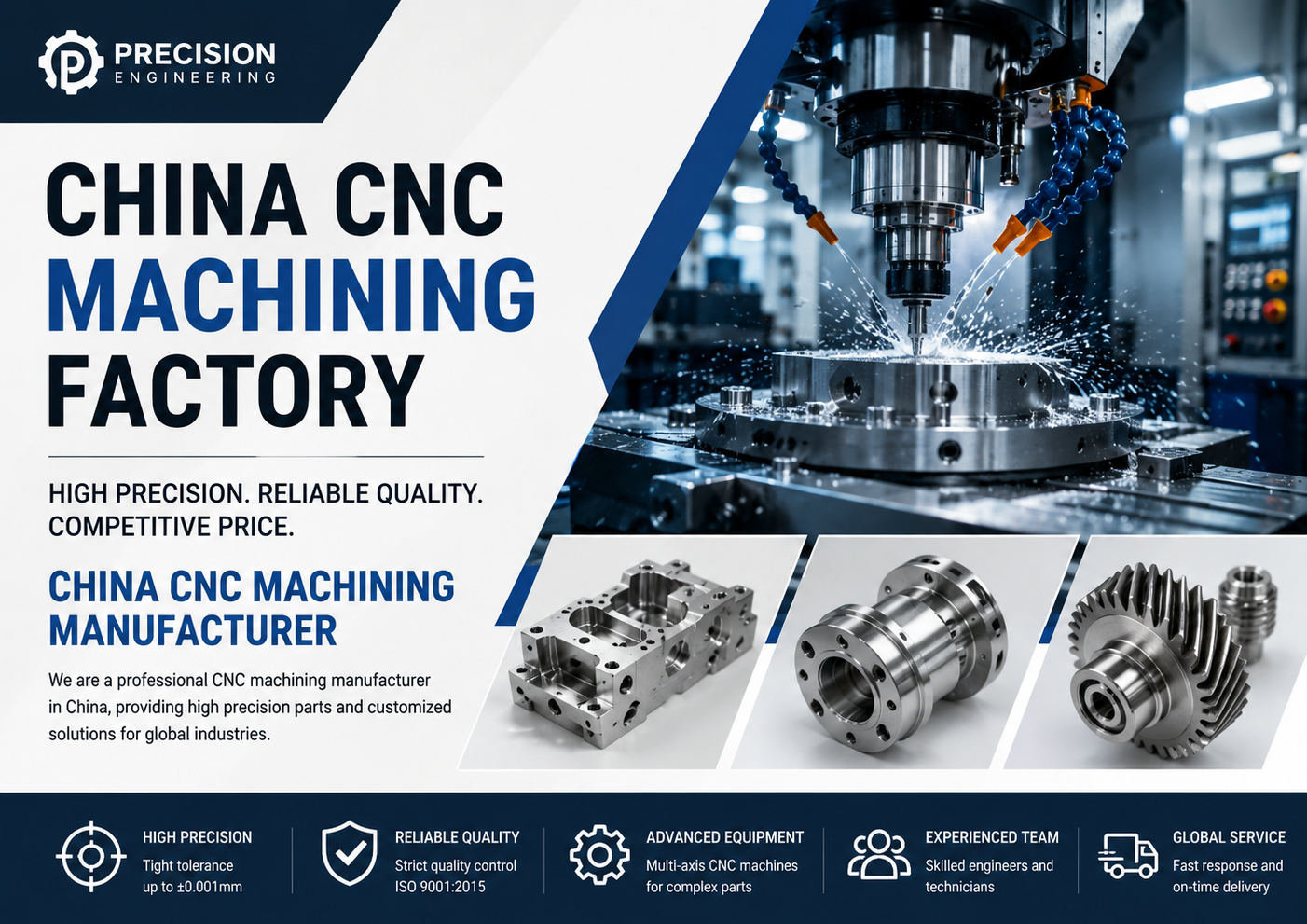
Product development used to follow a relatively predictable path: create a design, build tooling, manufacture samples, make corrections and eventually move into production. Today, companies often need to complete that journey much faster.
Shorter product cycles, customised components and increasingly complex designs have changed what manufacturers expect from their suppliers. Precision machining has become an important part of this transition, particularly when businesses need functional prototypes or custom components without committing immediately to dedicated production tooling.
This changing environment has also increased international interest in finding an experienced china cnc machining factory capable of supporting both development work and ongoing manufacturing.
But what exactly is driving this shift, and what should businesses understand about China’s CNC machining sector?
The Growing Role of CNC Machining in Product Development
CNC machining uses computer-controlled equipment to remove material from a solid workpiece until the required geometry is achieved.
While the technology itself is well established, its role in modern product development continues to expand.
CNC machining can be particularly useful when a company needs:
- Functional prototypes
- Custom mechanical components
- Engineering test parts
- Replacement components
- Low-volume production
- Production tooling
- Complex metal parts
- Precision plastic components
Unlike processes that require dedicated moulds or dies, CNC machining can often begin from digital design data and prepared raw material.
That makes it especially relevant during development stages where designs may still change.
From Digital Model to Physical Component
One of the most significant developments in manufacturing is the increasingly direct connection between digital engineering and physical production.
Designers create components using CAD software. Those designs can then be reviewed for manufacturability before machining programs and toolpaths are prepared.
A professional china cnc machining manufacturer may receive both 3D CAD data and detailed engineering drawings.
The CAD model describes the component’s geometry, while the engineering drawing can specify important manufacturing information such as:
- Dimensional tolerances
- Threads
- Material grade
- Surface roughness
- Geometric tolerances
- Finishing requirements
- Critical dimensions
This information provides the bridge between design intent and actual manufacturing.
Why China’s Manufacturing Ecosystem Matters
CNC machining does not operate in isolation.
A machined component may require raw material, specialist cutting tools, heat treatment, anodising, plating, grinding, laser marking, assembly or custom packaging before it is ready for use.
China’s established manufacturing regions contain extensive networks of companies supporting these processes.
For an international buyer, access to a broader industrial ecosystem can simplify the development of components requiring several manufacturing stages.
This is one reason companies may choose a china cnc machining factory instead of evaluating machining capability alone.
The supporting supply chain can be just as important as the machines themselves.
Where CNC Machining Fits Among Manufacturing Technologies
CNC machining is only one method of producing components. Its suitability depends on the project.
| Manufacturing Method | Common Application | Key Consideration |
| CNC Machining | Precision prototypes and production parts | No mould usually required |
| Injection Moulding | High-volume plastic components | Requires tooling |
| Die Casting | Volume metal components | Initial tooling investment |
| 3D Printing | Prototypes and complex geometries | Material/process limitations |
| Sheet Metal Fabrication | Panels, covers and enclosures | Best suited to sheet designs |
There is no universally superior manufacturing process.
For example, injection moulding may become economically attractive for large quantities of plastic components, while CNC machining may be more practical for lower quantities or components requiring machining from engineering-grade stock.
Manufacturing decisions should therefore be based on design, material, quantity, tolerance and application.
Multi-Axis Technology Is Enabling More Complex Designs
Traditional machining often required a workpiece to be manually repositioned several times.
Modern multi-axis equipment can reduce this limitation.
Three-axis machines remain highly useful for many conventional parts, while four-axis and five-axis systems provide additional movement.
Five-axis machining is particularly valuable for components containing complicated angles, curved surfaces or features located on multiple sides.
Reducing the number of setups can potentially improve manufacturing efficiency and minimise errors caused by repeated repositioning.
However, advanced equipment should not be used simply because it is available. A skilled china cnc machining manufacturer selects machinery according to the actual engineering requirements.
Material Choice Is Becoming More Application-Specific
Modern products increasingly combine materials according to specific performance requirements.
CNC machining supports a broad range of metals and engineering plastics.
Common metals include:
- Aluminium alloys
- Stainless steel
- Carbon steel
- Brass
- Copper
- Titanium
Common engineering plastics include:
- POM
- Nylon
- PTFE
- PEEK
- ABS
- Acrylic
Material selection can influence strength, weight, thermal behaviour, corrosion resistance, electrical properties and component cost.
It also affects manufacturing.
A material that is easy to machine may require less production time than one that creates excessive heat, rapidly wears cutting tools or requires conservative cutting parameters.
Design for Manufacturing Is Becoming More Important
A component can be technically possible to manufacture while still being unnecessarily expensive.
This distinction is central to Design for Manufacturing, commonly known as DFM.
Imagine a designer specifies a deep, narrow pocket with extremely small internal corner radii. Manufacturing that feature may require small cutting tools, long machining cycles and conservative cutting speeds.
Increasing the corner radius could potentially allow a larger tool to be used.
Similar opportunities exist throughout component design.
Useful DFM considerations include:
- Avoid unnecessary deep cavities.
- Use standard hole and thread sizes where possible.
- Specify realistic internal radii.
- Limit tight tolerances to functional features.
- Consider tool access during component design.
- Avoid unnecessarily thin walls.
Early communication between designer and manufacturer can reveal these opportunities before production begins.
Precision Does Not Mean Making Every Dimension Extremely Tight
A common misconception is that tighter tolerances automatically indicate higher-quality engineering.
In reality, tolerance should match function.
If a non-critical external dimension can vary slightly without affecting performance, imposing an extremely restrictive tolerance may provide no practical benefit.
Conversely, dimensions controlling bearings, seals, shafts or mating components may genuinely require precise control.
A technically capable china cnc machining factory should understand which dimensions are critical and establish suitable inspection procedures around them.
Precision manufacturing is therefore about controlled accuracy where accuracy actually matters.
Quality Control Is Becoming More Data-Driven
Inspection has always been part of manufacturing, but modern quality control increasingly relies on measurable records rather than subjective judgement.
Depending on the project, CNC components can be inspected using:
- Micrometers
- Calipers
- Height gauges
- Thread gauges
- Bore gauges
- Optical measuring equipment
- Surface roughness testers
- Coordinate measuring machines
Inspection may occur during production as well as after machining.
For repeated orders, maintaining consistent inspection methods can also help identify process changes before they create larger production problems.
Why Prototypes Remain Important
Digital simulation has improved significantly, but physical prototypes continue to provide valuable information.
A prototype allows engineers to test actual fit, movement, assembly and handling.
For example, a component may appear correct in CAD but become difficult to assemble because there is insufficient access for a tool or fastener.
Prototype machining can identify these practical problems before production quantities increase.
It also gives buyers an opportunity to evaluate the manufacturing capability of a new supplier.
What Will Matter Most in Future CNC Sourcing?
As global manufacturing continues to develop, purchasing decisions are likely to become increasingly focused on capability rather than price alone.
Companies evaluating a china cnc machining manufacturer should consider:
- Engineering communication
- CNC equipment
- Material expertise
- Inspection technology
- DFM support
- Prototype capability
- Production scalability
- Surface finishing
- Documentation
- Supply-chain reliability
The manufacturer that offers the lowest initial unit price may not necessarily provide the lowest overall project cost.
Consistency, reduced rework and dependable delivery can be equally important.
Frequently Asked Questions
1. What does a China CNC machining factory do?
A china cnc machining factory manufactures custom components from digital designs and technical drawings using computer-controlled machine tools.
2. Is CNC machining suitable for new product development?
Yes. It is frequently used for functional prototypes, engineering samples and low-volume components during product development.
3. What is CNC milling?
CNC milling uses rotating cutting tools to remove material and create features such as holes, pockets, slots and complex surfaces.
4. What is CNC turning?
CNC turning rotates a workpiece while cutting tools remove material, making it particularly suitable for cylindrical components.
5. What is five-axis machining used for?
It is commonly used for components with complex surfaces, multiple angles or features requiring machining from several directions.
6. Can CNC machines process plastics?
Yes. Many engineering plastics, including POM, nylon, PTFE and PEEK, can be machined.
7. Why does CNC machining cost vary?
Cost depends on material, geometry, machining time, tolerance, tooling, quantity, inspection and secondary finishing.
8. What is DFM in CNC machining?
Design for Manufacturing involves modifying or reviewing component designs to make them practical and efficient to manufacture while preserving their intended function.
9. Are tight tolerances always necessary?
No. Tight tolerances should generally be specified where dimensional accuracy directly affects function, fit or assembly.
10. What should buyers send to a CNC manufacturer?
A comprehensive RFQ should include CAD files, drawings, material specifications, quantities, tolerances, finishing requirements and any important inspection criteria.
Read more – https://shopnets.com/china-cnc-custom-machining-how-to-choose-the-right-manufacturing-partner/
https://newsgrow.blogspot.com/2026/08/china-cnc-custom-machining-practical.html
https://newsgrow.blogspot.com/2026/08/china-cnc-machining-suppliers-and.html
https://newsgrow.blogspot.com/2026/08/sla-3d-printing-china-and-vacuum.html
https://newsgrow.blogspot.com/2026/08/vacuum-casting-factory-and-sla-3d.html
https://newsgrow.blogspot.com/2026/08/cnc-machining-companies-in-china.html
https://shopnets.com/from-cad-file-to-finished-part-inside-chinas-cnc-machining-ecosystem/
https://newsgrow.blogspot.com/2026/09/china-cnc-machining-factory-and-china.html
https://freeseobacklinks.info/why-china-has-become-a-key-destination-for-precision-cnc-machining/