
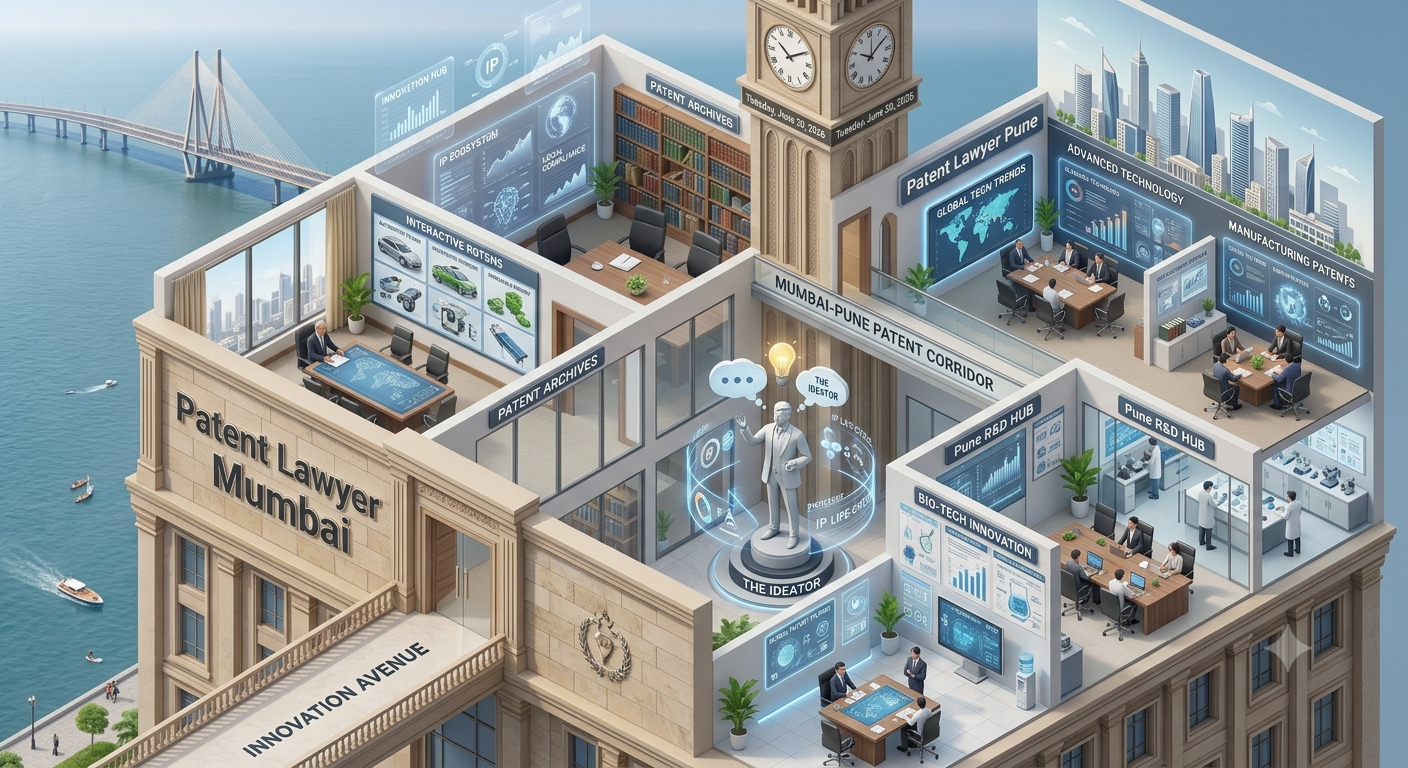
Creating something new is exciting. Protecting it, however, requires a completely different kind of thinking.
An engineer may develop a more efficient machine component. A technology startup may build a new technical solution. A manufacturer may improve an existing production process. In each situation, the creator eventually faces the same question: can competitors legally copy this innovation?
This is where patent protection enters the picture.
For businesses and inventors in Maharashtra, consulting a Patent Lawyer Mumbai or Patent Lawyer Pune can help clarify whether an invention may qualify for protection, what should be done before disclosure and how a patent strategy should support future commercial plans.
Understanding these issues before filing can be just as important as the application itself.
Why Should Patent Planning Start Before Product Launch?
A common misconception is that patent protection can simply be considered after a product becomes successful.
That approach can create problems.
Patent systems place considerable importance on novelty. Publicly revealing important technical details before filing can potentially affect the ability to secure patent rights.
Public disclosure could occur through:
- Product launches
- Websites
- Social media
- Exhibitions
- Research papers
- Technical presentations
- Sales demonstrations
- Publicly available videos
This is why an inventor may consult a Patent Lawyer Mumbai before taking a new technology to market rather than waiting until competitors appear.
Early advice allows patent protection, confidentiality and commercialisation to be considered together.
What Makes an Invention Worth Patenting?
Not every improvement needs a patent, and not every good idea qualifies for one.
A patent strategy should begin by asking whether the invention is both legally protectable and commercially worth protecting.
Novelty Comes First
An invention should be new compared with relevant prior art.
If the same technical concept has already been publicly disclosed, the applicant may face difficulty establishing novelty.
This makes prior-art research an important part of early patent evaluation.
An Improvement Should Not Be Obvious
Imagine a company changes an existing machine by replacing a standard steel component with another commonly used material without creating a meaningful technical advancement.
The modification may be new to that particular company, but that alone does not necessarily establish an inventive step.
A Patent Lawyer Pune can help analyse the legal issues while appropriate technical professionals evaluate the invention against known technology.
The Invention Needs Practical Application
Patent protection generally concerns inventions capable of industrial application.
The technical concept should therefore have practical utility rather than existing only as an abstract thought.
What Happens During a Patent Consultation?
An inventor should be prepared to explain the invention in technical rather than purely promotional terms.
Instead of saying:
“Our machine is faster and better than competitors.”
The useful information is:
What makes it faster? Which component has changed? How does that component operate? What technical problem existed previously? Why does the new configuration solve it?
A Patent Lawyer Mumbai may need information concerning:
- The technical problem
- Existing solutions
- New technical features
- Development history
- Inventors involved
- Previous disclosures
- Product-launch plans
- Target markets
- Commercial applications
The more clearly the invention is understood, the easier it becomes to develop an appropriate patent strategy.
Why Prior-Art Searching Can Save Time and Money
Imagine spending significant resources preparing an application only to discover that another inventor published nearly identical technology several years earlier.
A prior-art search helps reduce this uncertainty.
Patent searches can investigate earlier:
- Patent applications
- Granted patents
- Scientific publications
- Technical literature
- Research papers
- Publicly disclosed technologies
Prior art can also be useful even when similar inventions are found.
It can reveal exactly where your invention differs from existing technology. Those differences may become particularly important when determining the potential inventive contribution.
Should You File a Provisional or Complete Specification?
This decision often depends on how developed the invention is.
| Situation | Provisional Specification | Complete Specification |
| R&D Still Continuing | May be appropriate | Depends on available disclosure |
| Invention Fully Developed | May not be necessary | Often considered |
| Claims Required | Generally No | Yes |
| Detailed Disclosure | Initial disclosure | Comprehensive disclosure |
| Purpose | Establish filing position | Define and pursue patent protection |
A provisional specification is sometimes casually described as a “temporary patent”. That description can be misleading.
It is a patent specification associated with an application, not a granted patent.
A Patent Lawyer Pune can help an inventor understand which filing route may be appropriate based on development status and commercial plans.
What Makes Patent Drafting So Important?
One of the biggest mistakes businesses can make is treating patent drafting like ordinary technical writing.
A patent specification has a very different purpose.
It needs to explain the invention sufficiently while supporting the protection being sought.
Patent Claims Define the Protection
Claims are especially important because they establish the boundaries of the invention for which protection is sought.
Consider a hypothetical company that develops a new industrial filtration system.
Its commercial innovation may lie in a particular arrangement of filters rather than the complete machine.
If the patent is drafted only around one exact machine configuration, alternative implementations of the core innovation may not necessarily fall within the intended scope.
Drafting Should Consider Alternatives
Patent professionals may therefore consider:
- Essential technical features
- Optional components
- Alternative embodiments
- Different configurations
- Commercial applications
- Potential competitor modifications
This is where patent drafting becomes strategic rather than simply descriptive.
Why Mumbai Businesses Need a Commercial Patent Strategy
Mumbai supports businesses across pharmaceuticals, chemicals, healthcare, electronics, fintech, manufacturing and emerging technologies.
For these businesses, patents can potentially play several roles.
A Patent Lawyer Mumbai may help companies evaluate patent protection in relation to:
- Product development
- Technology licensing
- Investment transactions
- Joint ventures
- Research collaborations
- Corporate IP portfolios
- Competitive positioning
A patent should therefore be considered as a business asset rather than merely a legal certificate.
Why Pune’s Engineering Ecosystem Makes Patent Protection Relevant
Pune has a strong concentration of engineering, automotive, manufacturing, software, education and research organisations.
A Patent Lawyer Pune may therefore encounter inventions relating to industrial machinery, automotive systems, automation, electronics, manufacturing processes and technology-driven products.
For an engineering company, even a relatively small technical improvement can have commercial significance when it reduces production time, improves efficiency or solves a recurring technical problem.
The key question is whether that improvement satisfies patentability requirements.
Patent Protection vs Trade Secret: Which Is Better?
Not every valuable innovation must necessarily be patented.
Sometimes businesses choose to protect information as a trade secret.
| Patent | Trade Secret |
| Requires disclosure | Information remains confidential |
| Protection is time-limited | Can potentially continue while secrecy remains |
| Statutory exclusive rights | Depends heavily on maintaining confidentiality |
| Suitable for qualifying inventions | Useful for confidential know-how |
| Application and examination required | No patent registration required |
The appropriate choice depends on whether the technology can remain secret, whether competitors can reverse-engineer it and how the company intends to commercialise it.
Questions to Ask a Patent Lawyer Before Filing
Before appointing a professional, consider asking:
- Do you have experience with my technical industry?
- Who will prepare the patent specification?
- Will prior-art searching be conducted?
- What information do you need from the inventor?
- What are the professional and official fees?
- How are examination objections handled?
- Can you support international patent applications?
- How will confidential information be protected?
Whether choosing a Patent Lawyer Mumbai or Pune professional, technical understanding and relevant experience deserve serious consideration.
Frequently Asked Questions About Patent Lawyers
1. Why do I need a Patent Lawyer Mumbai?
Patent lawyers can provide legal advice concerning patentability, ownership, prosecution, licensing, opposition, infringement and broader intellectual property strategy.
2. What industries can a Patent Lawyer Pune assist?
Patent matters may arise across engineering, manufacturing, automotive, biotechnology, electronics, medical devices and technology-related industries.
3. Can a business idea be patented?
A business idea by itself generally does not automatically qualify. Patentability depends on whether there is a qualifying invention under applicable law.
4. Can I disclose my invention before filing?
Public disclosure can create patentability risks. Obtain professional advice before publicly revealing important technical information.
5. What is a patent search?
It is a search for existing patents and other prior art that may be relevant to the novelty or inventive step of an invention.
6. Is a provisional specification compulsory?
No. Applicants may file a complete specification directly when appropriate.
7. How long is an Indian patent valid?
The standard patent term is generally 20 years from the applicable filing date, subject to statutory conditions and renewal requirements.
8. Does my Indian patent protect me in other countries?
No. Patent rights are territorial. Protection outside India requires an appropriate foreign or international filing strategy.
9. Can someone challenge a patent after it is granted?
Yes. Indian patent law provides mechanisms through which patents may be challenged under specified circumstances.
10. Are manufacturing improvements patentable?
They can potentially be patentable when they satisfy novelty, inventive-step, industrial-applicability and other statutory requirements.
https://newsgrow.blogspot.com/2026/08/patent-lawyer-mumbai-and-patent-lawyer.html