Extreme heat is only one challenge faced by modern industrial materials. In semiconductor processing, vacuum systems, research laboratories and specialised manufacturing equipment, components may simultaneously encounter thermal cycling, electrical fields, reactive substances and strict contamination requirements.
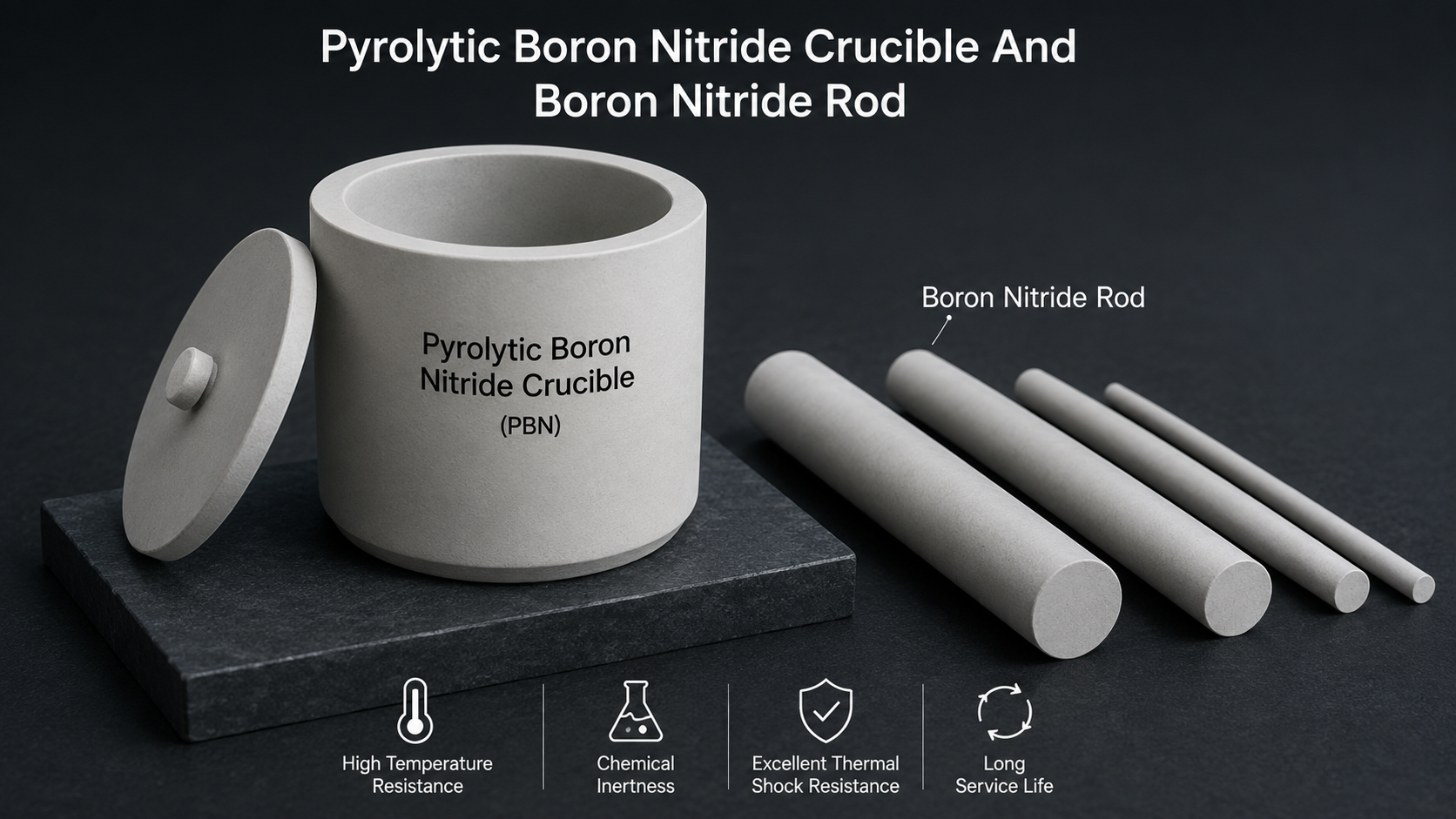
This combination has encouraged engineers to look beyond conventional metals and ceramics. Pyrolytic Boron Nitride Crucible and Boron Nitride Rod products are two examples of advanced ceramic solutions developed for demanding environments.
They share the boron nitride name, but their roles are quite different. One is primarily designed to contain and process sensitive materials, while the other provides a machinable starting point for creating specialised ceramic components.
Understanding where each product fits can make material selection considerably easier.
When Conventional Materials Are Not Enough
A material performing well at room temperature may behave very differently inside a furnace or vacuum chamber.
High-temperature components can experience expansion, oxidation, chemical attack, electrical interference and repeated heating and cooling. In highly controlled processes, contamination from the component itself may also affect the material being manufactured.
Engineers therefore need to evaluate several properties together:
- Thermal stability
- Electrical insulation
- Chemical compatibility
- Purity
- Thermal-shock behaviour
- Vacuum compatibility
- Machinability
- Dimensional stability
Boron nitride ceramics are noteworthy because they can combine several of these characteristics within one material family.
PBN Crucibles Address the Challenge of Process Purity
A Pyrolytic Boron Nitride Crucible is not simply a ceramic container designed to tolerate heat. It is particularly useful when maintaining a clean processing environment is a major priority.
Pyrolytic boron nitride, or PBN, is typically produced through chemical vapour deposition. Material is deposited under controlled conditions to create a dense, high-purity structure.
The manufacturing route distinguishes PBN from conventional powder-processed boron nitride ceramics.
Because additional binders are not normally required in the same way as in many conventional ceramic manufacturing processes, very high levels of purity can be achieved.
That makes PBN particularly interesting for industries where even small quantities of impurities can matter.
How PBN Crucibles Support Semiconductor Processing
Semiconductor manufacturing requires precise control over materials and processing conditions. Contamination introduced during heating or evaporation can potentially influence subsequent processing or material quality.
The Pyrolytic Boron Nitride Crucible is therefore commonly associated with sophisticated processes such as:
- Molecular beam epitaxy
- Vacuum evaporation
- Compound semiconductor production
- Crystal growth
- Thin-film research
- High-purity material processing
Its electrical insulation, chemical stability and low contamination potential can be valuable in these environments.
However, simply choosing PBN is not enough. Crucible dimensions, wall thickness, thermal orientation, source material and heating conditions should all be considered when developing a reliable process.
BN Rods Solve a Different Engineering Problem
Imagine an engineer needs an electrically insulating spacer that must operate inside high-temperature equipment. A standard ceramic component may not be available in the exact dimensions required.
This is where a Boron Nitride Rod becomes useful.
Instead of functioning as a finished container, the rod can act as machinable ceramic stock. It can be transformed into specialised parts according to equipment drawings and application requirements.
Possible components include:
- Furnace supports
- Electrical insulators
- Bushings
- Sleeves
- Nozzles
- Spacers
- Sensor holders
- Thermal fixtures
- Custom laboratory components
This flexibility allows BN rods to serve industries where component geometry can be just as important as material performance.
Machinability Gives Boron Nitride an Important Advantage
Many advanced ceramics deliver impressive thermal performance but can be difficult to machine into complicated shapes.
Certain hot-pressed boron nitride grades are comparatively machinable. A Boron Nitride Rod can therefore be processed into customised shapes, including components containing holes, grooves and other precision features.
This can be beneficial during prototyping, research equipment development, equipment maintenance and low-volume production.
Machinability does not mean the material should be treated like ordinary plastic or metal. Correct machining procedures remain important because BN is still a technical ceramic.
How Do PBN Crucibles and BN Rods Compare?
| Requirement | PBN Crucible | BN Rod |
| Typical function | Material containment | Custom component production |
| Common structure | Pyrolytic BN | Hot-pressed BN |
| Typical manufacturing | Chemical vapour deposition | Powder processing and hot pressing |
| Purity | Extremely high grades available | Varies by grade |
| Custom machining | Limited/specialised | Major advantage |
| Electrical insulation | Excellent | Excellent |
| Typical application | Semiconductor and evaporation | Furnaces and industrial equipment |
| Main selection reason | Purity and process cleanliness | Machinability and flexibility |
The important point is that the products are not direct substitutes.
A Pyrolytic Boron Nitride Crucible addresses containment requirements, while a Boron Nitride Rod provides material for engineering custom parts.
Temperature Rating Should Never Be the Only Selection Factor
One of the easiest mistakes when selecting high-temperature ceramics is comparing maximum temperature ratings without considering how those values were established.
A component operating at elevated temperatures in an inert atmosphere does not necessarily experience the same conditions as one operating in air.
Before selecting BN, engineers should examine:
- Continuous operating temperature
- Peak temperature
- Heating and cooling rates
- Vacuum conditions
- Presence of oxygen
- Contact materials
- Mechanical stress
- Required component lifetime
The correct BN grade for one furnace may therefore be inappropriate for another application operating at a similar temperature.
Chemical Compatibility Is Equally Important
Thermal resistance alone cannot guarantee successful performance.
A crucible, nozzle or fixture may directly contact molten materials, vapours or reactive chemicals. The interaction between these substances and the ceramic must therefore be understood.
Boron nitride is valued for its chemical stability and useful non-wetting characteristics against various materials, but compatibility depends on the exact process.
Testing should be considered when introducing BN into a critical application involving unfamiliar chemicals, molten materials or unusual atmospheric conditions.
Where Boron Nitride Technology Is Heading
The demand for precision ceramic materials is closely connected with advances in electronics, semiconductor manufacturing, vacuum processing, thermal management and specialised industrial equipment.
As processes become more controlled, the supporting components must meet increasingly specific requirements.
PBN crucibles offer a solution when cleanliness and purity are central to the process. BN rods, meanwhile, allow manufacturers to create customised parts without abandoning the advantages associated with advanced ceramics.
This distinction makes the boron nitride family useful across very different engineering environments.
Frequently Asked Questions
1. What exactly is a Pyrolytic Boron Nitride Crucible?
It is a specialised high-purity PBN container used for demanding thermal and vacuum-processing applications.
2. Why is PBN used in semiconductor equipment?
Its purity, electrical insulation and thermal characteristics make it suitable for sensitive semiconductor processes.
3. Is a PBN crucible suitable for vacuum processing?
Yes, PBN is commonly considered for high-vacuum and controlled-atmosphere applications.
4. What is the purpose of a Boron Nitride Rod?
A BN rod provides machinable ceramic material for producing customised high-temperature components.
5. What parts can be manufactured from BN rods?
Examples include spacers, sleeves, insulators, nozzles, fixtures and furnace components.
6. Can a Boron Nitride Rod be machined?
Yes. Many hot-pressed BN grades are specifically valued for their machinability.
7. Are BN and PBN the same material?
They belong to the same ceramic family, but their manufacturing methods, structures and typical applications differ.
8. Does boron nitride provide electrical insulation?
Yes. Strong electrical insulation is one of the important characteristics associated with many BN materials.
9. Can boron nitride handle sudden temperature changes?
BN materials can offer good thermal-shock performance, although actual capability depends on material grade and component design.
10. What information should be provided when ordering BN components?
Temperature, atmosphere, dimensions, tolerances, chemical exposure, electrical requirements and application details should be specified.
Read more – https://newsgrow.blogspot.com/2026/09/boron-nitride-crucibles-and-boron.html
https://newsgrow.blogspot.com/2026/09/pyrolytic-boron-nitride-and-zirconium.html
https://newsgrow.blogspot.com/2026/09/pyrolytic-boron-nitride-crucible-and.html