
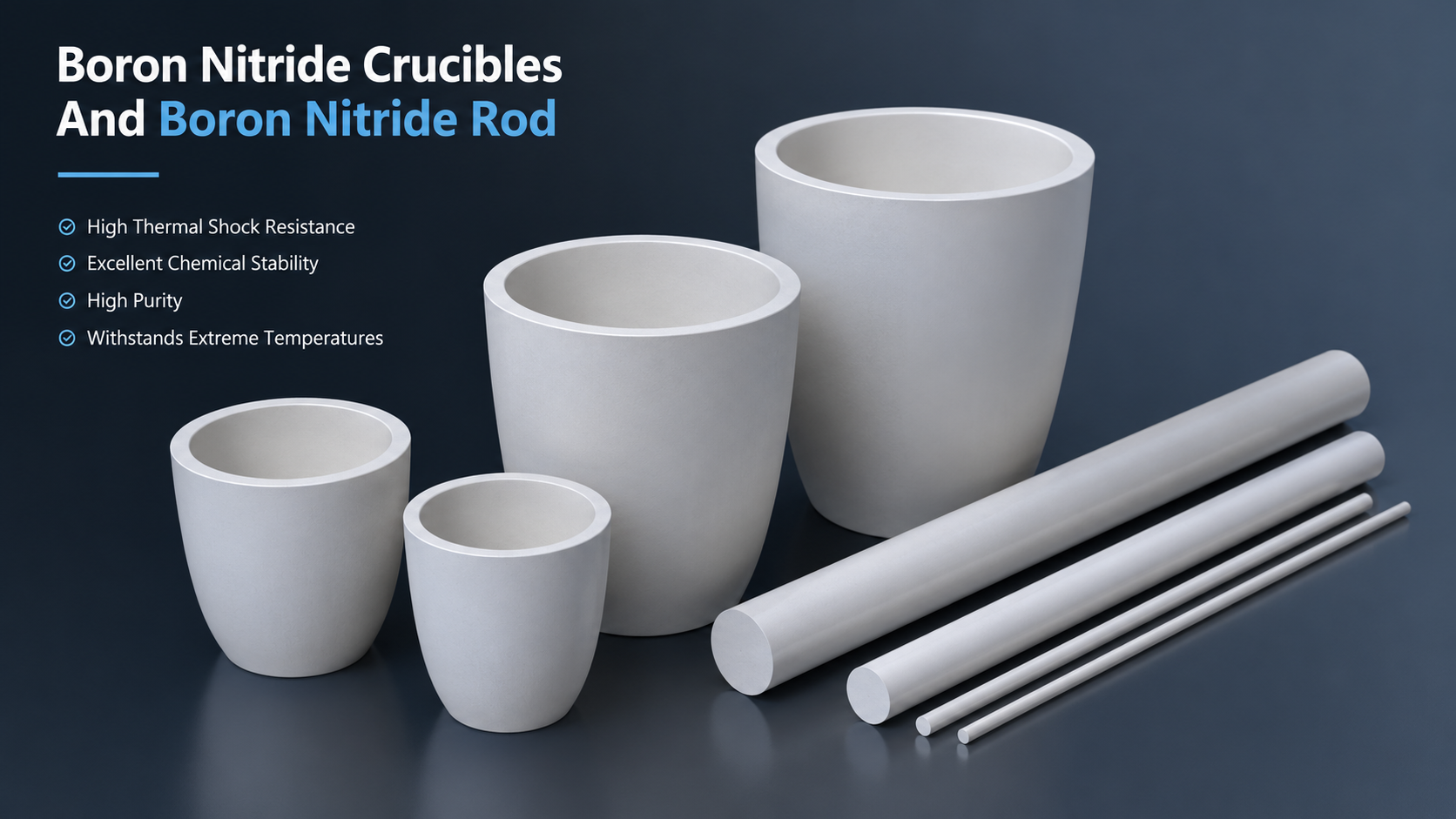
Modern manufacturing increasingly depends on materials that can operate reliably under conditions where conventional metals and ceramics face limitations. Extreme temperatures, rapid thermal cycling, electrical isolation requirements, and exposure to molten materials all create significant challenges for engineers.
Among the advanced ceramics developed for such environments, boron nitride has attracted considerable attention. In particular, Boron Nitride Crucibles and Boron Nitride Rod are being used across research, electronics, metallurgy, semiconductor processing, and other specialised industries.
What makes this material interesting is not simply its ability to withstand heat. Boron nitride combines several properties that are rarely found together in one engineering material.
Understanding Boron Nitride as an Advanced Ceramic
Boron nitride is a compound formed from boron and nitrogen. It exists in different crystalline forms, with hexagonal boron nitride being especially important for industrial ceramic applications.
Hexagonal boron nitride has a layered structure and is sometimes compared with graphite because of its lubricating characteristics and machinability. However, unlike graphite, boron nitride is generally an electrical insulator.
This combination gives engineers access to several valuable characteristics:
- High-temperature performance
- Excellent electrical insulation
- Good thermal-shock resistance
- Low thermal expansion
- Useful thermal conductivity
- Low friction
- Chemical stability in many environments
- Good machinability in suitable grades
These properties explain why boron nitride components are increasingly considered for demanding thermal applications.
Why Crucible Material Matters in High-Temperature Processing
A crucible may appear to be a relatively simple container, but its role becomes much more important when materials are heated to extreme temperatures.
The crucible must maintain its structure while preventing unwanted reactions with the material being processed. In purity-sensitive applications, contamination from the crucible itself can influence experimental results or final product quality.
Boron Nitride Crucibles provide an interesting solution because BN offers good thermal stability together with non-wetting characteristics toward various molten materials.
Rather than strongly adhering to the crucible surface, certain processed materials may be easier to separate after cooling. This can be particularly useful in specialised metallurgical and laboratory processes.
Where Are Boron Nitride Crucibles Used?
The suitability of a BN crucible depends on the grade, atmosphere, operating temperature and material being processed.
Common application areas can include:
- Vacuum evaporation
- Molten-metal processing
- Crystal growth
- Semiconductor production
- Advanced materials research
- Laboratory experiments
- High-temperature furnaces
- Specialised alloy processing
Their resistance to rapid temperature changes can also be valuable where repeated heating and cooling cycles are unavoidable.
However, no crucible material should be considered universally compatible. Chemical interaction, oxidation conditions and maximum operating temperatures should always be evaluated before selecting a particular grade.
Boron Nitride Rod Offers Greater Design Flexibility
Crucibles are designed primarily for containment, whereas Boron Nitride Rod serves a different engineering purpose.
BN rods provide machinable ceramic stock from which manufacturers and engineers can produce application-specific parts. Depending on the grade, boron nitride can be machined into relatively complex geometries.
Typical products manufactured from BN rod include:
- Electrical insulation components
- High-temperature spacers
- Ceramic sleeves
- Furnace fixtures
- Bushings
- Nozzles
- Supports
- Thermal isolation components
This flexibility can be particularly useful during prototype development when engineers need custom ceramic parts rather than mass-produced standard components.
Machinability Is an Important Advantage
Many technical ceramics provide excellent thermal and mechanical characteristics but can be difficult to machine after manufacturing.
Boron nitride is different.
Suitable Boron Nitride Rod grades can often be machined using conventional manufacturing methods. Holes, grooves, slots and other detailed features can therefore be incorporated into finished components.
Machining still requires appropriate care. Boron nitride remains a ceramic material, so aggressive cutting forces or poor component support may lead to edge damage.
Sharp tools, controlled cutting conditions, suitable dust extraction and careful handling can help maintain component quality.
Boron Nitride Crucibles vs Boron Nitride Rod
| Factor | Boron Nitride Crucibles | Boron Nitride Rod |
| Primary purpose | High-temperature containment | Custom component manufacturing |
| Typical geometry | Cup, boat or container | Cylindrical stock |
| Key advantage | Controlled material processing | Machining flexibility |
| Common application | Melting and evaporation | Insulators, nozzles and fixtures |
| Customisation | Shape and dimensions | Extensive machining options |
| Typical users | Laboratories and metallurgy | Engineers and manufacturers |
Both forms use the advantages of boron nitride but solve different industrial challenges.
How Boron Nitride Supports Semiconductor Applications
Semiconductor manufacturing requires extremely controlled environments. Materials used inside production equipment may need to handle elevated temperatures without introducing unnecessary electrical conductivity or contamination.
Boron nitride’s combination of electrical insulation and thermal performance makes it relevant to selected semiconductor-processing equipment.
Custom components manufactured from Boron Nitride Rod can be incorporated into thermal assemblies, while specialised crucibles may be considered for processes involving material heating or evaporation.
Material purity becomes especially important in such applications, making grade selection a critical part of engineering design.
Factors to Consider Before Selecting Boron Nitride
Not all BN ceramics have identical properties. Composition, manufacturing method, additives and material orientation can affect final performance.
Before purchasing a component, engineers should consider:
- Maximum operating temperature
- Continuous versus intermittent exposure
- Vacuum, inert or oxidising atmosphere
- Material purity
- Electrical requirements
- Chemical compatibility
- Thermal cycling
- Mechanical loading
- Dimensions and tolerances
- Required surface finish
The operating atmosphere deserves special consideration because temperature capability can vary considerably between vacuum, inert gas and air environments.
Frequently Asked Questions About Boron Nitride
What are Boron Nitride Crucibles mainly used for?
They are used for specialised high-temperature processes such as material melting, evaporation, laboratory research and crystal-growth applications.
What is Boron Nitride Rod?
It is cylindrical boron nitride ceramic stock that can be machined into customised engineering components.
Is boron nitride an electrical insulator?
Hexagonal boron nitride is widely valued for its electrical insulating characteristics.
Can boron nitride withstand rapid temperature changes?
Boron nitride generally offers good thermal-shock resistance, making it useful for applications involving heating and cooling cycles.
Can Boron Nitride Rod be machined?
Yes. Suitable machinable BN grades can be formed into detailed components using appropriate machining methods.
Are BN crucibles suitable for molten metals?
They can be suitable for various molten-material applications, but compatibility should always be checked for the specific material and temperature.
Where is boron nitride commonly used?
Applications can be found in semiconductor manufacturing, metallurgy, electronics, vacuum technology, laboratories and specialised thermal equipment.
Are all boron nitride grades the same?
No. Different grades can vary in purity, strength, thermal characteristics, additives and environmental resistance.
Why is BN useful for custom ceramic parts?
Its machinability allows engineers to manufacture complex components more easily than with many conventional technical ceramics.
What should buyers check before ordering BN components?
Buyers should review dimensions, temperature, atmosphere, purity, chemical exposure, tolerances and the manufacturer’s technical specifications.
Read more – https://newsgrow.blogspot.com/2026/09/boron-nitride-crucibles-and-boron.html