
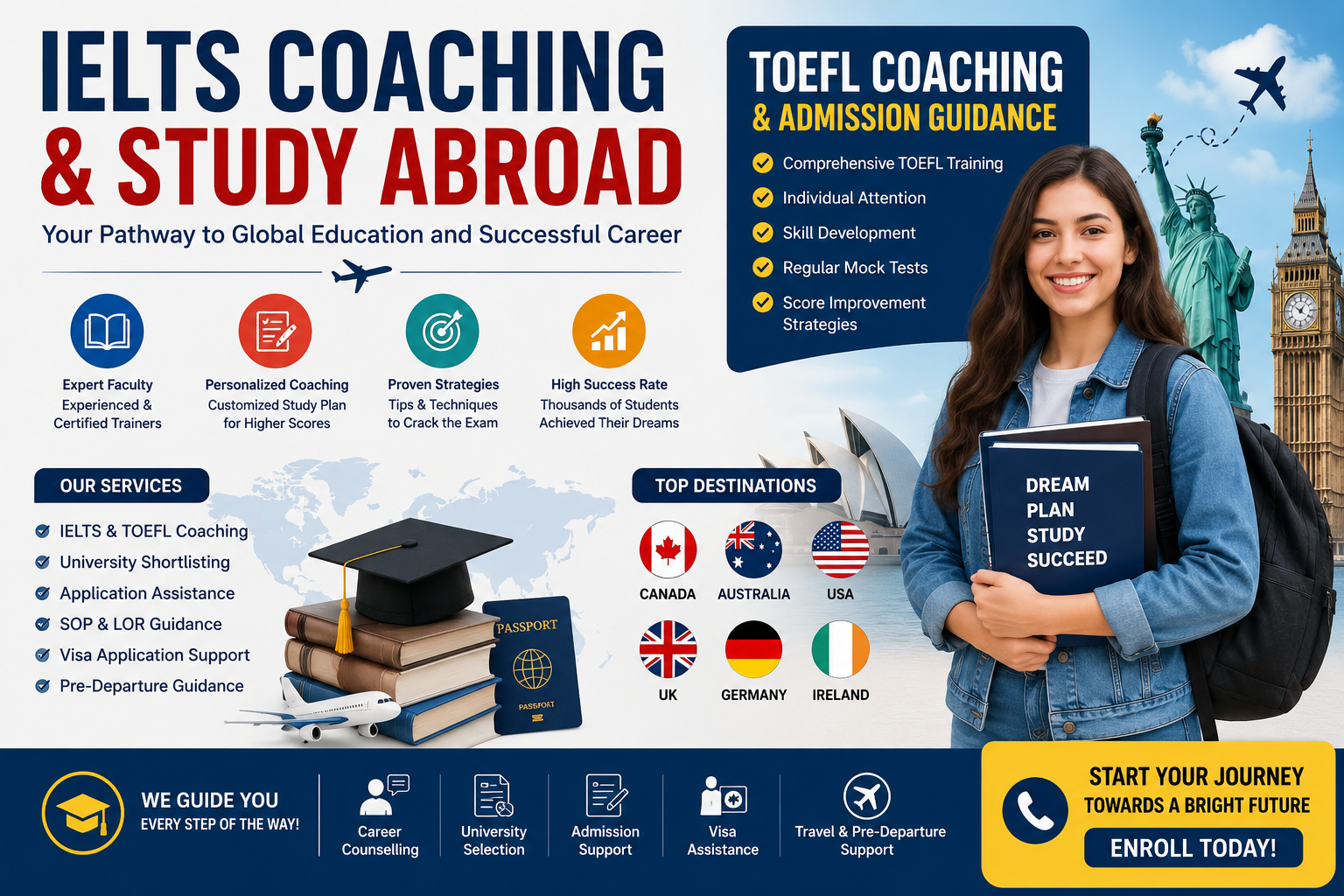
International education is not simply about getting accepted by a foreign university. It is a carefully planned journey involving language proficiency, academic choices, documentation, university applications, finances, and visa preparation. Students who organise these stages early are better positioned to make informed decisions and avoid last-minute complications.
This is where IELTS Coaching and Study Abroad support becomes valuable. Students considering TOEFL can similarly combine TOEFL Coaching and Admission Guidance to prepare for their language examination while developing a practical university application strategy.
Instead of viewing test preparation and admissions as two unrelated processes, students can approach them as connected stages of one international education plan.
Start With Your Academic and Career Goals
Before choosing IELTS, TOEFL, a university, or even a destination, students should understand what they want from international education.
Consider questions such as:
- Which subject matches your academic background?
- What career would you like to pursue?
- Which countries offer relevant programmes?
- What is your realistic education budget?
- Do shortlisted universities accept IELTS or TOEFL?
- What are the application deadlines?
- Are scholarships available?
Clear answers make subsequent decisions easier and prevent students from applying randomly to institutions that may not match their goals.
Building Strong English Skills Through IELTS Coaching
IELTS preparation should focus on developing genuine communication ability rather than simply learning shortcuts.
The examination measures four essential language skills: Listening, Reading, Writing, and Speaking. Students need a balanced preparation strategy because weakness in one area can affect their overall performance.
Professional IELTS coaching can help candidates work on vocabulary, grammar, pronunciation, comprehension, writing organisation, speaking fluency, and examination techniques.
Regular practice tests are equally important. They introduce candidates to time pressure while helping trainers identify areas that require additional attention.
Connecting IELTS Coaching and Study Abroad Planning
A major advantage of combining IELTS Coaching and Study Abroad counselling is better timeline management.
For example, students can shortlist universities while preparing for IELTS instead of waiting until their examination is complete. They can simultaneously collect transcripts, research programmes, prepare application documents, and monitor deadlines.
A practical sequence may include:
- Profile assessment
- Destination research
- Course selection
- University shortlisting
- IELTS preparation
- Language examination
- Application preparation
- University submission
- Offer evaluation
- Visa and departure planning
Following a structured pathway makes the process easier to understand and manage.
Why Students Choose TOEFL Preparation
TOEFL is designed to measure English communication skills commonly required in academic environments. Its tasks evaluate how effectively candidates understand and use English across Reading, Listening, Speaking, and Writing.
Successful preparation requires familiarity with the test format as well as strong academic English.
TOEFL coaching may include practice with:
- Academic reading passages
- Lecture-based listening exercises
- Note-taking
- Speaking responses
- Integrated language tasks
- Essay organisation
- Vocabulary development
- Timed mock examinations
Students should practise consistently instead of relying on intensive preparation immediately before the examination.
Combining TOEFL Coaching and Admission Guidance
A language score alone does not determine the success of an international university application. Academic history, programme eligibility, documents, deadlines, and institution-specific requirements also matter.
Therefore, TOEFL Coaching and Admission Guidance can work effectively together.
While students prepare for TOEFL, admission specialists can assist them in researching suitable programmes, understanding eligibility conditions, preparing application documents, and creating an application timeline.
This approach keeps language preparation aligned with the student’s broader academic objective.
IELTS and TOEFL at a Glance
| Consideration | IELTS | TOEFL |
| Core Areas | Listening, Reading, Writing, Speaking | Reading, Listening, Speaking, Writing |
| Environment | Multiple testing formats may be available | Commonly computer-based |
| Communication Focus | Practical and academic English | Strong academic context |
| Speaking Approach | Depends on test format | Responses typically recorded |
| Selection | Check institution requirements | Check institution requirements |
Students should never choose an examination solely because friends or classmates prefer it. Always confirm the latest requirements directly with the universities being considered.
What Good Admission Guidance Should Cover
Reliable admission guidance should help students understand their options rather than simply recommend a list of universities.
Support may cover course research, institution comparison, eligibility assessment, application planning, document preparation, scholarship exploration, offer evaluation, and visa-related guidance.
Students should also receive clear explanations about tuition fees, expected living expenses, programme duration, and other important considerations before making a final decision.
Creating a Strong University Application
A strong application presents the student’s academic profile clearly and accurately.
Depending on the institution and programme, applicants may need:
- Academic transcripts and certificates
- IELTS or TOEFL scores
- Passport details
- Statement of Purpose
- Letters of Recommendation
- Resume or CV
- Work experience documents
- Financial evidence
- Portfolio or research proposal
Requirements differ significantly between universities. Applicants should therefore follow official programme instructions instead of using identical documents for every application.
Common Study Abroad Mistakes to Avoid
Students can improve their planning by avoiding several common mistakes.
Applying too late, selecting universities without checking eligibility, submitting generic statements, ignoring financial planning, and preparing for English tests without understanding target scores can create unnecessary difficulties.
Another mistake is depending entirely on third parties. Professional guidance can be useful, but students should understand their own applications and independently verify important information from official university and immigration sources.
Frequently Asked Questions
1. Why is IELTS coaching useful?
IELTS coaching provides structured preparation, practice exercises, feedback, and strategies across all four tested language skills.
2. What does study abroad guidance cover?
It can cover course selection, university shortlisting, applications, documentation, scholarships, offers, visas, and pre-departure preparation.
3. What is TOEFL coaching designed for?
It helps candidates develop the academic English and test-taking skills required for TOEFL.
4. Should I choose IELTS or TOEFL?
Choose according to university requirements, test availability, your preferred format, and personal strengths.
5. When should study abroad planning begin?
Ideally, students should begin researching well before application deadlines so they have sufficient time for testing and documentation.
6. Can IELTS preparation and applications happen together?
Yes. Coordinating both processes can save time and create a more efficient application schedule.
7. Does a high TOEFL score guarantee admission?
No. Universities typically evaluate multiple factors, including academic qualifications and programme-specific requirements.
8. What is university shortlisting?
It involves identifying institutions that match your academic profile, preferred programme, budget, destination, and career objectives.
9. Is an SOP important?
Where required, a Statement of Purpose helps explain your academic background, motivations, goals, and reasons for choosing a programme.
10. Can admission consultants guarantee a visa?
No legitimate adviser can guarantee a visa. Decisions are made by the relevant immigration authorities according to applicable requirements.