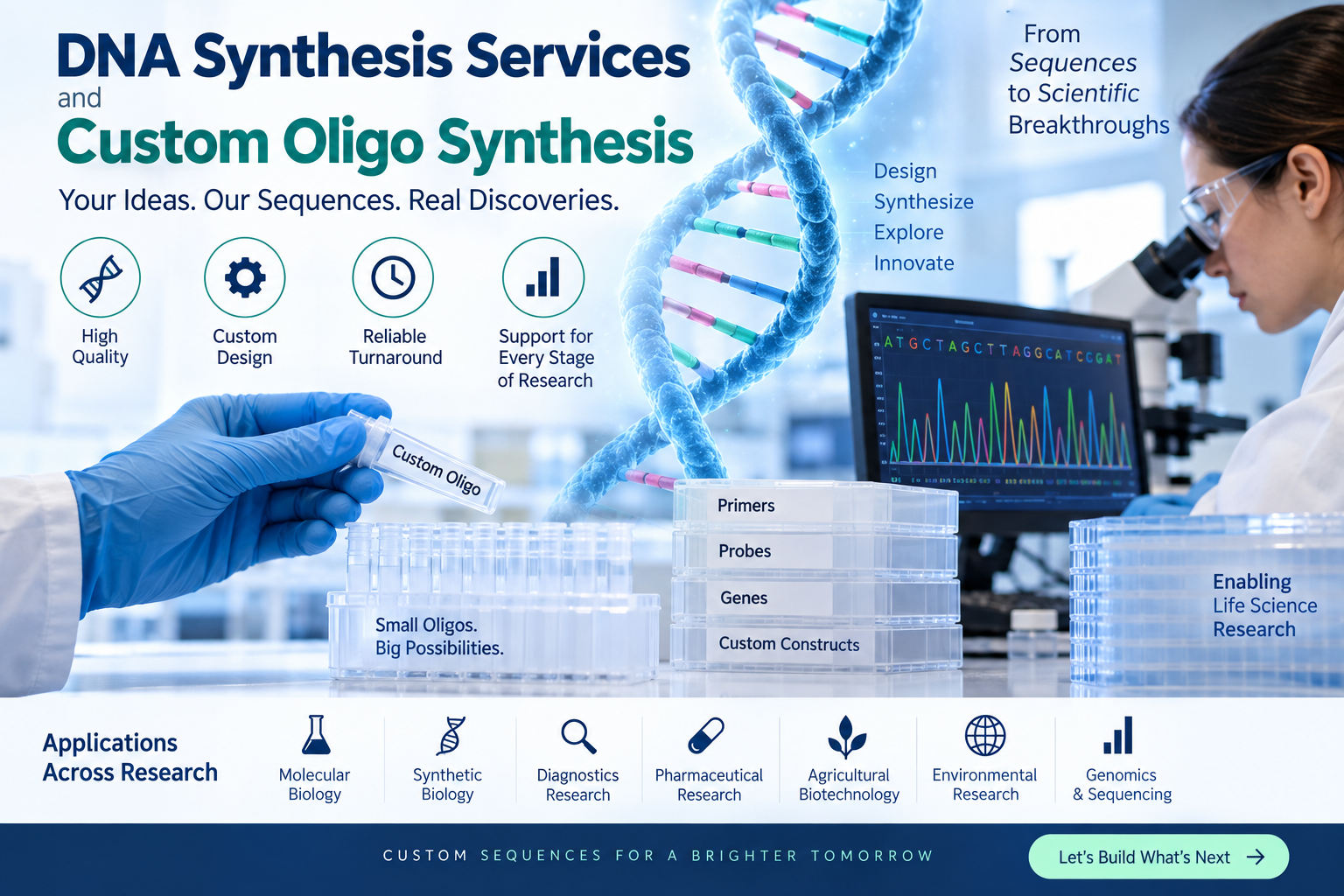
From academic research and molecular diagnostics to synthetic biology and pharmaceutical development, researchers need dependable genetic material that matches specific experimental requirements. This growing demand has made DNA synthesis services and custom oligo synthesis essential resources for laboratories working across life sciences.
Instead of relying only on naturally occurring DNA, scientists can now order precisely designed sequences for defined research applications. These services help reduce preparation time, improve experimental consistency, and support increasingly complex molecular biology projects.
What Are DNA Synthesis Services?
DNA synthesis services involve the production of artificial DNA sequences according to specifications supplied by researchers. A customer provides the required nucleotide sequence, and the synthesis provider manufactures the DNA in a suitable format for downstream laboratory use.
Depending on project requirements, synthesized DNA may range from relatively short sequences to longer constructs used for cloning, expression studies, assay development, and synthetic biology.
Common applications include:
- Gene construction and cloning
- Protein expression studies
- Molecular diagnostics research
- Synthetic biology projects
- Genetic engineering
- Sequencing controls
- Functional genomics
- Research assay development
One major advantage of DNA synthesis is flexibility. Researchers can design sequences specifically around their experiments rather than being limited to DNA obtained from biological samples.
Understanding Custom Oligo Synthesis
Custom oligo synthesis focuses primarily on manufacturing short, defined strands of DNA or RNA known as oligonucleotides. These molecules are widely used as primers, probes, adapters, controls, and other research reagents.
Scientists provide the desired sequence and specify characteristics such as synthesis scale, purification requirements, modifications, and delivery format.
Custom oligos are commonly used for:
- PCR primers
- qPCR probes
- DNA sequencing
- Hybridisation experiments
- Gene assembly
- Molecular detection assays
- Next-generation sequencing workflows
- Research involving gene regulation
Because every project has different requirements, customization allows researchers to select oligonucleotides specifically suited to their experimental objectives.
Why DNA Synthesis Is Important in Modern Biotechnology
Traditional molecular biology often requires isolating DNA from organisms and modifying it through multiple laboratory steps. Synthetic DNA provides another route by allowing researchers to begin with a designed genetic sequence.
This approach can improve workflow efficiency while providing greater control over sequence composition.
For example, researchers studying protein production may require a gene sequence adapted for expression in a specific research system. DNA synthesis can provide a designed version that meets those experimental requirements.
Similarly, synthetic biology researchers frequently require multiple engineered genetic elements. Professional synthesis services simplify access to these customized sequences.
Benefits of Custom Oligo Synthesis
High-quality custom oligo synthesis can support reliable laboratory workflows by providing oligonucleotides manufactured according to clearly defined specifications.
Important benefits include:
- Precise sequence customization for specific research applications.
- Multiple purification choices depending on experimental sensitivity.
- Different synthesis scales for small experiments or larger research programs.
- Availability of specialized modifications for advanced molecular applications.
- Consistent production that helps laboratories maintain standardized workflows.
These advantages make synthesized oligonucleotides useful across both routine molecular biology and specialized research projects.
DNA Synthesis Services vs Custom Oligo Synthesis
| Feature | DNA Synthesis Services | Custom Oligo Synthesis |
| Typical product | Longer DNA sequences or constructs | Short DNA or RNA sequences |
| Common use | Gene construction, cloning, synthetic biology | Primers, probes, sequencing and assays |
| Customization | Sequence and construct design options | Sequence, scale, purification and modifications |
| Research scope | Complex molecular projects | Routine and specialized laboratory workflows |
| Primary advantage | Access to designed genetic material | Precise short-sequence production |
Both services complement one another. Many research programs require oligonucleotides during early experimental stages and longer synthesized DNA constructs during later development.
Key Factors When Choosing a DNA Synthesis Provider
Selecting a reliable synthesis partner requires more than simply comparing prices. Researchers should consider technical capability, quality processes, customization options, and communication.
Important evaluation points include:
- Sequence accuracy
- Quality-control procedures
- Available purification methods
- Supported synthesis lengths
- Modification options
- Documentation
- Packaging and delivery formats
- Technical customer support
- Turnaround expectations
- Ability to handle complex sequences
A suitable provider should clearly explain available specifications so laboratories can select products appropriate for their intended research use.
Purification and Quality Considerations
Purification plays an important role in custom oligo synthesis, particularly for sensitive molecular applications. Different experiments may require different levels of purity.
Basic research procedures may work with standard purification, while more demanding applications can require higher-purity oligonucleotides.
Researchers should therefore match purification methods with their downstream experiments rather than automatically selecting either the lowest-cost or highest-level option.
Quality documentation can also be important when laboratories need consistent records across multiple projects.
Applications Across Life Science Research
The combined use of DNA synthesis services and custom oligonucleotides supports many areas of biotechnology.
Synthetic biology uses designed DNA components to investigate and construct biological systems. Molecular diagnostics research uses primers and probes to study methods for identifying genetic targets.
Pharmaceutical research may use synthesized genetic material during early discovery and assay development. Academic laboratories frequently depend on custom primers for PCR, sequencing, cloning, and gene-expression studies.
Agricultural biotechnology, environmental research, microbiology, and genomics also benefit from access to precisely manufactured DNA sequences.
How Custom Synthesis Improves Research Efficiency
One of the strongest advantages of outsourcing DNA synthesis is reduced internal preparation work.
Instead of manually performing several steps to create every required sequence, laboratories can specify their requirements and receive manufactured material prepared for downstream workflows.
This can help research teams:
- Focus more time on experimentation
- Standardize frequently used sequences
- Reduce repetitive preparation
- Scale projects more efficiently
- Access specialized synthesis capabilities
The result is a more streamlined research process, particularly when many different sequences are required.
Frequently Asked Questions
What are DNA synthesis services?
They are professional services that manufacture artificial DNA sequences according to researcher-provided specifications for molecular biology and biotechnology applications.
What is custom oligo synthesis?
It is the production of customized short DNA or RNA sequences designed for particular laboratory applications.
Where are custom oligos commonly used?
They are widely used in PCR, sequencing, hybridisation, molecular detection, gene assembly, and genomics research.
Can synthesized DNA be customized?
Yes. Researchers can specify the required nucleotide sequence and select available manufacturing options depending on the provider.
What is the difference between an oligo and a synthesized gene?
Oligos are generally short nucleotide sequences, while synthesized genes are longer DNA constructs designed for broader molecular applications.
Why is purification important?
Purification helps ensure oligonucleotide preparations are suitable for the sensitivity and technical requirements of particular experiments.
Are DNA synthesis services useful for synthetic biology?
Yes. Synthetic biology commonly depends on designed DNA components for constructing and studying engineered biological systems.
Can custom oligos be used as PCR primers?
Yes. PCR primer production is one of the most common applications of custom oligonucleotide synthesis.
How should researchers choose a synthesis provider?
They should evaluate quality systems, synthesis capability, customization, purification options, documentation, technical support, and project requirements.
Are DNA synthesis and oligo synthesis used together?
Frequently. Oligos may support amplification, sequencing, or assembly, while longer synthesized DNA can support cloning and advanced research.