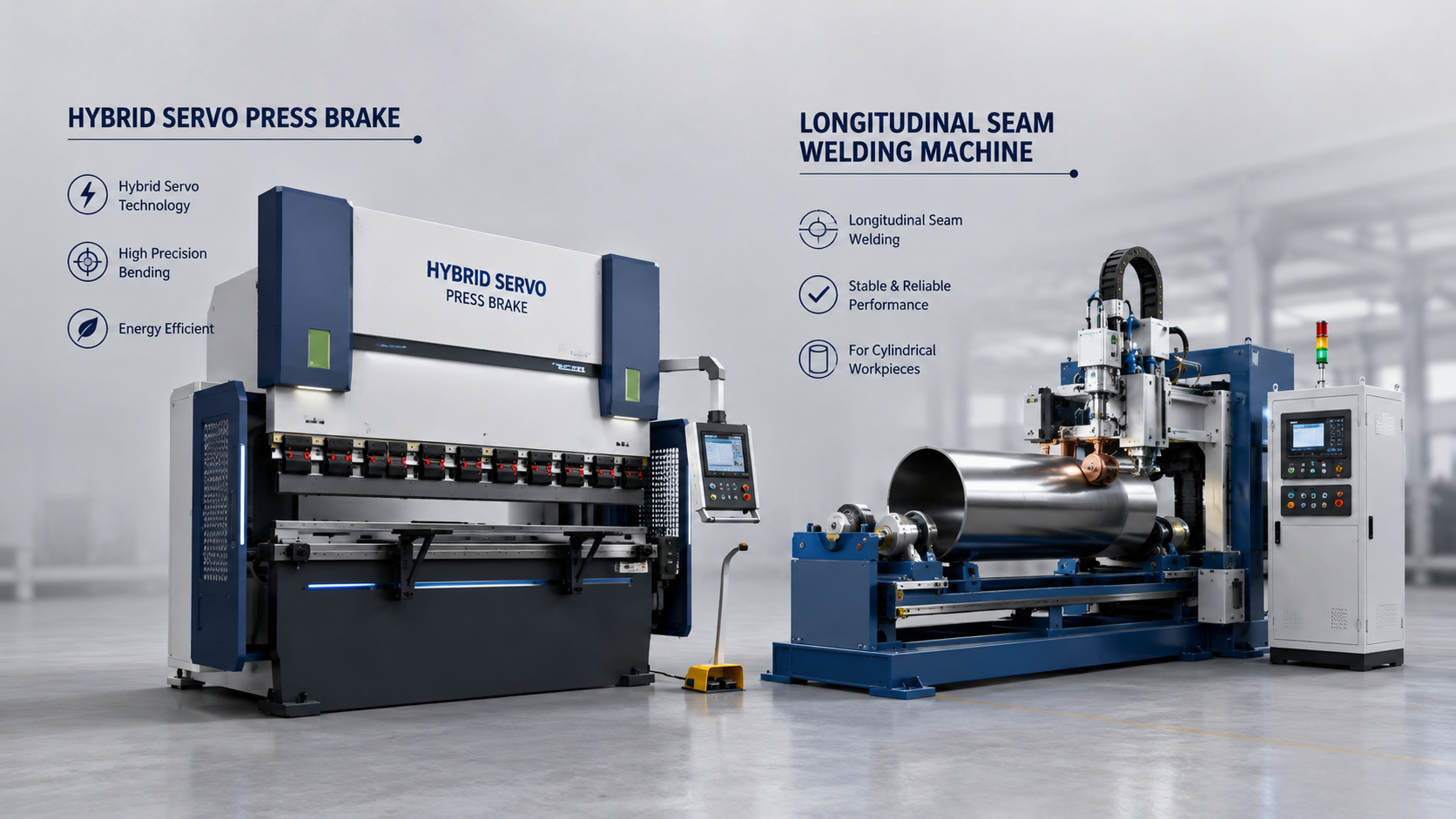
Manufacturers producing enclosures, cabinets, tanks, automotive components, pressure vessels, HVAC equipment, and industrial machinery increasingly require equipment capable of maintaining consistent quality while reducing production costs. Two technologies playing an important role in this transformation are the hybrid servo press brake and the longitudinal seam welding machine.
Although these machines perform different manufacturing operations, they frequently complement each other. A hybrid servo press brake creates accurate bends and profiles, while a longitudinal seam welding machine produces continuous, uniform welded joints. Together, they support efficient sheet-metal production from initial forming to final assembly.
What Is a Hybrid Servo Press Brake?
A hybrid servo press brake is an advanced sheet-metal bending machine combining servo-driven technology with hydraulic power. The hybrid configuration provides precise ram movement while maintaining the high bending force required for demanding metal-forming applications.
Traditional hydraulic press brakes rely heavily on hydraulic pumps operating continuously. Hybrid systems intelligently control hydraulic pressure according to actual bending requirements. This approach can reduce unnecessary energy consumption while improving positioning accuracy.
Common applications include:
- Electrical cabinets and enclosures
- Automotive components
- Stainless-steel fabrication
- HVAC equipment
- Machinery covers
- Kitchen equipment
- Architectural metalwork
- Industrial control panels
Modern machines may also feature CNC controls, automatic crowning, programmable back gauges, safety systems, and intelligent bending compensation.
How Hybrid Servo Press Brake Technology Works
Servo-Controlled Hydraulic Operation
The servo motor controls the hydraulic pump according to the movement required during each bending cycle. Instead of continuously operating at maximum capacity, the system supplies hydraulic power when needed.
This enables smoother acceleration and deceleration while helping maintain accurate ram positioning.
CNC Bending Control
Advanced CNC systems allow operators to program bending angles, material thickness, tooling specifications, ram depth, and back-gauge positions.
Once parameters are configured, the machine can repeatedly produce bends with minimal variation.
Automatic Compensation
High-quality press brakes may automatically compensate for material characteristics, machine deflection, and bending conditions. These functions are particularly valuable when producing long components where small deviations could create dimensional problems.
Major Benefits of a Hybrid Servo Press Brake
Manufacturers increasingly choose hybrid bending systems because they balance performance with operating efficiency.
Important advantages include:
- High bending accuracy and repeatability.
- Lower energy consumption compared with conventional hydraulic systems.
- Reduced hydraulic oil requirements.
- Faster positioning and cycle times.
- Lower operating noise.
- Precise CNC-controlled movement.
- Improved consistency across production batches.
- Flexible processing of different sheet-metal materials.
For companies producing multiple product designs, programmable bending technology can also reduce setup time when switching between jobs.
What Is a Longitudinal Seam Welding Machine?
A longitudinal seam welding machine is designed to create straight, continuous welds along the length of cylindrical, rectangular, or flat metal components. The machine securely positions the workpiece while a welding torch travels along the seam at a controlled speed.
Maintaining consistent alignment, welding speed, torch position, and heat input helps create uniform weld quality.
The technology is widely used for manufacturing:
- Stainless-steel tanks
- Pipes and tubes
- Pressure vessels
- Water heaters
- Industrial cylinders
- Metal ducts
- Exhaust components
- Food-processing equipment
- Chemical-processing equipment
Depending on production requirements, the system can support TIG, MIG/MAG, plasma, or other suitable welding technologies.
How Longitudinal Seam Welding Works
Workpiece Positioning
The fabricated component is placed into the machine and accurately aligned along the seam. Clamping systems hold both edges securely during welding.
Proper alignment is essential because irregular gaps can affect penetration and weld consistency.
Automated Welding Movement
After positioning, the welding torch travels along the joint at a predetermined speed. Automated controls regulate important welding parameters to create a consistent seam.
Welding Parameter Control
Important variables can include:
- Welding current
- Voltage
- Travel speed
- Shielding gas flow
- Torch angle
- Wire-feed speed
- Heat input
Precise parameter control reduces variations that commonly occur with manual welding.
Benefits of a Longitudinal Seam Welding Machine
Automation can significantly improve productivity in repetitive welding operations.
Key advantages include:
- Consistent weld appearance
- Improved seam accuracy
- Stable penetration
- Faster production
- Reduced operator dependency
- Lower rework requirements
- Better repeatability
- Controlled welding speed
- Improved manufacturing efficiency
For high-volume applications, automated longitudinal welding allows manufacturers to maintain consistent standards across hundreds or thousands of components.
Hybrid Servo Press Brake vs Longitudinal Seam Welding Machine
| Feature | Hybrid Servo Press Brake | Longitudinal Seam Welding Machine |
| Main operation | Sheet-metal bending | Straight seam welding |
| Primary process | Forming | Joining |
| Automation | CNC bending control | Automated welding control |
| Typical materials | Steel, stainless steel, aluminium | Steel, stainless steel, aluminium |
| Main advantage | Accurate bending | Consistent welded seams |
| Applications | Panels, cabinets, brackets | Tanks, tubes, cylinders |
| Production benefit | Repeatable forming | Repeatable joining |
The machines are not alternatives. Instead, they perform different stages within a complete fabrication workflow.
Using Both Machines in Metal Fabrication
Consider the production of a stainless-steel industrial enclosure.
First, sheet metal is cut according to required dimensions. A hybrid servo press brake then bends the sheet into the required profile. Accurate angles help ensure that adjoining edges align correctly.
After forming, the component can be transferred to a longitudinal seam welding machine, where the aligned edges are joined through a controlled welding process.
The typical workflow becomes:
Cutting → Bending → Positioning → Welding → Inspection → Finishing.
Integrating accurate forming with automated welding can reduce dimensional errors and improve finished-component consistency.
How to Select the Right Equipment
Manufacturers should evaluate actual production requirements before investing in either technology.
For a press brake, consider bending tonnage, working length, material thickness, CNC capability, tooling availability, back-gauge configuration, energy efficiency, and service support.
For seam welding equipment, evaluate maximum welding length, material type, thickness range, welding process, clamping mechanism, automation level, torch movement accuracy, and production volume.
Equipment should ultimately match the component specifications rather than simply offering the highest capacity.
Frequently Asked Questions
What is a hybrid servo press brake?
It is a bending machine that combines servo-controlled operation with hydraulic force to achieve accurate and energy-efficient sheet-metal forming.
Is a hybrid press brake energy efficient?
Generally, hybrid systems can reduce unnecessary pump operation by supplying hydraulic power according to machine demand.
Which materials can be bent?
Common materials include mild steel, stainless steel, aluminium, copper, and other workable sheet metals.
What is longitudinal seam welding?
It is a process used to produce a continuous straight weld along the length of a fabricated component.
Which welding methods can be used?
Depending on machine configuration, TIG, MIG/MAG, plasma, and other welding processes may be supported.
Can longitudinal welding be automated?
Yes. Torch travel, welding speed, and important welding parameters can be automatically controlled.
What industries use seam welding machines?
They are common in tank manufacturing, HVAC, automotive, pressure-vessel, pipe, food-processing, and general fabrication industries.
Does CNC control improve press brake accuracy?
Yes. CNC technology controls ram and back-gauge positioning to improve bending consistency and repeatability.
Can both machines work in one production line?
Yes. Components can first be bent using a press brake and subsequently joined using automated seam welding.
How should manufacturers choose a machine?
Selection should be based on material, dimensions, thickness, required accuracy, production volume, automation requirements, and technical support.