
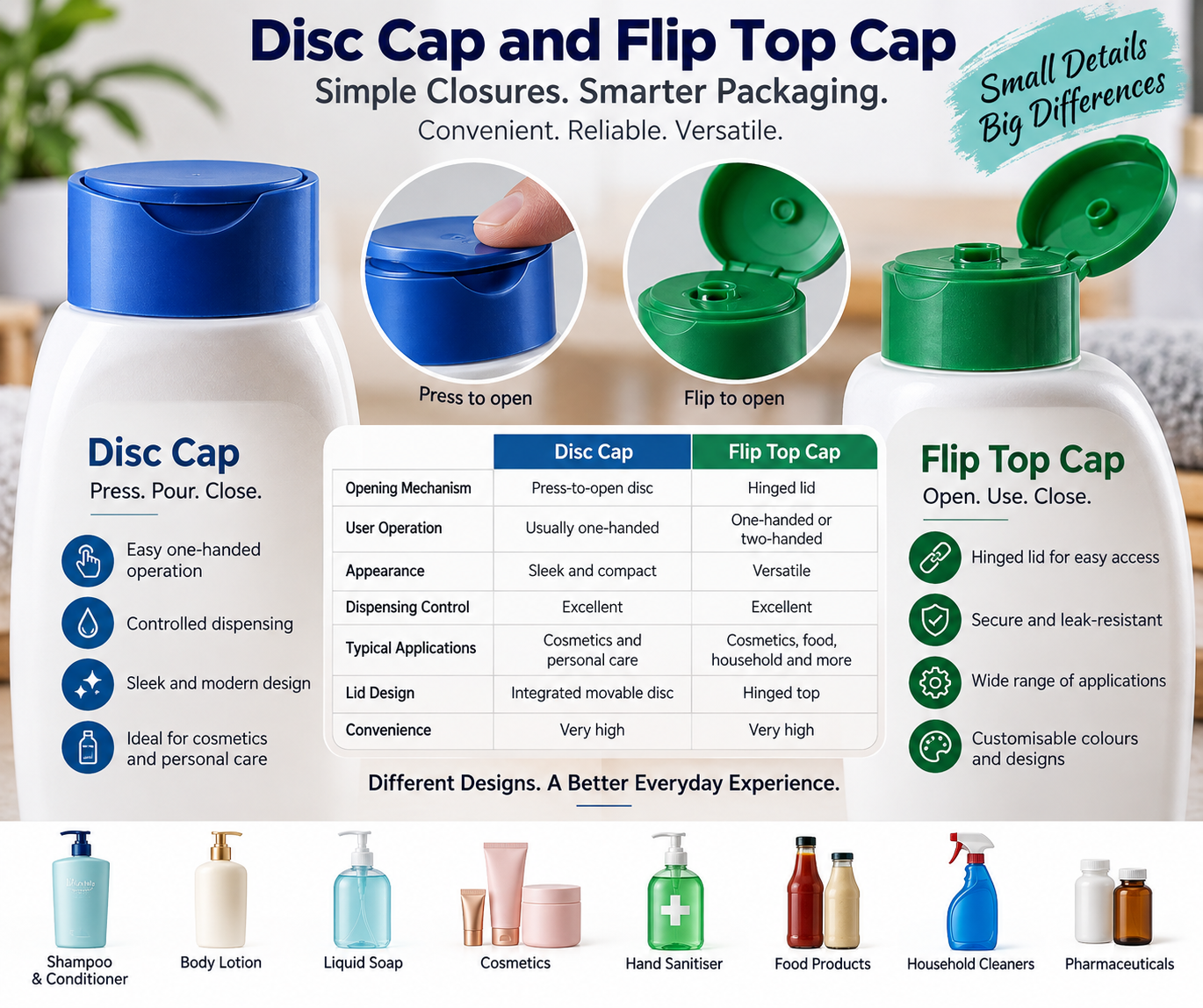
For shampoos, lotions, oils, personal care products, household cleaners, and many other liquid formulations, the closure directly affects convenience, dispensing control, product safety, and the overall customer experience. Two of the most widely used closure solutions are the disc cap and flip top cap.
Although both closures are designed to make dispensing easier, their mechanisms, applications, appearance, and suitability differ. Understanding these differences can help manufacturers, packaging companies, cosmetic brands, and product developers select the right closure for a particular bottle and formulation.
What Is a Disc Cap?
A disc cap, also commonly known as a disc top closure, is a dispensing cap operated by pressing one side of the upper disc. When pressure is applied, the opposite side rises and reveals a dispensing opening.
The user can squeeze or pour the product through this opening and then press the raised section back down to close it.
Disc caps are frequently used for products that need controlled dispensing and convenient one-handed operation.
Common applications include:
- Shampoo and conditioner
- Body lotion
- Liquid soap
- Massage oil
- Hair care products
- Cosmetic formulations
- Hand sanitiser
- Personal care liquids
The compact appearance of a disc cap also makes it suitable for packaging designs where manufacturers want a clean and modern bottle profile.
What Is a Flip Top Cap?
A flip top cap consists of a closure body with a hinged lid that can be opened and closed repeatedly. The user flips the lid upward to expose the dispensing opening and presses it downward until it snaps securely into place.
Because the lid remains attached to the closure, it is convenient for products that consumers use frequently.
A flip top cap is widely used in industries such as:
- Cosmetics
- Personal care
- Food packaging
- Household cleaning
- Pharmaceutical packaging
- Hair care
- Skin care
Shampoo bottles, shower gels, creams, sauces, hand washes, and cleaning liquids are common examples.
Disc Cap vs Flip Top Cap
Choosing between these two closures depends on the product’s viscosity, bottle design, consumer expectations, and dispensing requirements.
| Feature | Disc Cap | Flip Top Cap |
| Opening mechanism | Press-to-open disc | Hinged lid |
| User operation | Usually one-handed | One-handed or two-handed |
| Appearance | Sleek and compact | Highly versatile |
| Dispensing control | Excellent | Excellent |
| Typical applications | Cosmetics and personal care | Cosmetics, food and household products |
| Lid design | Integrated movable disc | Hinged top |
| Convenience | Very high | Very high |
Neither option is universally better. The ideal closure depends on how consumers are expected to use the packaged product.
Benefits of Using a Disc Cap
The popularity of the disc cap is largely connected to its simple operation and attractive appearance.
Controlled Product Dispensing
The dispensing opening can help users control how much liquid leaves the container. This is particularly useful for shampoos, lotions, conditioners, and cosmetic liquids.
Convenient One-Handed Operation
Consumers can often open the closure simply by pressing one side of the disc with a finger.
Clean Packaging Appearance
Disc closures create a streamlined bottle profile, making them particularly attractive for cosmetic and personal care packaging.
Suitable for Different Bottle Designs
Manufacturers can produce disc closures in different diameters, colours, finishes, and dispensing configurations.
Where Disc Closures Perform Best
Products with medium-flow liquid formulations often work particularly well with this closure because users can squeeze the bottle while maintaining dispensing control.
Advantages of a Flip Top Cap
The flip top cap has become one of the most versatile packaging closures because it combines convenient access with repeated opening and closing.
Easy Opening and Closing
Consumers simply lift the hinged lid to access the dispensing hole.
Attached Lid
Unlike separate screw caps, the lid remains connected to the closure. This reduces the chance of users losing the cap.
Wide Range of Applications
A flip top cap can be designed for thin liquids, thicker creams, gels, sauces, detergents, and many other formulations.
Flexible Design Options
Manufacturers can customise:
- Closure diameter
- Orifice size
- Cap colour
- Surface finish
- Hinge design
- Neck compatibility
- Logo or branding
This flexibility allows brands to match closure design with bottle appearance and product positioning.
How to Choose Between Disc Cap and Flip Top Cap
Manufacturers should evaluate the complete packaging system rather than selecting a closure based only on appearance.
Consider the following factors:
- Product viscosity
- Bottle neck specification
- Required dispensing quantity
- Leakage resistance
- Consumer usage pattern
- Transportation conditions
- Packaging appearance
- Closure material
- Manufacturing cost
- Product compatibility
For example, a premium body lotion bottle may benefit from the streamlined appearance of a disc cap, while a frequently used shampoo or shower gel may perform better with a flip top cap.
Material Selection for Packaging Caps
Polypropylene, commonly known as PP, is frequently used for dispensing closures because it offers durability, flexibility, and good hinge performance.
Other plastic materials may also be selected depending on the product requirements.
Packaging developers should conduct compatibility testing because the formulation stored inside the bottle may interact differently with particular plastics.
Important tests can include:
- Leakage testing
- Drop testing
- Torque testing
- Transportation testing
- Chemical compatibility testing
- Opening and closing cycle testing
Testing the complete bottle-and-cap combination is essential before large-scale production.
Importance of Orifice Size
The dispensing opening has a significant influence on consumer experience.
A very small opening can make thick products difficult to dispense. A very large opening may release excessive quantities of thin liquids.
Manufacturers therefore need to match the dispensing orifice with product viscosity.
Thicker formulations such as creams and conditioners usually require different dispensing characteristics compared with lightweight oils or liquid cleansers.
Both disc cap and flip top cap designs can be developed with different orifice dimensions to meet these requirements.
Customisation and Branding Opportunities
Packaging closures contribute to brand recognition just as much as bottle shape and label design.
Manufacturers can customise closures using different colours, finishes, and decorative options.
Matching a flip top cap or disc closure with the bottle colour can create a sophisticated monochromatic appearance, while contrasting colours can help products stand out on retail shelves.
Brands should also consider usability. Attractive packaging that is difficult to open or creates product leakage can negatively affect the customer experience.
Frequently Asked Questions
1. What is a disc cap used for?
A disc cap is commonly used for dispensing shampoos, lotions, conditioners, oils, liquid soaps, and cosmetic products.
2. How does a disc cap open?
Pressing one side of the upper disc causes the opposite side to rise, exposing the dispensing opening.
3. What is a flip top cap?
A flip top cap is a dispensing closure featuring a hinged lid that opens upward and snaps closed after use.
4. Which cap is better for shampoo bottles?
Both closures can work effectively, although flip top closures are particularly common for shampoo packaging.
5. Are disc caps suitable for cosmetics?
Yes. Their sleek design and controlled dispensing make them popular for cosmetic and personal care packaging.
6. Can flip top caps handle thick liquids?
Yes, provided the dispensing opening is appropriately designed for the viscosity of the formulation.
7. What materials are commonly used for these caps?
Polypropylene is commonly used, although material selection depends on packaging and formulation requirements.
8. Can these closures be customised?
Yes. Manufacturers can customise colour, diameter, finish, dispensing opening, and other features.
9. How can manufacturers reduce closure leakage?
Selecting compatible bottle neck dimensions, proper closure design, suitable materials, and thorough leakage testing are important.
10. Which closure offers better dispensing control?
Both can provide excellent control when their dispensing openings are properly matched with the product viscosity.