
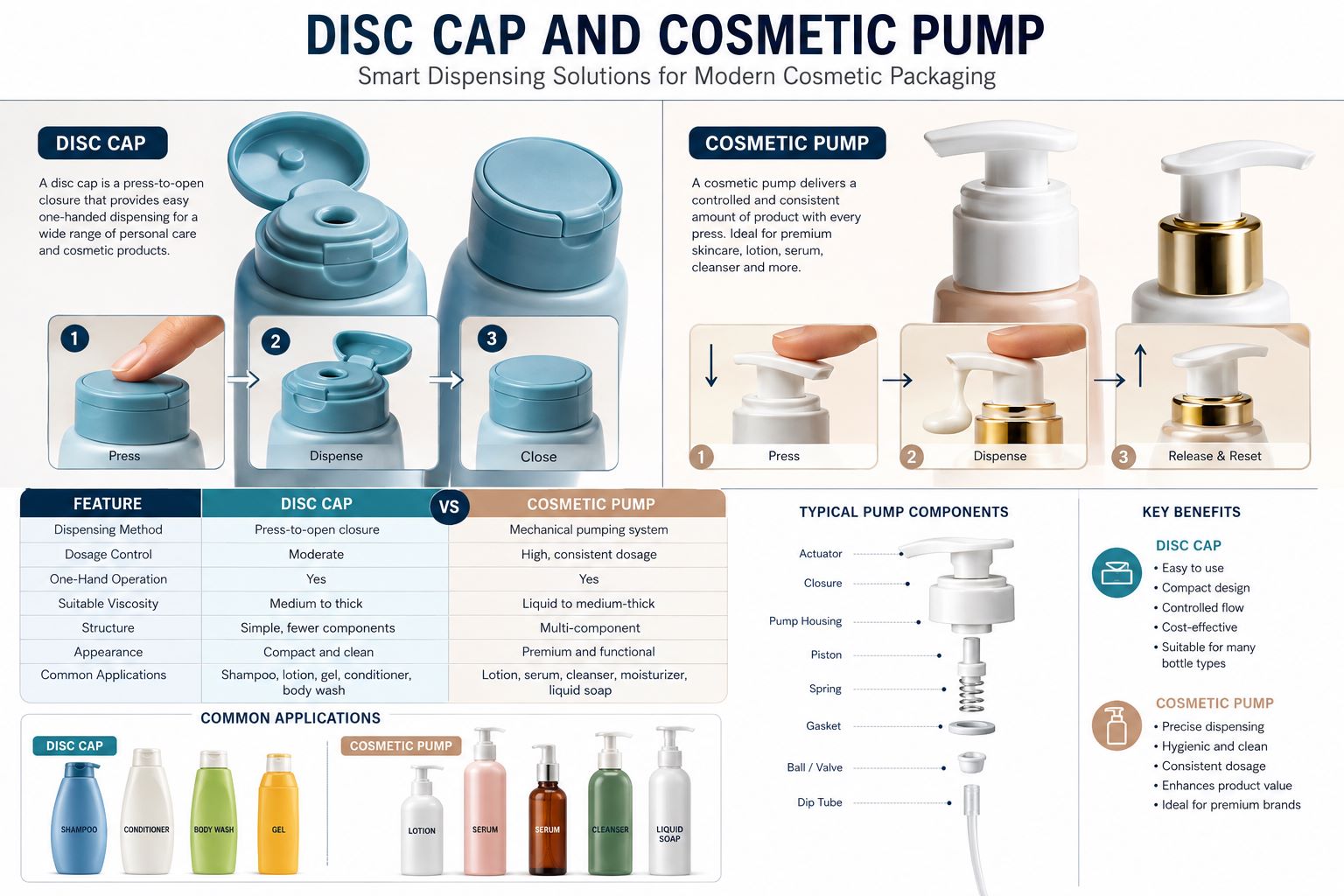
Packaging does more than hold a cosmetic or personal care product. It controls how the formula is dispensed, protects the contents, improves convenience, and influences the customer’s perception of the brand. Two widely used dispensing components are the disc cap and cosmetic pump. Although both provide controlled product delivery, they serve different formulations, packaging styles, and consumer needs.
From shampoos and lotions to serums, cleansers, creams, and body care products, selecting the correct closure can significantly improve the overall user experience. Understanding the differences between these dispensing systems helps manufacturers, cosmetic brands, packaging suppliers, and product developers make better packaging decisions.
What Is a Disc Cap?
A disc cap is a dispensing closure commonly fitted onto plastic bottles containing shampoos, conditioners, lotions, gels, body washes, and similar personal care formulations. The top contains a circular disc that operates with simple finger pressure.
When one side of the disc is pressed, the opposite side rises and exposes the dispensing opening. After use, pressing the raised section closes the cap again.
This simple mechanism provides several advantages:
- Convenient one-handed operation
- Controlled dispensing
- Clean and compact bottle appearance
- Reduced risk of accidental leakage
- Compatibility with numerous bottle shapes
- Cost-effective packaging for mass-market products
A disc top closure is particularly suitable for medium-viscosity formulations that can flow naturally when the bottle is squeezed or tilted.
Why Disc Caps Are Popular in Personal Care Packaging
Convenience is one of the biggest reasons manufacturers choose a disc cap. Consumers do not need to unscrew a closure every time they use the product.
For products used frequently, such as shampoo or body lotion, this small improvement can make packaging considerably easier to use.
Another advantage is its minimalist appearance. Disc closures create a smooth profile that works well with contemporary cosmetic bottle designs.
Manufacturers can also customise them using different:
- Colours
- Neck sizes
- Surface finishes
- Materials
- Orifice dimensions
- Decorative treatments
Choosing the appropriate dispensing hole is especially important because product viscosity determines how easily the formulation flows.
What Is a Cosmetic Pump?
A cosmetic pump is a dispensing mechanism designed to release a measured quantity of liquid, cream, lotion, serum, or gel when its actuator is pressed.
Instead of requiring the user to squeeze or invert the bottle, the internal pumping mechanism draws the formulation upward through a dip tube and releases it through the nozzle.
Cosmetic pumps are commonly found on:
- Facial cleansers
- Hand lotions
- Moisturisers
- Liquid foundations
- Hair products
- Body lotions
- Serums
- Massage products
- Professional beauty formulations
A high-quality pump can provide smooth, consistent dispensing while helping minimise unnecessary contact between the consumer and the remaining formulation.
Main Components of a Cosmetic Pump
Although designs vary between manufacturers, a standard pump generally contains several functional parts.
The actuator is the component pressed by the consumer. Beneath it sits the pump mechanism, which creates the pressure required to draw the product from the container.
A dip tube extends into the bottle and transports the formulation toward the pumping chamber.
Other components may include:
- Closure
- Stem
- Piston
- Spring
- Gasket
- Housing
- Ball valve
- Dip tube
Each component contributes to dispensing accuracy, sealing performance, and product compatibility.
Disc Cap vs Cosmetic Pump
Both packaging systems offer controlled dispensing, but their ideal applications are different.
| Feature | Disc Cap | Cosmetic Pump |
| Operating method | Press-and-open disc | Push-down actuator |
| Product dispensing | Bottle is tilted or squeezed | Pump draws product upward |
| Best for | Shampoo, gel, conditioner | Lotion, cleanser, serum |
| Portion control | Moderate | High |
| Packaging cost | Generally lower | Generally higher |
| User convenience | High | Very high |
| Premium appearance | Moderate to high | High |
| Mechanism complexity | Simple | More complex |
The best option depends on formulation viscosity, bottle construction, desired dosage, brand positioning, and expected consumer behaviour.
How to Choose the Right Disc Cap
Choosing a disc cap requires more than selecting a colour that matches the bottle.
First, check bottle-neck compatibility. The closure dimensions and thread must correspond accurately with the container to create a reliable seal.
Next, consider product viscosity. A thick conditioner may require a larger dispensing opening than a relatively fluid shampoo.
Important considerations include:
- Bottle neck diameter and thread specification
- Product thickness and flow behaviour
- Required dispensing quantity
- Closure material
- Leak-resistance requirements
- Colour and surface finish
- Transportation conditions
Packaging should also undergo compatibility and leakage testing before full-scale production.
How to Select the Right Cosmetic Pump
Selecting a cosmetic pump requires careful evaluation because different formulas behave differently inside pumping systems.
One important specification is dosage output. Some products need a small controlled dose, while body lotions may require considerably more product with each stroke.
Dip-tube length is equally important. A poorly sized tube can make it difficult for customers to access the remaining product.
Manufacturers should evaluate:
- Output per stroke
- Formula viscosity
- Bottle-neck specification
- Dip-tube dimensions
- Pump priming performance
- Locking mechanism
- Chemical compatibility
- Leakage resistance
Testing the pump with the actual formulation is recommended because oils, alcohols, fragrances, surfactants, and other ingredients may interact differently with packaging components.
Material Selection and Packaging Compatibility
Polypropylene is frequently used for dispensing closures because it combines durability, chemical resistance, flexibility, and manufacturing efficiency.
However, packaging compatibility cannot be determined from material alone.
The complete formulation should be tested against the disc cap or pump assembly under realistic storage conditions. Temperature variations, transportation, repeated use, and prolonged formula contact can influence performance.
A reliable packaging development process may include:
- Leak testing
- Drop testing
- Compatibility testing
- Dispensing-cycle testing
- Torque testing
- Storage stability evaluation
These procedures help identify packaging problems before products enter commercial distribution.
Improving Brand Presentation Through Dispensing Packaging
Closures are highly visible parts of a cosmetic package. Their design can therefore influence brand perception.
A simple disc cap can create a clean, practical look for everyday hair care and personal care products. A stylish cosmetic pump, meanwhile, can help communicate a more premium or professional appearance.
Brands can coordinate closures with bottles using custom colours, matte finishes, glossy surfaces, metallic effects, or minimalist neutral shades.
Good packaging combines visual appeal with dependable functionality. An attractive closure that leaks, jams, or dispenses inconsistently can quickly damage the customer experience.
Sustainability Considerations
Sustainability is becoming increasingly important throughout cosmetic packaging development.
Brands are exploring lighter packaging components, recyclable materials, mono-material structures, refillable systems, and reduced packaging weight.
Because pumps contain multiple parts, their recyclability can sometimes be more complicated than that of simpler closures. Packaging developers should therefore discuss available recyclable or reduced-component pump technologies with their supplier.
A simpler disc cap may offer advantages in certain sustainability-focused packaging applications, particularly when its material is compatible with the bottle recycling stream.
Frequently Asked Questions
1. What is a disc cap used for?
It is commonly used for dispensing shampoos, conditioners, lotions, gels, body washes, and other personal care products.
2. How does a disc cap work?
Pressing one side of the top disc raises the opposite side and exposes the dispensing opening.
3. What is a cosmetic pump used for?
It dispenses products such as lotions, cleansers, serums, creams, foundations, and hair care formulations.
4. Which is better, a disc cap or cosmetic pump?
Neither is universally better. The correct choice depends on formulation viscosity, dosage requirements, packaging design, and budget.
5. Are disc caps suitable for thick products?
Yes, provided the formulation and dispensing-orifice size are compatible.
6. Can cosmetic pumps dispense thick lotions?
Yes. Pumps designed specifically for higher-viscosity formulations are available.
7. Can dispensing closures be customised?
Yes. Manufacturers may offer customised colours, finishes, sizes, outputs, and decorative options.
8. Why is pump dosage important?
Controlled output helps consumers use an appropriate amount and provides a more consistent application experience.
9. How is the correct dip-tube length determined?
It is normally calculated according to bottle height, pump design, and internal container geometry.
10. Should packaging be tested before bulk production?
Yes. Formula compatibility, leakage, dispensing performance, and transportation resistance should be evaluated before commercial production.