
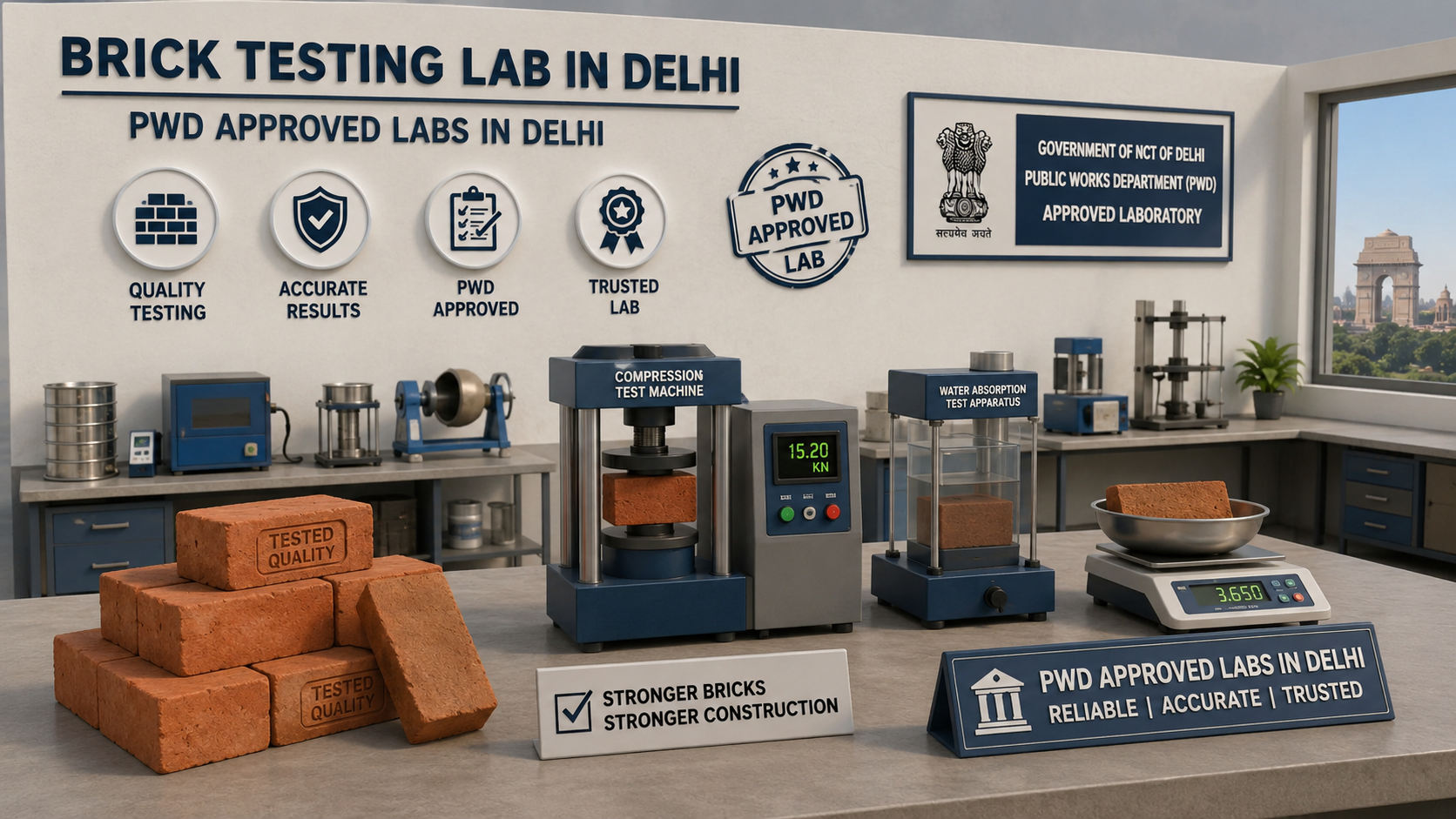
Construction quality depends heavily on the strength and performance of the materials used at a project site. Bricks, cement, aggregates, concrete, steel, soil, and water all influence the durability and safety of a building. Among these materials, bricks are especially important because they are widely used for walls, partitions, foundations, and structural masonry. Choosing a reliable brick testing lab in Delhi can therefore help builders, contractors, architects, engineers, and government agencies verify whether bricks meet the required quality standards.
For infrastructure and government-related construction, testing requirements may be even stricter. This is why project owners frequently look for PWD approved labs in Delhi capable of conducting recognised construction material tests and providing proper laboratory reports.
Why Brick Testing Is Important in Construction
Bricks may look similar externally, but their strength, water absorption, dimensions, density, and durability can vary significantly. Poor-quality bricks may absorb excessive moisture, develop cracks, lose strength, or cause plaster and masonry failures.
A professional brick testing laboratory evaluates important physical and mechanical characteristics before the bricks are used in construction.
Testing helps determine whether materials are suitable for:
- Residential buildings
- Commercial complexes
- Government projects
- Roads and infrastructure facilities
- Schools and hospitals
- Industrial buildings
- Boundary walls and masonry structures
Using a professional brick testing lab in Delhi allows construction teams to detect unsuitable materials before they become part of a permanent structure.
Common Tests Conducted on Bricks
A construction material laboratory may conduct several tests depending on project specifications and applicable standards.
Common brick tests include:
- Compressive strength testing
- Water absorption testing
- Efflorescence testing
- Dimensional testing
- Visual inspection
- Density testing
- Warpage and shape evaluation
Among these, compressive strength and water absorption tests are particularly important for evaluating brick quality.
Compressive strength indicates how much load a brick can withstand before failure. Water absorption testing determines how much moisture the brick absorbs under specified test conditions.
Importance of Compressive Strength Testing
Compressive strength is one of the primary indicators of masonry brick performance. During testing, a prepared brick specimen is placed inside a compression testing machine and subjected to gradually increasing pressure until failure occurs.
The test result helps engineers determine whether the brick satisfies the strength requirement specified for the project.
A competent brick testing lab in Delhi maintains calibrated equipment, controlled testing procedures, trained technical personnel, and proper documentation to produce dependable results.
Accurate strength testing is particularly important for large-scale construction where thousands or millions of bricks may be used.
Understanding Water Absorption Testing
Bricks contain pores that can absorb moisture. Excessive water absorption may lead to dampness, deterioration, salt deposits, and reduced durability.
During a typical water absorption test, brick samples are dried, weighed, immersed in water under specified conditions, and weighed again. The percentage increase in weight helps determine the material’s water absorption characteristics.
This test can help contractors identify bricks that may not be suitable for demanding environments or specific masonry applications.
What Are PWD Approved Labs in Delhi?
PWD generally refers to the Public Works Department responsible for various government buildings and infrastructure projects. Construction materials used in public projects may need to be tested by laboratories that satisfy the requirements specified by the concerned authority or tender conditions.
Therefore, contractors frequently search for PWD approved labs in Delhi when working on government construction projects.
Such laboratories may test materials including:
- Bricks and blocks
- Cement
- Fine aggregates
- Coarse aggregates
- Concrete cubes
- Reinforcement steel
- Soil
- Bitumen
- Paver blocks
- Tiles
- Construction water
Project requirements can vary, so contractors should always verify the latest approval status and testing scope required by the relevant authority before submitting samples.
Brick Testing Lab vs General Construction Material Lab
| Testing Area | Brick Testing Laboratory | Construction Material Laboratory |
| Brick strength | Yes | Yes |
| Water absorption | Yes | Yes |
| Efflorescence | Yes | Usually |
| Cement testing | Limited | Yes |
| Aggregate testing | Limited | Yes |
| Concrete cube testing | Sometimes | Yes |
| Steel testing | Usually limited | Yes |
| Soil testing | Usually limited | Yes |
A specialised brick testing lab in Delhi may focus heavily on masonry products, while a full construction material laboratory can provide multiple testing services under one facility.
How to Choose a Reliable Testing Laboratory
Selecting a laboratory should not be based only on testing charges. The quality of the laboratory directly influences the reliability of the test report.
Before selecting a laboratory, consider:
- Laboratory accreditation or relevant recognition
- Approval requirements mentioned in the project documents
- Availability of calibrated testing equipment
- Experience of laboratory technicians
- Testing standards followed
- Report turnaround time
- Sample identification procedure
- Testing scope
- Report format and traceability
For government projects, confirm whether the laboratory satisfies the project’s required approval conditions instead of assuming that every laboratory is automatically acceptable.
Benefits of Using PWD Approved Labs in Delhi
Working with suitable PWD approved labs in Delhi can simplify construction quality control and documentation.
Major benefits include:
- Reliable material evaluation
- Better construction quality monitoring
- Proper testing documentation
- Easier compliance with project specifications
- Identification of defective materials
- Improved traceability
- Support during quality audits and inspections
- Reduced possibility of using substandard materials
Testing should ideally be performed before large quantities of materials are permanently incorporated into the project.
Brick Sample Collection and Testing Process
The testing process generally begins with proper sampling.
A typical workflow may include:
- Select representative brick samples.
- Assign identification details.
- Submit samples to the laboratory.
- Provide project and material information.
- Conduct required laboratory tests.
- Record observations and calculations.
- Prepare the final test report.
- Compare results with project specifications.
Representative sampling is essential because testing only unusually strong or visually perfect bricks may provide misleading information about an entire batch.
Why Laboratory Calibration Matters
Testing machines must produce accurate measurements. A compression testing machine that is not correctly calibrated may provide incorrect strength results.
Professional laboratories follow equipment calibration and maintenance schedules to improve measurement reliability.
When choosing a brick testing lab in Delhi, ask whether the equipment used for your required test is maintained and calibrated according to applicable laboratory procedures.
Role of Material Testing in Government Projects
Government projects usually involve detailed specifications, quality control procedures, inspections, and documentation.
Material testing helps engineers verify whether supplied construction materials meet specified requirements.
Testing records may also become part of project quality documentation.
This makes dependable PWD approved labs in Delhi valuable for contractors involved in public buildings, infrastructure projects, renovation work, and civil engineering contracts.
Frequently Asked Questions
What is a brick testing lab?
A brick testing lab is a facility where bricks are tested for characteristics such as compressive strength, water absorption, dimensions, efflorescence, and other quality parameters.
Why should bricks be tested before construction?
Testing helps determine whether bricks satisfy the strength and durability requirements of the project before large quantities are used.
What is the main strength test for bricks?
Compressive strength testing is one of the most commonly performed tests for determining the load-bearing capacity of bricks.
What does water absorption testing indicate?
It indicates how much water a brick can absorb under defined testing conditions, which can affect durability and moisture performance.
What are PWD approved labs in Delhi?
They generally refer to laboratories accepted or recognised for testing materials related to Public Works Department projects, subject to applicable project and authority requirements.
Can one laboratory test multiple construction materials?
Yes. Many construction material laboratories test bricks, cement, aggregates, concrete, soil, steel, tiles, and other civil engineering materials.
How long does brick testing take?
The duration depends on the required tests, sample preparation procedure, laboratory workload, and applicable testing method.
How many bricks are required for testing?
The required sample quantity depends on the testing standard, project specifications, and number of tests requested.
Can contractors submit brick samples directly?
In many cases, yes. However, some projects may require sampling or witnessing procedures specified by consultants, engineers, or government authorities.
How can I verify whether a laboratory is approved?
Request current approval, accreditation, scope, or recognition documents and compare them with the specific requirements mentioned in your tender or project specification.
Are laboratory reports important for construction audits?
Yes. Test reports can provide documented evidence that construction materials were evaluated as part of the project’s quality-control process.