
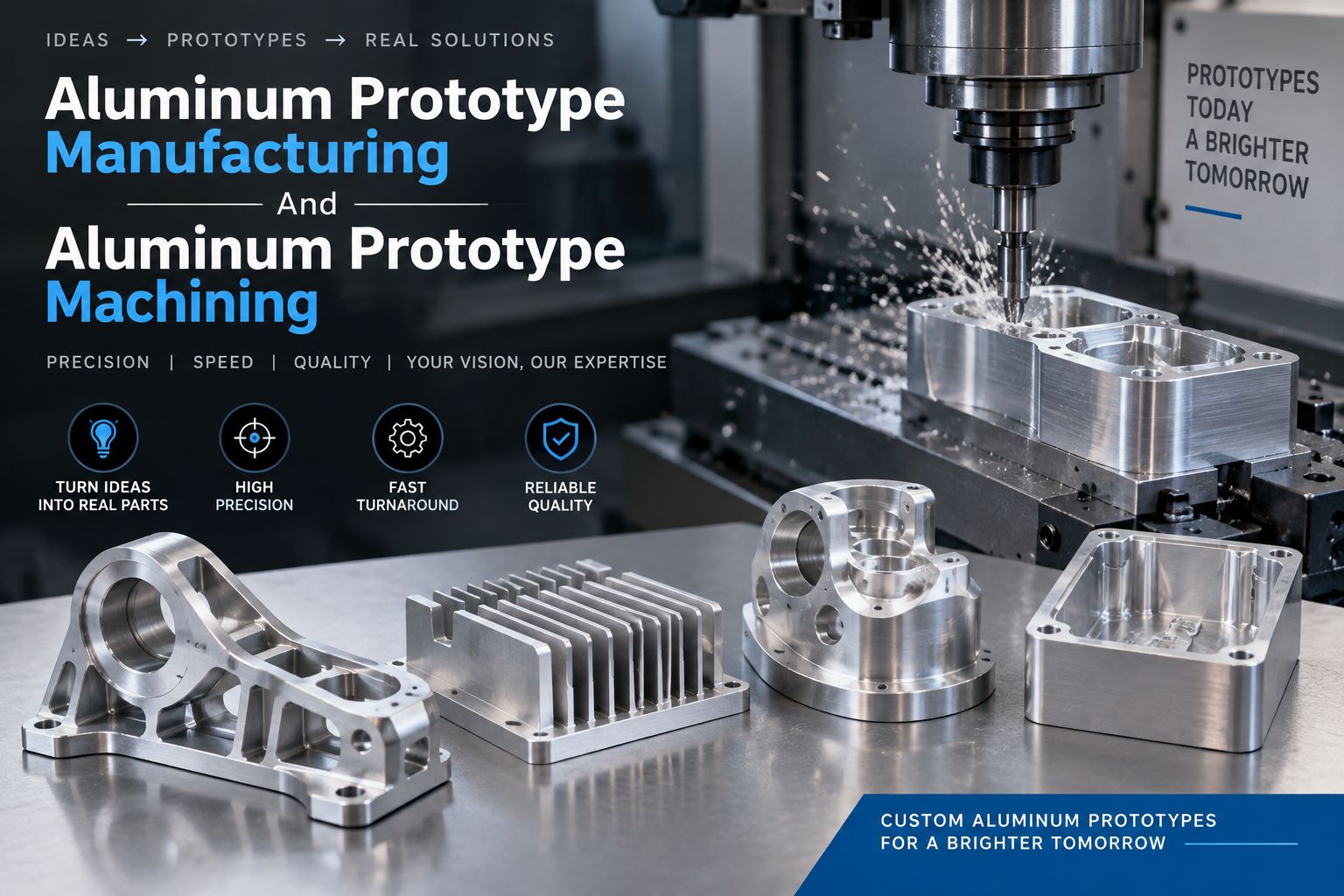
Turning a product idea into a reliable physical part is a critical stage of engineering. For manufacturers, startups, automotive teams, aerospace companies, electronics brands, and industrial designers, aluminum offers an excellent balance of strength, machinability, corrosion resistance, and appearance. This is why aluminum prototype manufacturing is used for developing functional parts before mass production.
When tight tolerances, complex geometry, or realistic mechanical performance are required, aluminum prototype machining provides the accuracy needed to test a design under real operating conditions. A well-planned prototyping process can expose design weaknesses, shorten development cycles, improve manufacturability, and reduce expensive production changes.
Why Aluminum Works Well for Functional Prototypes
Aluminum delivers useful mechanical performance. Compared with many plastics, it better represents the behavior of a future metal component. Engineers can evaluate fit, thermal response, structural performance, mounting features, threads, surface quality, and assembly compatibility using a predictable material.
Key advantages include:
- High strength-to-weight ratio
- Excellent CNC machinability
- Good corrosion resistance
- Reliable thermal conductivity
- Multiple alloy choices
- Easy anodizing and finishing
- Good dimensional stability
These qualities make aluminum prototype manufacturing suitable for enclosures, housings, brackets, heat sinks, robotic components, automotive parts, medical components, jigs, fixtures, and custom assemblies.
How Aluminum Prototype Machining Works
Most aluminum prototype machining projects begin with a 3D CAD model. Engineers review geometry, tolerances, material grade, finish, and functional purpose before choosing machining strategies. CNC milling and turning are most common, while drilling, tapping, grinding, EDM, and secondary finishing may also be used.
Typical Production Workflow
- Review CAD files and drawings.
- Select the aluminum alloy.
- Check tolerances and machinability.
- Prepare CAM programming and tooling.
- Machine the component.
- Inspect critical dimensions.
- Apply required finishing.
- Complete final quality verification.
Why Design Review Matters
Design-for-manufacturing analysis can identify deep cavities, thin walls, inaccessible corners, unnecessary tight tolerances, or features needing special tools. Correcting these issues before machining improves quality and controls cost.
Choosing the Right Aluminum Alloy
Material choice affects strength, machinability, corrosion behavior, weight, and finishing. Two common grades are 6061 and 7075 aluminum.
| Factor | Aluminum 6061 | Aluminum 7075 |
| Machinability | Excellent | Excellent |
| Strength | Medium to high | Very high |
| Corrosion resistance | Very good | Moderate |
| Typical use | Housings, general parts | Aerospace, high-load parts |
| Cost | More economical | Usually higher |
For general aluminum prototype manufacturing, 6061 is often practical because it machines cleanly and performs well in many environments. When higher strength is essential, 7075 may be more suitable.
Benefits for Product Development Teams
A physical aluminum prototype provides information that a digital model cannot fully reproduce. Teams can evaluate assembly, vibration, heat transfer, tool access, fastening behavior, and user interaction.
Aluminum prototype machining can help teams:
- Verify dimensions before tooling
- Test real assembly conditions
- Evaluate functional performance
- Check mounting and fastening points
- Validate heat dissipation
- Identify manufacturing risks
- Present realistic samples
CNC Machining Versus Other Prototype Methods
| Method | Accuracy | Material Realism | Best Application |
| CNC aluminum machining | High | Excellent | Functional metal prototypes |
| 3D printing | Medium to high | Varies | Concept and geometry testing |
| Casting | Medium to high | Excellent | Production-like metal parts |
| Sheet metal fabrication | High | Excellent | Panels and enclosures |
For parts with precise bores, threads, sealing surfaces, pockets, and controlled tolerances, aluminum prototype machining is often the most dependable choice.
What Affects Prototype Cost and Lead Time?
Prototype pricing depends on geometry, setup time, tolerances, machine access, quantity, inspection, material, and finishing.
Costs can often be reduced by:
- Avoiding unnecessary tight tolerances
- Using standard hole sizes and threads
- Reducing extremely deep pockets
- Designing accessible internal corners
- Choosing standard stock sizes
- Limiting cosmetic finishing where possible
Early communication during aluminum prototype manufacturing is valuable because small design adjustments can simplify machining without reducing part performance.
Quality Control and Surface Finishing
Reliable prototyping requires dimensional inspection. Calipers, micrometers, thread gauges, pin gauges, height gauges, surface testers, and coordinate measuring machines may be used depending on the project.
A capable supplier should maintain material traceability, calibrated inspection equipment, controlled procedures, and clear tolerance communication.
Machined aluminum may also receive bead blasting, anodizing, polishing, powder coating, brushing, painting, or conversion coating. Anodizing is especially popular because it can improve corrosion resistance, surface hardness, and appearance.
Frequently Asked Questions
1. What is aluminum prototype manufacturing?
It is the production of low-volume aluminum parts for testing, validation, demonstration, or product development before full-scale manufacturing.
2. What is aluminum prototype machining?
It usually refers to CNC milling, turning, drilling, and related processes used to create accurate aluminum prototype components.
3. Why use aluminum instead of plastic?
Aluminum offers higher strength, rigidity, heat resistance, and more realistic performance for many final metal products.
4. Is CNC machining suitable for one prototype?
Yes. CNC machining works well for one-off components and small prototype batches.
5. Which aluminum grade is commonly used?
6061 is common for general prototypes, while 7075 is used when higher strength is required.
6. Can aluminum prototypes be anodized?
Yes. Many aluminum alloys can be anodized for improved appearance, corrosion resistance, and surface durability.
7. How accurate can machined prototypes be?
Accuracy depends on part geometry, equipment, setup, tolerance requirements, and inspection methods.
8. What files are needed for a quotation?
Manufacturers usually need a 3D CAD file, technical drawing, material, quantity, tolerances, and finishing requirements.
9. How can prototype cost be reduced?
Use practical tolerances, simpler geometry, standard materials, accessible features, and only necessary surface finishing.
10. When should aluminum prototypes be used?
They are useful for engineering validation, assembly checks, product testing, demonstrations, pilot production, and pre-production development.