The nonwoven industry supports hygiene, healthcare, agriculture, packaging, furniture, filtration, construction, and many consumer products. Two technologies sit at the center of this manufacturing ecosystem: the Nonwoven Production Line and the PP Spunbond Nonwoven Machine.
Together, they convert polypropylene resin into lightweight, strong, breathable, and economical fabric. Success depends on machine selection, process control, waste reduction, and matching fabric specifications with end-use requirements.
Understanding a Nonwoven Production Line
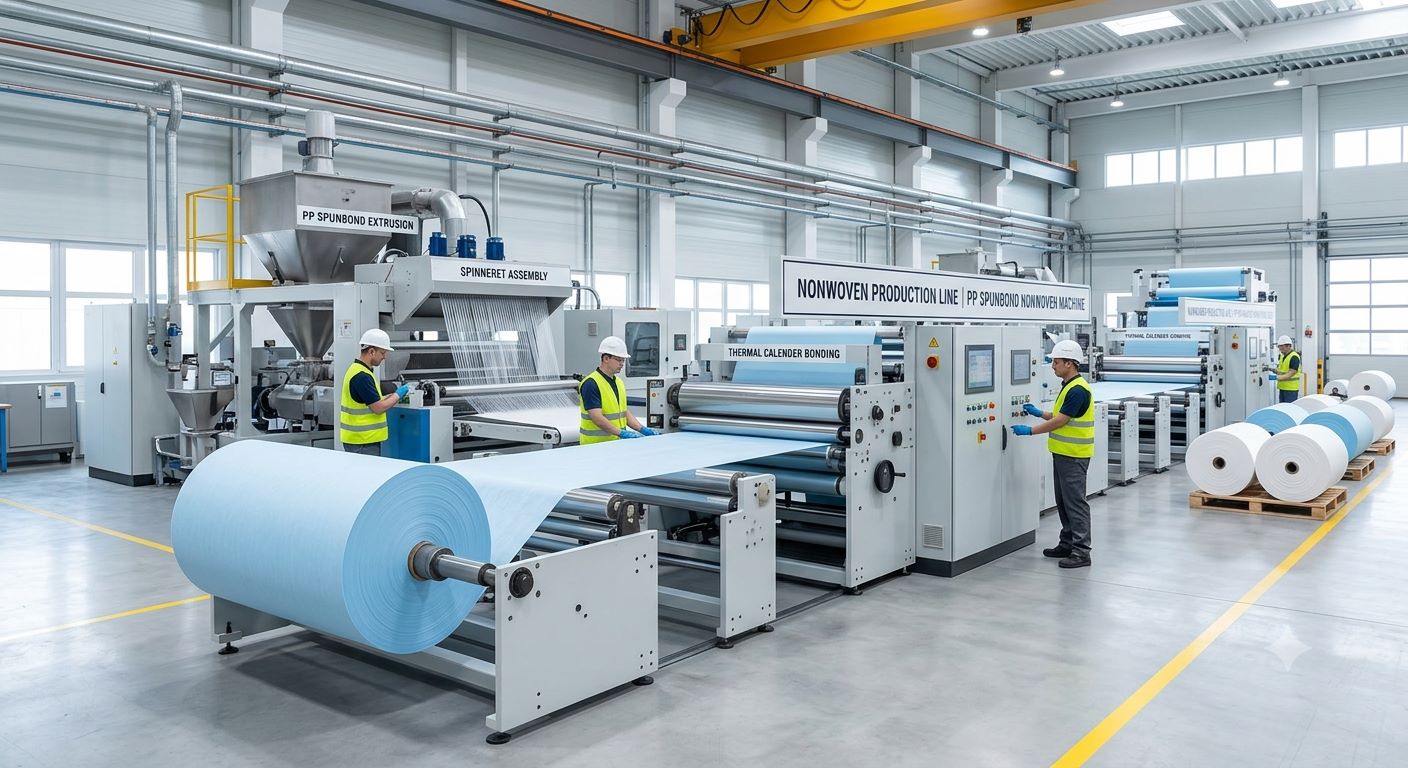
A Nonwoven Production Line produces fabric without conventional weaving or knitting. Instead of interlacing yarns, it forms a web of fibers or continuous filaments and bonds them using thermal, mechanical, or chemical methods.
In polypropylene spunbond production, the line handles resin feeding through finished roll winding. Automation helps maintain stable GSM, width, tensile strength, uniformity, and production speed.
Main Production Stages
A typical production flow includes:
- Raw material feeding and mixing
- Polymer melting and extrusion
- Filtration and metering
- Filament spinning
- Cooling and stretching
- Web formation
- Thermal bonding
- Slitting and winding
Every stage affects performance. Variations in temperature, airflow, pressure, speed, or tension may cause uneven GSM, weak areas, or filament defects.
How a PP Spunbond Nonwoven Machine Works
A PP Spunbond Nonwoven Machine converts polypropylene granules into continuous filaments. PP is widely used because it is lightweight, chemically resistant, economical, and suitable for high-speed processing.
The resin enters an extruder, where controlled heat melts the polymer. After filtration and metering, molten PP reaches the spinning beam and spinneret. Fine filaments are created, cooled with air, stretched, and distributed across a moving conveyor.
The web then passes through heated calender rollers. Heat and pressure bond the fibers at controlled points. The fabric is cooled, trimmed, slit when required, and wound into rolls.
Why Spunbond Technology Matters
Spunbond production combines continuous processing with good mechanical strength. Manufacturers can create different widths, GSM ranges, colors, embossing patterns, and functional grades.
Important Machine Components
A reliable Nonwoven Production Line commonly includes:
- Automatic raw-material feeding system
- Extruder with controlled heating zones
- Melt filter and metering pump
- Spinning beam and spinneret
- Quenching and drawing system
- Web-forming conveyor
- Thermal calender
- Slitting and winding unit
- PLC and HMI control system
Comparing Common Machine Configurations
Choosing a PP Spunbond Nonwoven Machine should depend on product quality and market requirements, not only maximum capacity.
| Configuration | Structure | Main Benefit | Common Uses |
| S | Single spunbond beam | Lower investment | Agriculture, packaging |
| SS | Double spunbond beam | Better strength and uniformity | Hygiene, furniture |
| SSS | Triple spunbond beam | Higher output and consistency | Premium hygiene products |
| SMS/SMMS | Spunbond and meltblown layers | Barrier and filtration performance | Medical materials |
The right system depends on fabric specifications, output, available power, and investment.
Factors That Influence Fabric Quality
Operators should monitor:
- Melt temperature and pressure
- Filament fineness
- Quenching airflow
- Conveyor speed
- Calender temperature
- Embossing pressure
- Winding tension
- Polymer consistency
A well-tuned PP Spunbond Nonwoven Machine should deliver even fabric with minimal thick spots, thin areas, broken filaments, or edge defects.
Choosing the Right Production Line
Before investing in a Nonwoven Production Line, define the products you intend to manufacture. Agricultural, hygiene, medical, and furniture fabrics may require different specifications.
Questions to Ask Before Buying
Evaluate:
- Required fabric width and GSM range
- Target applications
- Daily production capacity
- Automation level
- Power requirement
- Operator training
- Spare-parts availability
- Installation and after-sales support
Do not compare machines only by purchase price. Total ownership cost also includes energy, labor, maintenance, waste, downtime, and production efficiency.
Applications of PP Spunbond Fabric
Fabric made on a PP Spunbond Nonwoven Machine is used for medical gowns, masks, hygiene products, shoe covers, shopping bags, crop covers, furniture backing, mattress layers, packaging, filtration support, and construction materials.
Improving Efficiency and Reducing Waste
Efficient production focuses on stable saleable output. Preventive maintenance, trained operators, clean spinnerets, and consistent raw materials help reduce breakdowns and rejected fabric.
Efficient motors, heating control, edge recycling, and quality monitoring improve economics. An optimized Nonwoven Production Line increases usable output while lowering scrap and production cost.
Frequently Asked Questions
1. What is a PP spunbond nonwoven machine?
It melts polypropylene, forms continuous filaments, creates a web, thermally bonds it, and winds the finished fabric.
2. Which raw material is mainly used?
Polypropylene resin is the main material, often mixed with color or functional masterbatch.
3. What does GSM mean?
GSM means grams per square meter and represents fabric weight.
4. What is the difference between S and SS lines?
S uses one spunbond beam, while SS uses two beams for better uniformity and strength.
5. Can different fabric colors be produced?
Yes. Color masterbatch can be mixed with PP resin during feeding.
6. Which industries use spunbond fabric?
Healthcare, hygiene, agriculture, packaging, furniture, filtration, and construction are major users.
7. Can machine width be customized?
Yes. Production width can be selected according to product requirements.
8. What affects production speed?
GSM, polymer quality, extrusion capacity, filament stability, bonding conditions, and machine configuration influence speed.
9. How can fabric quality be improved?
Use consistent resin, stable process settings, clean spinning components, GSM monitoring, and preventive maintenance.
10. Is automation important?
Yes. Automation improves repeatability, control, tension stability, production tracking, and defect reduction.