The nonwoven sector continues to expand as manufacturers respond to demand from hygiene, medical, agriculture, packaging, filtration, furniture, construction, and industrial markets. This growth is increasing investment in a modern Nonwoven Production Line and an advanced PP Spunbond Nonwoven Machine capable of delivering reliable output, controlled fabric weight, efficient energy use, and consistent roll quality.
Unlike conventional woven textiles, nonwoven fabrics can be produced directly from fibers or continuous filaments without traditional weaving or knitting. For manufacturers, that means production performance depends heavily on extrusion stability, filament formation, web uniformity, bonding control, automation, and winding precision.
Modern Nonwoven Production Is Becoming More Automated
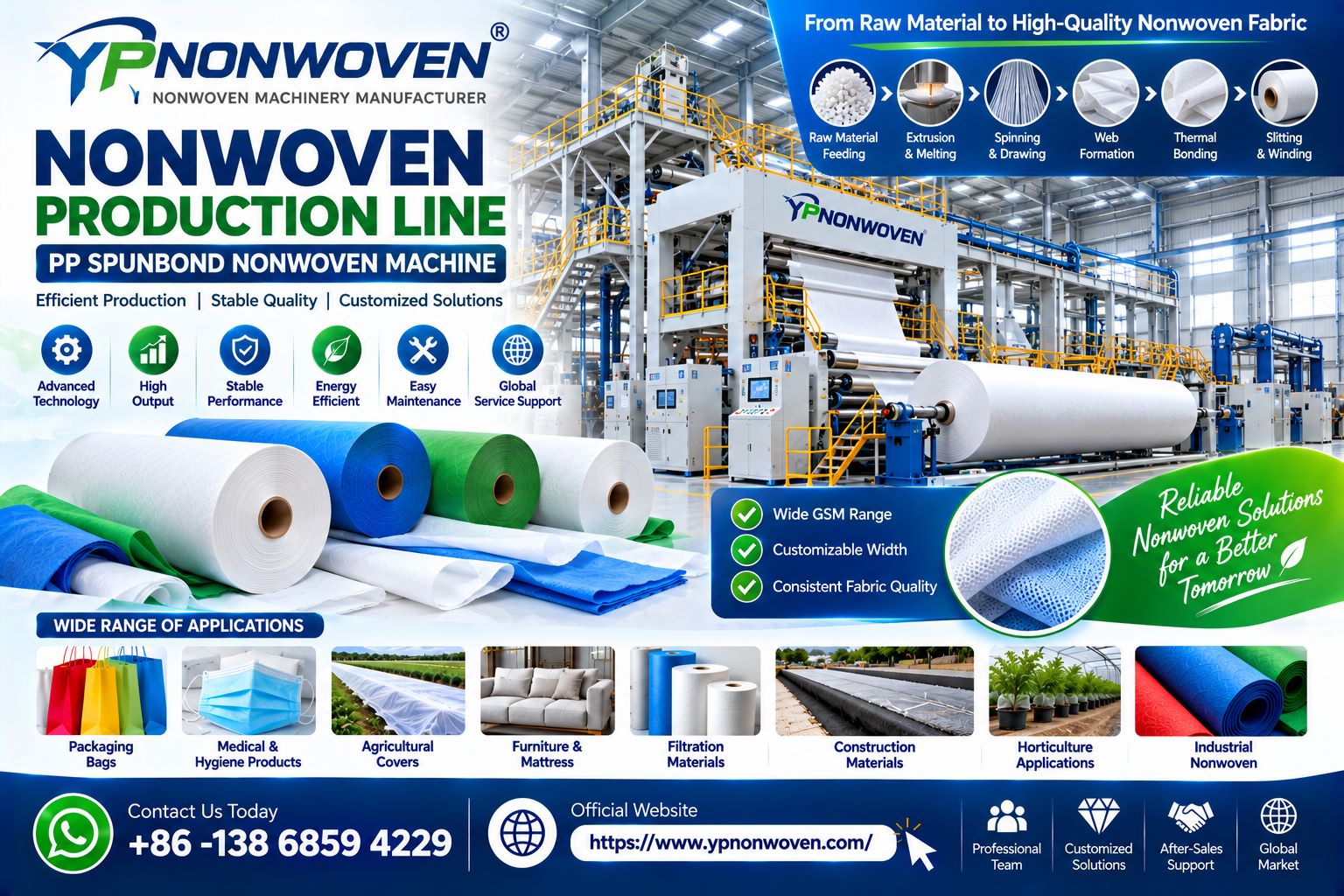
A Nonwoven Production Line combines several stages into one integrated manufacturing system.
Depending on the technology and product requirements, a line may include raw-material handling, polymer melting, filtration, spinning, web formation, bonding, cooling, slitting, and winding.
Typical production stages include:
- Raw-material feeding
- Polymer extrusion
- Melt filtration
- Filament spinning
- Fiber drawing
- Web laying
- Thermal bonding
- Cooling
- Slitting
- Automatic winding
Modern equipment increasingly uses centralized controls to synchronize these stages.
This integration can help manufacturers achieve more predictable output while reducing manual intervention.
What Is a PP Spunbond Nonwoven Machine?
A PP Spunbond Nonwoven Machine manufactures continuous-filament nonwoven fabric primarily from polypropylene.
During production, polypropylene granules are melted and passed through spinning components that form fine continuous filaments. These filaments are stretched, distributed across a moving belt, and bonded to form finished fabric.
A simplified workflow is:
Polypropylene Resin → Extrusion → Spinning → Filament Drawing → Web Formation → Bonding → Slitting → Winding
The resulting material can be engineered for different weights, widths, strengths, colors, and applications.
Why PP Spunbond Fabric Is Widely Used
Polypropylene spunbond fabric combines low weight with useful strength and production efficiency.
It can be manufactured for applications including:
- Disposable hygiene components
- Medical-related nonwoven products
- Agricultural covers
- Furniture and mattress materials
- Reusable and disposable bags
- Industrial wrapping
- Filtration support layers
- Protective materials
Fabric specifications can vary considerably, which makes process flexibility an important consideration when choosing equipment.
Fabric GSM and Uniformity Are Key Quality Factors
GSM, or grams per square meter, describes the basis weight of nonwoven fabric.
For manufacturers, maintaining stable GSM across the width and length of the roll is essential.
Uneven web formation may result in:
- Weak zones
- Inconsistent thickness
- Variable tensile strength
- Poor visual appearance
- Unstable downstream performance
A well-engineered Nonwoven Production Line should provide accurate control over material distribution and line speed to improve consistency.
Extrusion Stability Influences the Entire Process
Extrusion is one of the critical sections of a spunbond line.
Polypropylene must be heated, melted, filtered, and delivered consistently to the spinning system.
Variations in temperature or melt pressure may lead to:
- Uneven filaments
- Breakage
- Production interruption
- Irregular fabric appearance
- Increased waste
Accurate temperature control and properly designed melt distribution can improve operating stability.
Filament Drawing and Web Formation
Once filaments are produced, they must be stretched and distributed evenly.
Proper drawing helps achieve the intended filament characteristics, while controlled web formation determines how evenly fibers are deposited.
This stage can strongly influence:
- Fabric strength
- Uniformity
- Coverage
- Surface appearance
A high-performance PP Spunbond Nonwoven Machine should therefore maintain consistent airflow, drawing conditions, and belt synchronization.
Thermal Bonding Creates the Final Fabric Structure
After the web is formed, it must be bonded.
In spunbond production, thermal calender bonding is commonly used to consolidate the filament web.
Important variables include:
- Roller temperature
- Pressure
- Line speed
- Bonding pattern
If the bonding conditions are too aggressive, fabric may become unnecessarily stiff. If they are too weak, mechanical strength can suffer.
Process balance is therefore essential.
Production Capacity Should Be Evaluated Carefully
Manufacturers often compare equipment by maximum production capacity.
However, actual factory performance depends on more than headline speed.
A practical assessment should consider:
- Sustainable operating speed
- Product quality at that speed
- Waste percentage
- Downtime
- Energy use
- Changeover requirements
- Maintenance frequency
A stable Nonwoven Production Line operating continuously may create better economic results than a faster machine that requires frequent stoppages.
Energy Efficiency Is Becoming a Purchasing Priority
Energy consumption affects long-term operating costs.
Nonwoven machinery uses electricity for extrusion, heating, airflow, motors, cooling systems, bonding, and winding.
Manufacturers increasingly look for equipment incorporating:
- Efficient motors
- Optimized heating systems
- Better insulation
- Variable-frequency drives
- Intelligent process control
Even moderate energy savings can become significant over years of continuous production.
Smart Controls Improve Production Management
Modern nonwoven factories increasingly use digital controls.
A PP Spunbond Nonwoven Machine may incorporate features such as:
- PLC control
- Touchscreen HMI
- Temperature monitoring
- Speed synchronization
- Alarm management
- Automatic tension control
- Production-data recording
These systems can make production easier to monitor and help operators identify deviations before they create large quantities of off-spec material.
Flexible Production Supports Multiple Markets
Different customers may require different fabric specifications.
Manufacturers may need to switch between:
- Different GSM values
- Different roll widths
- Different colors
- Different levels of softness
- Different end-use applications
Equipment flexibility can therefore be a competitive advantage.
Before investing, manufacturers should define the products they expect to make rather than simply purchasing the highest-capacity configuration available.
Single-Beam and Multi-Beam Production Options
Spunbond equipment can be configured with different numbers of spinning beams.
The appropriate configuration depends on desired output, fabric characteristics, investment level, and target market.
Manufacturers should evaluate:
- Current customer demand
- Future expansion
- Product specifications
- Factory space
- Utility requirements
- Investment budget
A carefully matched system can offer better utilization than oversized equipment.
Machine Maintenance Protects Long-Term Productivity
Even highly automated systems require scheduled maintenance.
Key areas may include:
- Extruders
- Filters
- Spinnerets
- Air-drawing systems
- Calender rolls
- Bearings
- Drives
- Slitting units
- Winders
Preventive maintenance helps reduce unexpected shutdowns and supports longer equipment life.
Availability of spare parts, technical documentation, and remote or on-site support should also be evaluated before purchase.
Quality Inspection Should Continue Throughout Production
Quality control should not begin only after a roll is finished.
Manufacturers can monitor:
- Fabric GSM
- Width
- Tensile performance
- Elongation
- Surface condition
- Roll appearance
- Color consistency
Continuous monitoring allows process adjustments before large volumes of material are affected.
This reduces waste and improves customer consistency.
Frequently Asked Questions
What is a Nonwoven Production Line?
A Nonwoven Production Line is an integrated manufacturing system that converts polymers or fibers into nonwoven fabric through formation, bonding, finishing, and winding processes.
What is a PP Spunbond Nonwoven Machine?
A PP Spunbond Nonwoven Machine uses polypropylene to produce continuous-filament spunbond fabric through extrusion, spinning, web formation, and thermal bonding.
What is spunbond fabric used for?
It is commonly used in hygiene, agriculture, packaging, furniture, medical-related products, filtration, and industrial applications.
What does GSM mean?
GSM means grams per square meter and indicates the basis weight of the fabric.
Can one production line make multiple GSM ranges?
Many lines can manufacture several fabric weights within their designed operating range.
Why is web uniformity important?
Uniform web formation helps maintain consistent strength, thickness, appearance, and performance.
Does higher machine speed always mean better productivity?
No. Sustainable speed, fabric quality, downtime, waste, and energy use are equally important.
Why is automation valuable?
Automation improves synchronization, monitoring, process consistency, and production management.
How can manufacturers reduce operating costs?
Energy-efficient systems, stable production, preventive maintenance, lower waste, and effective process control can all help.
What should buyers compare before choosing a machine?
Production capacity, width, GSM capability, energy use, automation, quality, engineering support, installation, training, maintenance, and spare-parts availability should all be reviewed.
Media Contact
Nonwoven Machinery & Business Enquiries
Contact: +86 138 6859 4229
Official Website: https://www.ypnonwoven.com/