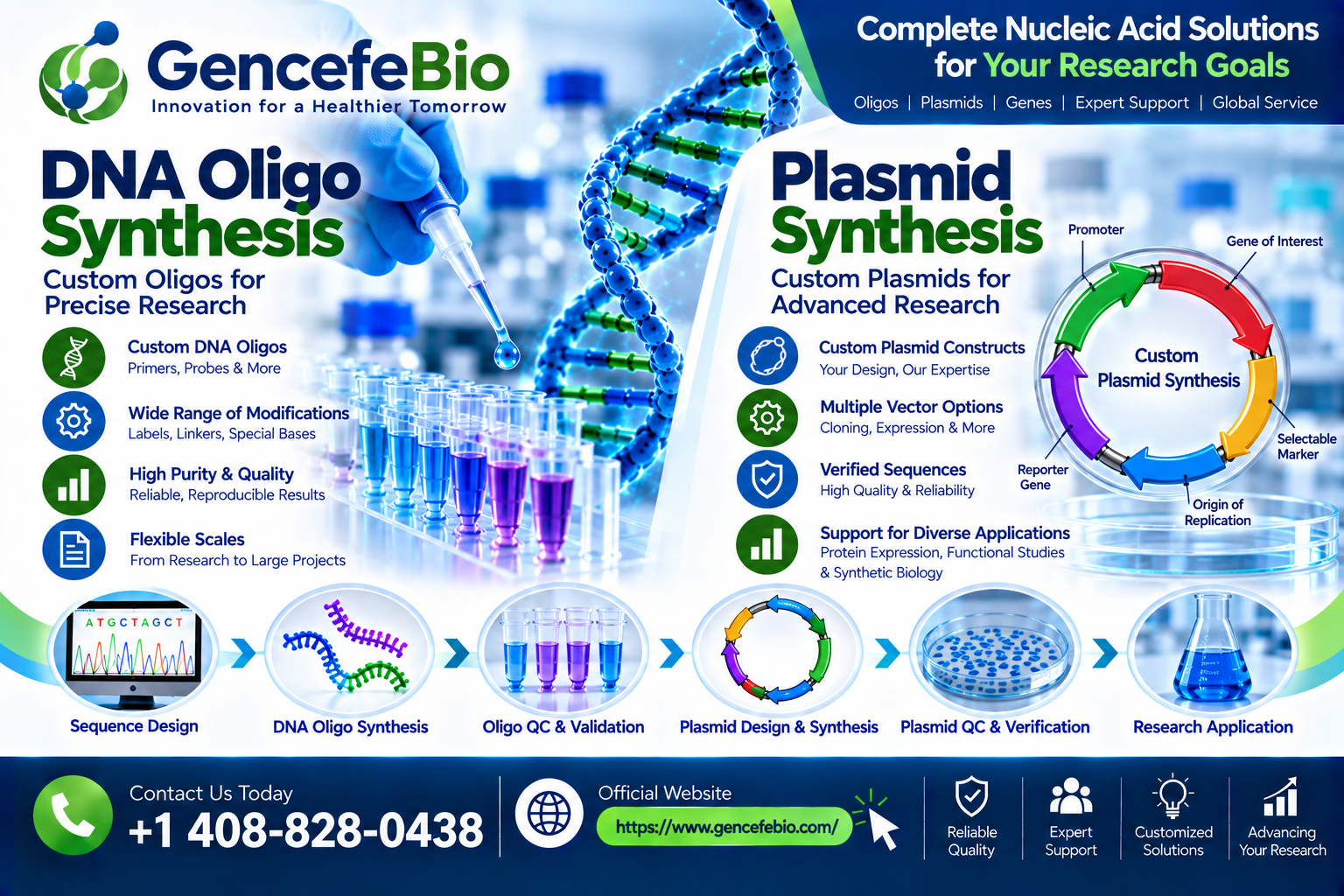
Biotechnology, molecular diagnostics, pharmaceutical research, synthetic biology, and academic laboratories are increasingly relying on precisely designed nucleic-acid reagents. As experimental workflows become more sequence-specific, demand for dna oligo synthesis and plasmid synthesis continues to grow among research teams looking for accurate, reproducible, and customizable genetic materials.
DNA oligonucleotides are short synthetic nucleotide sequences used as primers, probes, controls, and molecular-building components. Plasmids, meanwhile, are circular DNA constructs commonly used to carry genes, regulatory elements, and other sequences in research systems. Although these tools serve different purposes, they often support different stages of the same molecular biology project.
What Is DNA Oligo Synthesis?
dna oligo synthesis is the laboratory production of short DNA sequences according to a researcher-defined nucleotide design.
Oligonucleotides are widely used across life-science laboratories because they can be tailored to specific genes, genomic regions, mutations, or assay targets.
Common applications include:
- PCR primers
- DNA sequencing primers
- Hybridization probes
- Gene assembly
- Mutagenesis studies
- Genotyping
- Molecular diagnostics research
- Assay controls
- Synthetic biology
The appropriate sequence length, purity, scale, and modification depend on the intended application.
Why DNA Oligo Synthesis Is Important
Researchers often require sequences that are unique to a particular experiment. Standard catalog reagents cannot cover every possible target, making dna oligo synthesis an important customization tool.
For example, custom oligos may be designed to recognize a particular DNA sequence, introduce a defined mutation, or serve as building blocks for assembling longer genetic constructs.
Important Factors in Oligo Design
Successful oligo performance begins with careful sequence design.
Length
Shorter and longer oligos can behave differently during hybridization and amplification.
GC Content
The balance of guanine and cytosine can influence melting behaviour and binding efficiency.
Secondary Structure
Hairpins and self-complementary regions may interfere with performance.
Purity
Routine PCR and more demanding molecular applications may require different purification specifications.
Functional Modifications
Depending on the project, DNA oligos may include labels, linkers, affinity groups, or other modifications.
Researchers should match the oligo specification to its intended laboratory use.
Quality Control for DNA Oligos
Quality documentation can be especially important when oligos are used in sensitive or quantitative workflows.
Depending on synthesis scale and specifications, researchers may request information relating to:
- Identity
- Purity
- Quantity
- Concentration
- Molecular mass
- Modification confirmation
Maintaining detailed batch and sequence records can also help improve reproducibility between experiments.
What Is Plasmid Synthesis?
plasmid synthesis refers to the preparation of a defined plasmid DNA construct containing selected genetic components for research.
A plasmid may contain elements such as:
- A gene or coding sequence
- Promoters
- Regulatory regions
- Selectable markers
- Reporter genes
- Cloning sites
- Other research-specific DNA elements
Researchers may design plasmids for molecular cloning, protein expression, functional studies, synthetic biology, and assay-development programs.
Why Researchers Use Plasmid Synthesis
Traditional plasmid construction may involve several rounds of amplification, digestion, ligation, cloning, and verification.
Custom plasmid synthesis can provide researchers with a predefined construct built around a specific experimental design.
Potential advantages include:
Defined Genetic Architecture
Researchers can specify the arrangement of components before construction.
Reduced Manual Assembly
For some projects, obtaining a completed construct may reduce the number of upstream cloning steps.
Reproducibility
A defined plasmid sequence can be documented and reproduced when needed.
Easier Variant Comparison
Different construct versions can be designed to study changes in promoters, coding sequences, or regulatory elements.
Plasmids in Protein Expression Research
One common application of plasmid DNA is recombinant protein research.
A general workflow may involve:
Gene Selection → Sequence Design → Plasmid Construction → Expression System → Protein Analysis
The plasmid may contain a gene encoding a target protein along with regulatory elements appropriate for the research system.
Construct design can influence expression behaviour, making sequence planning an important early step.
How DNA Oligo Synthesis and Plasmid Synthesis Work Together
dna oligo synthesis and plasmid synthesis often complement one another.
Custom oligos may be used during:
- PCR amplification
- Sequence verification
- Mutagenesis
- Cloning
- Plasmid assembly
- Construct analysis
The plasmid then serves as a larger genetic vehicle for subsequent functional studies.
A typical research path may therefore look like:
Oligo Design → DNA Amplification or Assembly → Plasmid Construction → Sequence Verification → Functional Research
Applications in Synthetic Biology
Synthetic biology relies heavily on precisely designed genetic components.
Custom oligos can support:
- Sequence assembly
- Mutagenesis
- Verification
- Regulatory-element construction
Plasmids can then combine these elements into larger engineered systems for studying:
- Gene regulation
- Protein production
- Metabolic pathways
- Biological circuits
- Cellular functions
The combination of short-sequence synthesis and complete construct design helps researchers move from computational concepts to physical research tools.
Applications in Assay Development
Custom nucleic-acid reagents are also valuable in molecular assay research.
DNA oligos may function as:
- Primers
- Probes
- Controls
- Detection reagents
Plasmid constructs may act as:
- Defined reference materials
- Positive controls
- Target templates
- Research standards
Because the sequence is known, synthetic DNA materials can help laboratories establish more controlled experimental conditions.
Sequence Verification Is Essential
Sequence accuracy matters across both oligos and plasmids.
Even one unintended nucleotide change can potentially alter:
- Primer binding
- Protein coding
- Gene expression
- Restriction sites
- Regulatory function
- Experimental interpretation
Researchers should carefully review sequences before manufacturing and confirm that appropriate verification is included in the project specification.
Choosing a DNA Oligo Synthesis Provider
When comparing dna oligo synthesis providers, research teams may consider:
- Supported oligo lengths
- DNA synthesis scales
- Purification options
- Available modifications
- Quality-control documentation
- Packaging
- Technical support
- Turnaround expectations
The most appropriate specification depends on the actual experiment rather than simply choosing the highest available purity.
Choosing a Plasmid Synthesis Provider
For plasmid synthesis, researchers may want to evaluate:
- Supported construct size
- Vector options
- Cloning capability
- Sequence verification
- Complex-sequence handling
- Delivery format
- Technical consultation
- Scalability
Complex plasmid designs may require additional review, especially when they contain repetitive or structurally challenging DNA regions.
Frequently Asked Questions
What is dna oligo synthesis?
dna oligo synthesis is the laboratory manufacture of short DNA sequences based on a researcher-defined nucleotide design.
What are DNA oligos used for?
They are commonly used as PCR primers, sequencing primers, probes, controls, gene-assembly components, and mutagenesis reagents.
Can DNA oligos be modified?
Depending on manufacturing capability, selected labels, linkers, affinity groups, and other modifications may be available.
What is plasmid synthesis?
plasmid synthesis is the construction of defined circular DNA molecules containing selected genetic elements for research.
What are plasmids used for?
Plasmids can support cloning, protein-expression research, functional biology, synthetic biology, and assay development.
Can oligos be used to build plasmids?
Yes. Custom oligos may support amplification, assembly, mutagenesis, cloning, and verification during plasmid-development workflows.
Why is plasmid sequence verification important?
Verification helps confirm that the final construct matches the intended genetic design.
Can custom plasmids contain reporter genes?
Potentially, yes, depending on the research design and provider capabilities.
What information is needed for a plasmid project?
Researchers typically need to provide the intended sequence or genetic components, preferred vector information, downstream application, and quality requirements.
How should a synthesis provider be selected?
Technical capability, sequence accuracy, quality control, documentation, customization, scientific support, and reproducibility should all be considered.
Media Contact
Research & Business Enquiries
Contact: +1 408-828-0438
Official Website: https://www.gencefebio.com/