
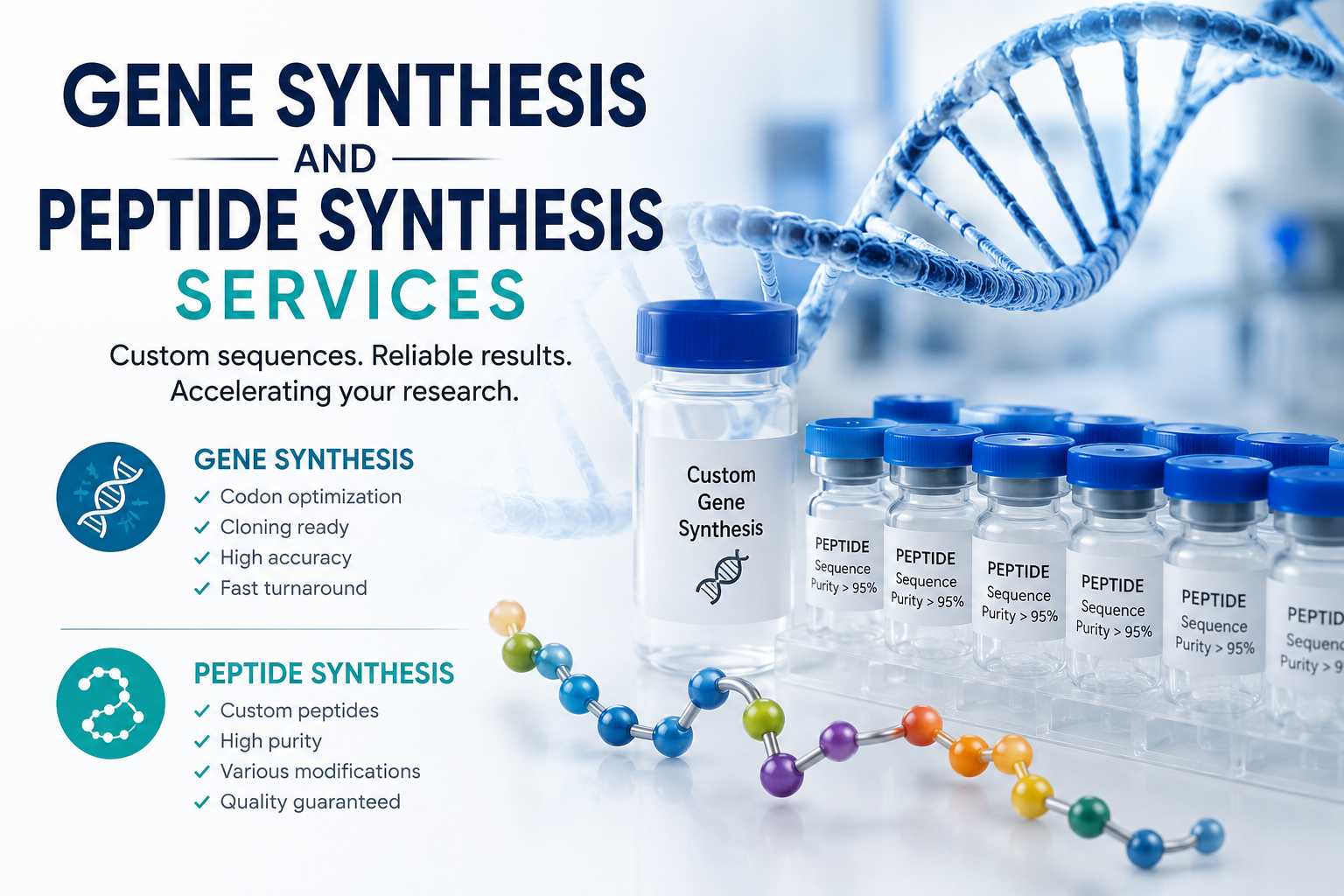
Modern biotechnology depends on the ability to design, produce, and study biological molecules with speed and precision. From drug discovery and vaccine development to molecular diagnostics and protein engineering, researchers increasingly rely on specialized laboratory technologies to transform ideas into measurable results. Among these technologies, peptide synthesis services and gene synthesis have become important tools for academic institutions, biotechnology companies, pharmaceutical developers, and research laboratories.
Although peptides and genes are fundamentally different biological materials, they are closely connected in modern research. Synthetic genes can be designed to encode specific proteins or peptides, while synthesized peptides can be used to investigate biological activity, develop antibodies, and validate potential therapeutic targets. By combining these capabilities, researchers can streamline experimental workflows and explore new scientific possibilities.
Understanding Peptide Synthesis Services
Peptide synthesis services involve the laboratory production of peptides—short chains of amino acids arranged in a specific sequence. These services are commonly used when researchers need customized peptides for applications such as drug discovery, immunology, diagnostics, structural biology, and biochemical research.
The most widely used approach is solid-phase peptide synthesis (SPPS), in which amino acids are added sequentially to a growing peptide chain attached to a solid support. After synthesis, the peptide is cleaved, purified, and analyzed to confirm its identity and quality.
Professional peptide synthesis providers may offer customized solutions based on sequence complexity, purity requirements, scale, and intended application.
Why Researchers Use Custom Peptide Synthesis
Custom peptides provide researchers with greater control over experimental design. Instead of relying exclusively on commercially available molecules, scientists can request sequences tailored to a specific research objective.
Common applications include:
- Antibody generation and immunization studies
- Epitope mapping
- Protein interaction research
- Enzyme and receptor studies
- Drug discovery and screening
- Biomarker investigation
- Vaccine research
- Diagnostic assay development
- Structure-activity relationship studies
Key Factors Affecting Peptide Quality
Several variables can influence the performance of a synthesized peptide:
- Sequence complexity: Longer or highly hydrophobic sequences may require specialized synthesis strategies.
- Purity: High-purity peptides are often essential for sensitive biological experiments.
- Modification requirements: Researchers may request phosphorylation, acetylation, amidation, biotinylation, fluorescent labeling, or other modifications.
- Scale: The required quantity depends on the application and experimental design.
- Quality control: Analytical methods such as mass spectrometry and chromatography help verify identity and purity.
What Is Gene Synthesis?
Gene synthesis is the process of creating a DNA sequence according to a researcher-defined design. Unlike traditional cloning methods that may begin with naturally occurring DNA, synthetic biology allows scientists to design sequences digitally before producing them in the laboratory.
This approach can help researchers introduce specific mutations, optimize codons, remove unwanted sequences, or create entirely new genetic constructs.
Synthetic genes can support projects involving:
- Recombinant protein expression
- Protein engineering
- Vaccine research
- Gene editing research
- Functional genomics
- Synthetic biology
- Molecular diagnostics
- Antibody development
- Enzyme engineering
Gene synthesis is particularly useful when the desired DNA sequence is difficult to obtain from a natural source or when researchers need a customized construct.
How Gene Synthesis Supports Research
A typical workflow begins with sequence design. Researchers define the DNA sequence required for their project and identify any necessary modifications. The sequence is then synthesized and assembled using appropriate molecular biology techniques.
Depending on the project, the final construct may be inserted into an expression vector for protein production or used in other downstream experiments.
The ability to customize DNA sequences offers several advantages:
- Faster access to experimental genetic material
- Greater design flexibility
- Easier introduction of targeted mutations
- Potential for codon optimization
- Support for complex molecular biology projects
Peptide Synthesis Services vs. Gene Synthesis
While both technologies support biotechnology research, they operate at different biological levels.
| Feature | Peptide Synthesis Services | Gene Synthesis |
| Primary product | Synthetic peptide | Synthetic DNA |
| Building blocks | Amino acids | Nucleotides |
| Main applications | Biochemistry, immunology, drug research | Molecular biology, protein expression |
| Customization | Sequence and chemical modifications | Sequence, mutations, and design |
| Typical downstream use | Assays, screening, antibody studies | Protein production and genetic research |
| Quality analysis | Purity and molecular mass | Sequence verification and DNA quality |
Choosing between these technologies depends on the research question. A laboratory studying a specific protein epitope may require a synthetic peptide, while a team seeking to express a modified recombinant protein may need a synthesized gene.
How the Two Technologies Work Together
The relationship between peptide and gene technologies is especially valuable in modern biotechnology. A researcher may design a synthetic gene to express a recombinant protein and then use synthetic peptides derived from that protein to investigate immune recognition or identify specific epitopes.
This integrated approach can support a broad range of projects.
For example, researchers might:
- Design a gene encoding a target protein.
- Use gene synthesis to create the required DNA construct.
- Express and purify the recombinant protein.
- Design peptides representing selected protein regions.
- Use peptide synthesis services to produce those sequences.
- Evaluate biological interactions through laboratory assays.
By combining complementary technologies, scientists can investigate biological systems from both genetic and molecular perspectives.
Selecting the Right Service Provider
Choosing a reliable provider is an important part of any research project. Quality, consistency, communication, and technical support can directly influence experimental outcomes.
Before selecting a provider, researchers should consider:
Technical Capabilities
Look for experience with complex peptide sequences, modified peptides, difficult DNA constructs, and specialized research requirements.
Quality Assurance
Ask about analytical testing, sequence verification, purification methods, and documentation. Clear quality-control data can help researchers evaluate whether materials meet project specifications.
Customization
A strong provider should offer flexible options rather than forcing every project into a standard workflow.
Scalability
Consider whether the provider can support future requirements if the project progresses from early research to larger-scale development.
Customer Support
Responsive technical communication can make it easier to resolve sequence issues, clarify specifications, and manage complex projects.
The Future of Synthetic Biology
The demand for peptide synthesis services and gene synthesis is expected to remain closely linked to innovation across biotechnology. Advances in automation, computational biology, artificial intelligence, and synthetic biology are making it increasingly practical to design biological molecules with greater precision.
Researchers are exploring new approaches to therapeutic development, personalized medicine, vaccine technologies, engineered proteins, and molecular diagnostics. As these fields evolve, the ability to quickly obtain customized DNA and peptide materials can help laboratories move from concept to experimentation more efficiently.
The future will likely involve greater integration between computational design and laboratory production. Researchers may increasingly use digital tools to design sequences, predict molecular behavior, and optimize candidates before ordering synthetic materials.
Frequently Asked Questions
1. What are peptide synthesis services?
Peptide synthesis services provide customized peptides produced according to a researcher’s required amino acid sequence and specifications.
2. What is gene synthesis used for?
Gene synthesis creates customized DNA sequences for applications including protein expression, synthetic biology, molecular research, and genetic engineering.
3. Are synthetic peptides used in drug discovery?
Yes. Synthetic peptides can support target validation, screening, structure-activity studies, and research into potential therapeutic candidates.
4. What is solid-phase peptide synthesis?
Solid-phase peptide synthesis is a widely used method in which amino acids are sequentially added to a peptide chain attached to a solid support.
5. Can peptides be chemically modified?
Yes. Depending on the provider and project, peptides may be produced with various chemical or functional modifications.
6. Why is gene synthesis useful?
Gene synthesis allows researchers to obtain precisely designed DNA sequences without depending solely on naturally available genetic templates.
7. Can gene synthesis support recombinant protein production?
Yes. Synthetic genes can be designed and incorporated into suitable expression systems to produce recombinant proteins.
8. How are synthetic peptides tested?
Peptides may be evaluated using analytical techniques such as mass spectrometry and chromatography to confirm identity and purity.
9. How should researchers choose a synthesis provider?
Researchers should evaluate technical expertise, quality control, customization options, documentation, scalability, and customer support.
10. Can peptide and gene synthesis be used together?
Yes. Combining both technologies can support integrated workflows involving genetic design, recombinant protein production, epitope analysis, and molecular research.
https://newsgrow.blogspot.com/2026/06/peptide-synthesis-services-accelerate.html