The global nonwoven industry is entering a new phase of growth as manufacturers respond to rising demand for lightweight, durable, hygienic, and cost-efficient materials. From medical products and filtration media to agriculture, construction, packaging, and personal care, nonwoven fabrics are becoming an essential part of modern supply chains.
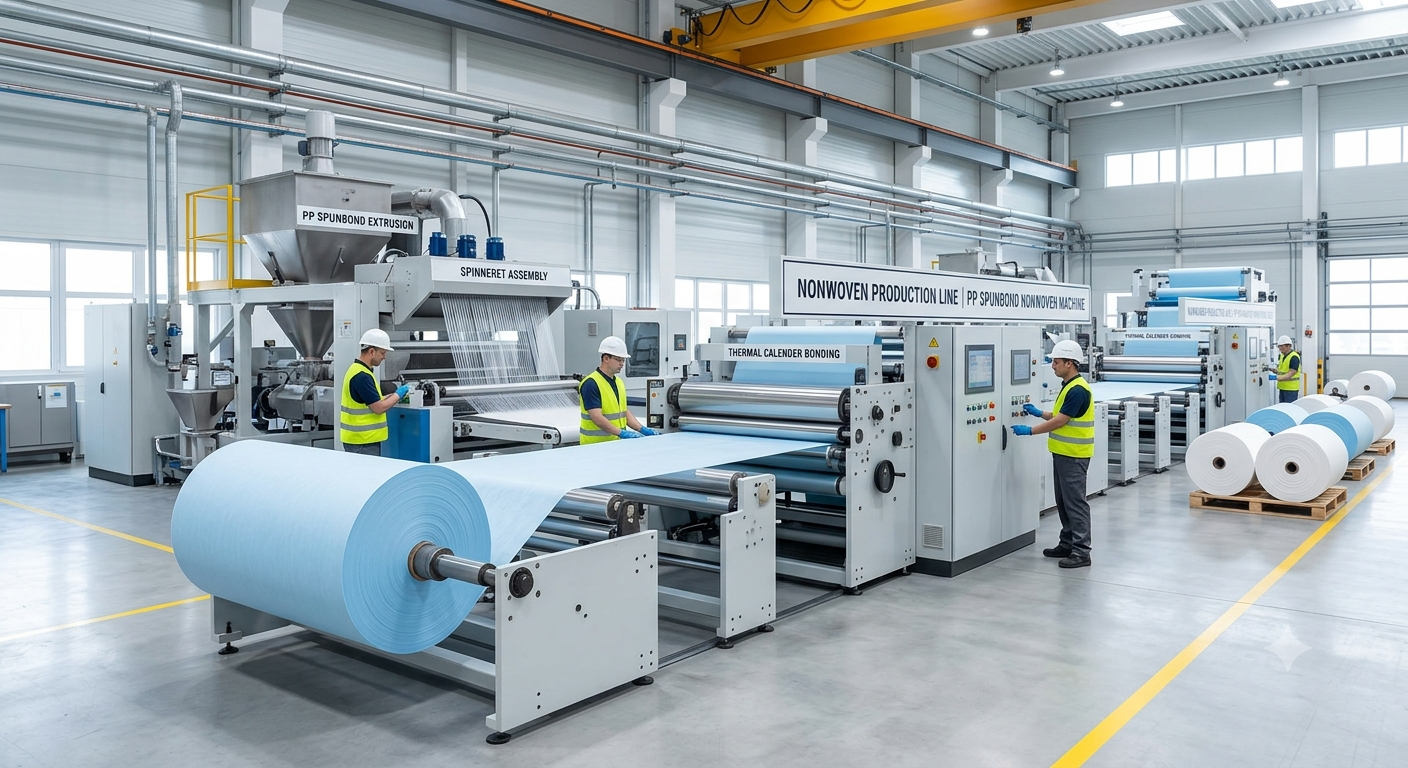
At the center of this transformation is the Nonwoven Production Line, supported by advanced automation, improved process control, and high-performance PP Spunbond Nonwoven Machine technology. Manufacturers are increasingly investing in efficient production systems that can deliver consistent quality while reducing material waste, energy consumption, and operational costs.
As industries look for scalable solutions with greater flexibility, the latest generation of nonwoven manufacturing equipment is helping producers meet changing market requirements while maintaining reliable output.
Growing Demand Drives Innovation in Nonwoven Manufacturing
Nonwoven fabrics are engineered materials produced without traditional weaving or knitting. Instead, fibers are bonded through mechanical, thermal, or chemical processes. This manufacturing approach allows producers to develop fabrics with specific characteristics, including strength, softness, breathability, liquid resistance, and filtration performance.
The versatility of nonwoven materials has expanded their use across multiple sectors:
- Medical gowns, masks, caps, and surgical products
- Baby diapers and feminine hygiene products
- Agricultural crop covers and plant protection fabrics
- Automotive interior components
- Geotextiles and construction materials
- Filtration and air purification products
- Furniture and mattress applications
- Shopping bags and reusable packaging
The expanding application base is encouraging manufacturers to modernize their production capabilities. A well-designed Nonwoven Production Line can integrate several stages of manufacturing into a coordinated process, helping businesses improve productivity and maintain uniform fabric specifications.
How a Modern Nonwoven Production Line Supports Efficiency
A modern production system typically combines raw material feeding, polymer processing, fiber formation, web formation, bonding, winding, and quality monitoring. The exact configuration depends on the required fabric characteristics and intended end use.
Key Components of a Production System
A typical line may include:
- Raw material feeding system – Delivers polypropylene or other polymers consistently into the production process.
- Extrusion unit – Melts and processes polymer material under controlled temperatures.
- Spinning system – Converts molten polymer into continuous filaments.
- Web-forming section – Arranges filaments into a uniform fiber web.
- Bonding unit – Uses thermal bonding or other techniques to create fabric strength.
- Calender system – Controls surface appearance, thickness, and bonding characteristics.
- Winding equipment – Produces finished rolls for storage, conversion, or shipment.
Automation across these stages can reduce manual intervention and improve process stability. Advanced control systems also allow operators to monitor temperature, production speed, pressure, and other parameters in real time.
PP Spunbond Nonwoven Machine Becomes a Strategic Investment
Polypropylene, commonly known as PP, remains a popular raw material for spunbond production because of its favorable combination of strength, low weight, chemical resistance, and processability.
A modern PP Spunbond Nonwoven Machine is designed to transform polypropylene resin into continuous filaments that are distributed into a web and bonded to form a strong nonwoven fabric.
Why Manufacturers Choose PP Spunbond Technology
PP spunbond materials offer several advantages:
- High strength-to-weight ratio
- Lightweight construction
- Good moisture resistance
- Efficient high-speed production
- Wide range of fabric weights
- Adaptability to different applications
- Cost-effective raw material utilization
Manufacturers can also produce fabrics with different colors, widths, and grammages depending on equipment configuration and customer requirements.
The growing adoption of PP spunbond technology reflects the industry’s shift toward production systems capable of combining speed, flexibility, and consistent quality.
Automation and Digital Controls Transform Factory Operations
One of the most significant developments in modern nonwoven manufacturing is the increasing use of automation. Intelligent controls can help manufacturers maintain stable operating conditions throughout the production cycle.
Key Benefits of Automated Production
Improved consistency: Automated systems can maintain precise process parameters and reduce variations between production batches.
Higher productivity: Faster production speeds and optimized workflows can increase output without proportionally increasing labor requirements.
Reduced waste: Better process monitoring can identify irregularities earlier, helping manufacturers minimize rejected material.
Simplified operation: User-friendly control interfaces allow operators to monitor production data and adjust settings more efficiently.
Predictive maintenance: Digital monitoring can help identify potential equipment problems before they cause extended downtime.
As competition increases, these capabilities can become important factors when selecting a new Nonwoven Production Line.
Sustainability Becomes a Manufacturing Priority
Environmental considerations are also influencing investment decisions in the nonwoven sector. Manufacturers are exploring ways to reduce energy consumption, improve material efficiency, and develop products that support circular economy objectives.
The focus is shifting toward:
- Lower production waste
- Improved energy efficiency
- Responsible raw material management
- Longer-lasting products
- Recyclable or reusable applications
- Optimized packaging and logistics
Although sustainability challenges vary between applications, efficient machinery can contribute by improving process control and reducing unnecessary material losses.
For businesses evaluating a PP Spunbond Nonwoven Machine, energy consumption, production efficiency, maintenance requirements, and material utilization should therefore be considered alongside initial equipment cost.
Choosing the Right Nonwoven Manufacturing Equipment
Selecting production equipment is a strategic decision that should be based on long-term operational needs rather than price alone.
Important Factors to Evaluate
| Evaluation Factor | Why It Matters |
| Production capacity | Determines whether output can meet current and future demand |
| Fabric specifications | Ensures the line can manufacture required GSM and widths |
| Automation level | Influences labor needs and process consistency |
| Energy efficiency | Affects long-term operating expenses |
| Maintenance support | Helps reduce unexpected downtime |
| Product flexibility | Enables manufacturers to serve multiple markets |
| Quality control | Supports consistent fabric performance |
| Scalability | Allows production capacity to grow with demand |
Manufacturers should also evaluate supplier experience, installation support, spare-parts availability, training, and after-sales service before finalizing an investment.
News Outlook: What Comes Next for the Nonwoven Industry?
The direction of the industry suggests that manufacturers will continue prioritizing efficiency, automation, flexibility, and sustainable production. Demand from healthcare, hygiene, agriculture, construction, and filtration applications is expected to encourage ongoing investment in advanced manufacturing technologies.
At the same time, customers increasingly expect nonwoven suppliers to deliver specialized materials rather than standardized products alone. This creates opportunities for producers capable of quickly adjusting fabric specifications and developing application-focused solutions.
The next generation of the Nonwoven Production Line is therefore likely to emphasize intelligent automation, improved resource efficiency, flexible production capabilities, and stronger quality management.
Frequently Asked Questions
1. What is a Nonwoven Production Line?
A Nonwoven Production Line is an integrated manufacturing system used to produce nonwoven fabrics through processes such as polymer extrusion, fiber spinning, web formation, bonding, and fabric winding.
2. What is a PP Spunbond Nonwoven Machine?
A PP Spunbond Nonwoven Machine converts polypropylene polymer into continuous filaments, forms them into a web, and bonds the filaments to create nonwoven fabric.
3. What is PP spunbond fabric used for?
PP spunbond fabric is used in hygiene products, medical supplies, agriculture, construction, packaging, automotive applications, filtration, and furniture industries.
4. Why is polypropylene popular for spunbond production?
Polypropylene is lightweight, strong, chemically resistant, and suitable for efficient high-speed processing, making it a practical material for many nonwoven applications.
5. Can spunbond machines produce different fabric weights?
Yes. Depending on machine configuration and process settings, manufacturers can produce different fabric weights and specifications for various applications.
6. How does automation improve nonwoven production?
Automation can improve process consistency, increase productivity, reduce manual intervention, minimize waste, and provide better monitoring of production parameters.
7. What should manufacturers consider before buying equipment?
Manufacturers should assess capacity, fabric specifications, energy efficiency, automation, maintenance, supplier support, scalability, and total operating costs.
8. Is spunbond technology suitable for large-scale production?
Yes. Spunbond technology is widely used for continuous, high-volume manufacturing where consistent quality and efficient output are important.
9. What industries use nonwoven fabrics?
Major users include healthcare, hygiene, agriculture, construction, automotive, filtration, packaging, furniture, and consumer-product industries.
10. How can manufacturers improve production efficiency?
Efficiency can be improved through optimized process parameters, preventive maintenance, automation, quality monitoring, skilled operators, and appropriate equipment selection.
https://newsgrow.blogspot.com/2026/06/nonwoven-production-line-powers_0570309919.html