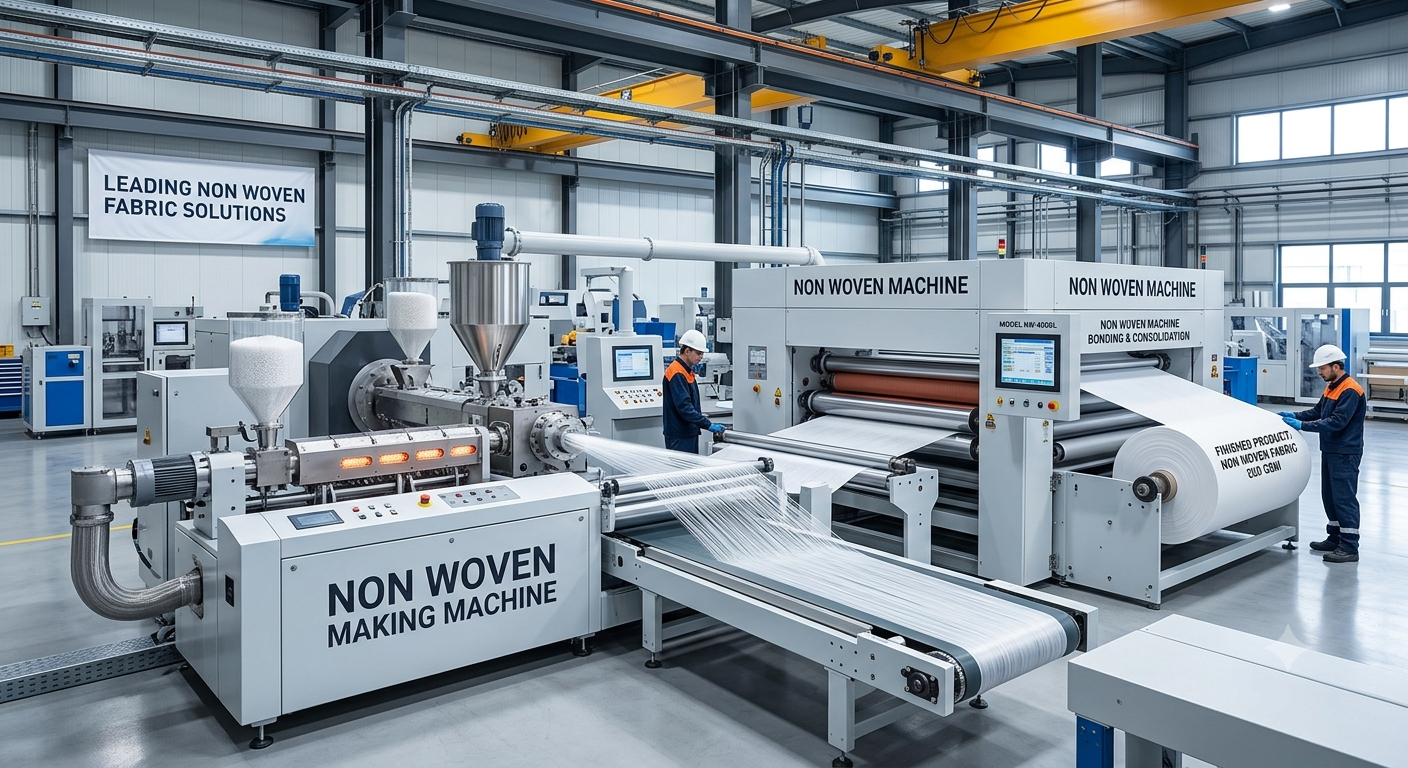
The global demand for lightweight, durable, hygienic, and cost-effective materials is reshaping the manufacturing industry. From medical masks and hygiene products to agricultural fabrics, shopping bags, filtration media, and industrial textiles, non woven materials have become essential across multiple sectors. Behind this growing industry is advanced production equipment designed to transform raw polymers or fibers into high-performance fabric.
A modern Non Woven Making Machine enables manufacturers to produce consistent, reliable, and application-specific materials at commercial scale. At the same time, a versatile Non Woven Machine can help businesses improve production efficiency, reduce material waste, and meet changing market requirements.
For manufacturers considering investment in non woven production, understanding machine types, production processes, benefits, and selection criteria is essential.
What Is a Non Woven Making Machine?
A Non Woven Making Machine is industrial equipment used to manufacture fabrics without traditional weaving or knitting. Instead of interlacing yarns, the machine forms a web of fibers and bonds them through mechanical, thermal, or chemical methods.
Depending on the technology, raw materials may include polypropylene (PP), polyester (PET), viscose, recycled fibers, or other synthetic and natural materials.
The manufacturing process generally involves:
- Raw material feeding
- Fiber opening and blending
- Web formation
- Fiber bonding
- Fabric treatment
- Calendering or finishing
- Winding and packaging
The final fabric can be engineered for specific properties such as softness, strength, breathability, water resistance, filtration efficiency, or durability.
How Does a Non Woven Machine Work?
The working principle of a Non Woven Machine depends on the production technology being used. Different manufacturing systems are designed for different applications and performance requirements.
1. Spunbond Technology
Spunbond machines melt polymer granules and extrude continuous filaments through specialized spinnerets. These filaments are stretched, distributed into a web, and bonded using heat.
Spunbond non woven fabrics are widely used for:
- Medical gowns and protective clothing
- Hygiene products
- Agriculture covers
- Packaging materials
- Furniture and construction applications
2. Meltblown Technology
Meltblown equipment uses high-speed hot air to draw extremely fine polymer fibers into a web. The resulting material has a high surface area and excellent filtration characteristics.
Meltblown fabrics are commonly used in:
- Air filtration
- Liquid filtration
- Medical masks
- Absorbent products
- Specialized industrial applications
3. Needle Punching
Needle-punching equipment mechanically entangles fibers using barbed needles. This creates thick and durable materials suitable for demanding applications.
Typical uses include:
- Automotive interiors
- Geotextiles
- Carpet backing
- Construction materials
- Industrial insulation
4. Spunlace Technology
Spunlace systems use high-pressure water jets to entangle fibers. The technology can create soft, flexible fabrics with excellent absorbency.
Common applications include:
- Wet wipes
- Cleaning wipes
- Medical textiles
- Personal care products
Key Components of a Non Woven Machine
A high-quality production line typically includes several integrated components. Each plays an important role in maintaining consistent output.
| Component | Primary Function |
| Feeding System | Delivers raw materials consistently |
| Extruder | Melts polymer materials in spunbond or meltblown production |
| Spinneret | Forms continuous polymer filaments |
| Fiber Drawing Unit | Controls filament stretching and orientation |
| Web Former | Distributes fibers evenly |
| Bonding Unit | Bonds fibers using heat, pressure, needles, or water |
| Calender | Controls thickness and surface characteristics |
| Winder | Rolls finished fabric efficiently |
| Control System | Monitors and adjusts production parameters |
Modern systems increasingly use automated controls and digital monitoring to improve production stability.
Benefits of Investing in a Non Woven Making Machine
Choosing the right Non Woven Making Machine can provide significant operational advantages for manufacturers.
High Production Efficiency
Automated production lines can operate continuously, allowing manufacturers to produce large volumes while reducing manual intervention.
Consistent Product Quality
Advanced control systems help maintain uniform fabric thickness, weight, strength, and appearance. Consistency is especially important for industries with strict product specifications.
Flexible Product Development
Many machines can be configured for different fabric weights and applications. This flexibility allows manufacturers to serve multiple markets using one production platform or a modular production setup.
Reduced Manufacturing Costs
Efficient energy management, automated material handling, and optimized production processes can help lower operating costs over time.
Wide Market Applications
Non woven fabrics are used in numerous industries, making production equipment a potentially versatile investment.
How to Choose the Right Non Woven Machine
Selecting equipment should involve more than comparing the purchase price. Manufacturers should evaluate the complete production requirement.
Consider These Factors
- Target application: Determine whether the fabric is intended for medical, hygiene, agricultural, filtration, automotive, or industrial use.
- Raw material: Confirm compatibility with PP, PET, viscose, recycled fibers, or other materials.
- Production capacity: Calculate the required output per hour or per year.
- Fabric specifications: Consider GSM, width, thickness, tensile strength, softness, and filtration requirements.
- Energy consumption: Compare the machine’s expected power requirements.
- Automation level: Evaluate PLC controls, monitoring systems, and production data capabilities.
- Maintenance: Check spare-part availability and accessibility of critical components.
- Technical support: Reliable installation, training, and after-sales service can reduce downtime.
Price vs. Long-Term Value
A low initial price does not always represent the best investment. A machine with better energy efficiency, stable output, lower maintenance requirements, and dependable technical support may deliver greater value over its operating life.
| Evaluation Factor | Basic Equipment | Advanced Equipment |
| Initial Investment | Lower | Higher |
| Automation | Limited | Extensive |
| Production Control | Standard | Precise |
| Energy Efficiency | Moderate | Optimized |
| Product Flexibility | Limited | Higher |
| Long-Term Productivity | Moderate | High |
Trends Shaping the Non Woven Industry
The non woven sector is evolving as manufacturers respond to sustainability demands and changing consumer expectations.
Sustainable Material Development
Recycled polymers, biodegradable fibers, and bio-based materials are gaining attention. Manufacturers are exploring ways to reduce waste and improve the environmental profile of non woven products.
Smart Manufacturing
Digital sensors, automated controls, predictive maintenance, and real-time monitoring are becoming increasingly important. These technologies can help identify production issues before they result in significant downtime.
Lightweight Materials
Industries increasingly seek materials that deliver strong performance with less raw material. Advanced fiber formation and bonding technologies can support lightweight product development.
Specialized Applications
Demand is growing for high-performance non woven materials designed for filtration, healthcare, construction, agriculture, and advanced industrial applications.
FAQ About Non Woven Making Machines
1. What is a Non Woven Making Machine?
It is industrial equipment that produces fabric by forming and bonding fibers without conventional weaving or knitting.
2. What raw materials are used?
Common materials include polypropylene, polyester, viscose, recycled fibers, and other synthetic or natural fibers.
3. What is a Non Woven Machine used for?
It can produce materials for hygiene products, medical supplies, agriculture, filtration, construction, packaging, and automotive applications.
4. What is the difference between spunbond and meltblown?
Spunbond generally produces stronger continuous filaments, while meltblown creates much finer fibers suited to filtration and specialized applications.
5. Is non woven fabric recyclable?
Recyclability depends on the material composition and product design. Single-material products are generally easier to recycle than complex multi-layer structures.
6. How can manufacturers improve production efficiency?
Regular maintenance, optimized process parameters, quality raw materials, automation, and operator training can improve overall efficiency.
7. Does machine speed determine production quality?
Not necessarily. Production quality depends on factors including fiber distribution, bonding, temperature, raw material quality, and process control.
8. Can one machine produce different types of fabric?
Some flexible production systems can manufacture multiple product specifications, but capabilities depend on the machine configuration and technology.
9. What industries use non woven fabrics?
Healthcare, hygiene, agriculture, construction, filtration, automotive, furniture, packaging, and industrial sectors all use non woven materials.
10. What should I check before purchasing?
Evaluate production capacity, material compatibility, fabric specifications, energy consumption, automation, maintenance requirements, spare parts, and supplier support.
https://newsgrow.blogspot.com/2026/06/non-woven-making-machine-drives-smart.html