
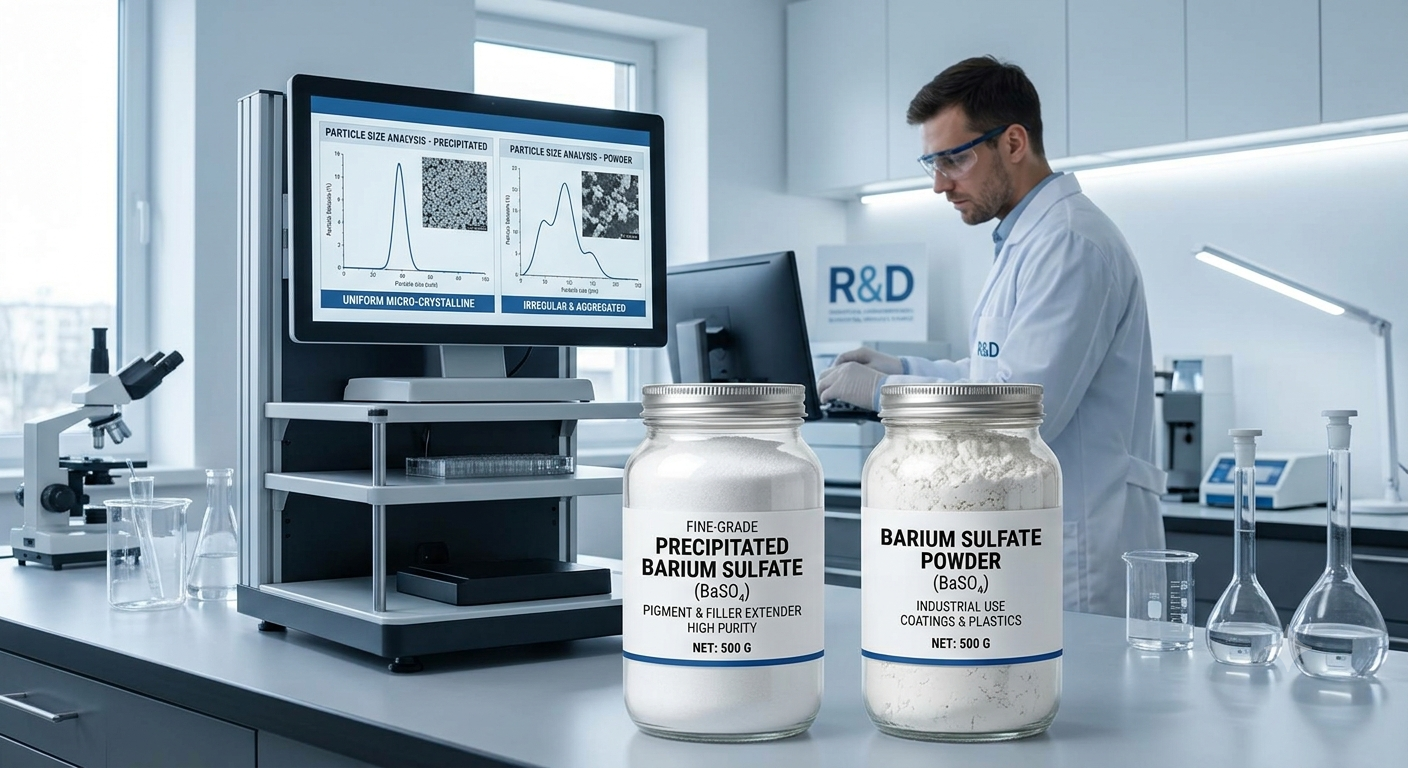
Industrial manufacturers are placing greater emphasis on material performance, consistency, and cost efficiency as global production requirements continue to evolve. Against this backdrop, Precipitated Barium Sulfate and Barium Sulfate Powder are attracting growing attention across coatings, plastics, rubber, inks, construction materials, and other specialized applications.
Known for its high density, chemical stability, whiteness, and resistance to heat and environmental conditions, barium sulfate has become an important functional material for manufacturers seeking to improve product performance. At the same time, advances in particle engineering and processing are expanding the role of precipitated grades in applications that require tighter control over particle size, purity, and dispersion.
The growing interest in these materials reflects a broader industrial shift toward engineered fillers that can deliver multiple performance benefits while supporting efficient production.
Why Barium Sulfate Is Becoming an Important Industrial Material
Barium sulfate is an inorganic compound widely recognized for its excellent chemical stability and low solubility in water. These characteristics make it suitable for demanding industrial environments where resistance to chemicals, heat, and weathering is important.
Barium Sulfate Powder is commonly used as a functional filler and extender. Depending on its grade and processing characteristics, it can contribute to improved opacity, surface properties, density, durability, and dimensional stability.
Key properties that support its industrial use include:
- High specific gravity
- Excellent chemical resistance
- Strong thermal stability
- Good whiteness
- Low oil absorption in selected grades
- Resistance to weathering
- Controlled particle-size availability
- Compatibility with numerous industrial formulations
These characteristics have helped barium sulfate maintain relevance in both traditional and emerging manufacturing sectors.
Precipitated Barium Sulfate Supports Precision-Focused Manufacturing
Controlled Particle Size and Purity
One of the major developments in the market is the increasing use of Precipitated Barium Sulfate, which is manufactured through controlled chemical precipitation rather than simply processing naturally occurring mineral sources.
This production approach allows manufacturers to achieve more consistent characteristics, including controlled particle size and improved purity. Such properties can be particularly valuable when manufacturers need precise dispersion and predictable performance in finished products.
In demanding formulations, material consistency can influence everything from surface appearance to processing behavior. As a result, precipitated grades are increasingly considered where tighter technical specifications are required.
Growing Use in Coatings and Paints
The coatings industry is one area where barium sulfate continues to demonstrate strong potential. It can be incorporated into paint and coating formulations as a functional extender, helping manufacturers optimize formulation economics while maintaining desirable physical properties.
Depending on the formulation, barium sulfate may contribute to:
- Improved surface finish
- Better opacity and brightness
- Enhanced durability
- Increased resistance to environmental conditions
- Improved formulation balance
High-quality grades can also support smooth dispersion, which is essential for achieving consistent coating performance.
Barium Sulfate Powder Finds Applications Across Diverse Industries
Plastics and Polymer Manufacturing
The plastics industry increasingly uses mineral fillers to modify physical properties and improve manufacturing efficiency. Barium Sulfate Powder can be incorporated into selected polymer systems where higher density, dimensional stability, or improved surface characteristics are desired.Its chemical stability makes it attractive for applications that require dependable performance under challenging operating conditions.
Rubber Products
Rubber manufacturers may use barium sulfate as a filler in specific formulations. Depending on the product design, it can help modify density and contribute to the desired physical characteristics of molded or extruded components.
Printing Inks
In printing and specialty ink formulations, particle characteristics and dispersion quality are critical. Carefully selected barium sulfate grades can support brightness, opacity, and formulation performance, particularly in applications where visual consistency is important.
Construction Materials
Barium sulfate is also relevant to specialized construction and industrial materials. Its high density makes it useful in selected formulations designed for radiation shielding and other applications requiring heavy mineral components.
Precipitated Barium Sulfate vs. Conventional Barium Sulfate Powder
Although both materials are based on the same chemical compound, their manufacturing methods and physical characteristics can differ significantly.
| Feature | Precipitated Barium Sulfate | Conventional Barium Sulfate Powder |
| Production method | Chemical precipitation | Typically mineral processing |
| Particle control | Highly controlled | Depends on processing and source |
| Purity | Often available in high-purity grades | Varies by mineral source |
| Dispersion | Generally optimized for specific applications | Depends on particle characteristics |
| Industrial use | Specialty and precision formulations | Broad filler and extender applications |
| Customization | More adaptable to technical requirements | Grade-dependent |
The right choice ultimately depends on the application, required specifications, processing conditions, and desired final-product performance.
What Manufacturers Should Consider Before Selecting a Grade
Choosing the appropriate material requires more than simply comparing product names. Manufacturers should evaluate technical requirements and supplier capabilities before making a purchasing decision.
Important Selection Factors
1. Particle Size
Particle size can affect dispersion, surface appearance, processing behavior, and final performance. Applications requiring fine and uniform dispersion may benefit from carefully engineered grades.
2. Purity
Purity requirements vary across industries. High-purity materials may be preferred for specialized applications where impurities could influence product quality.
3. Whiteness
For coatings, plastics, inks, and other visually sensitive products, whiteness can play an important role in the final appearance.
4. Dispersion Performance
A material that disperses consistently can help manufacturers achieve more uniform formulations and reduce processing challenges.
5. Supplier Reliability
Consistent supply, technical documentation, quality control, and batch-to-batch uniformity are important considerations when selecting a long-term supplier.
Market Outlook: Performance and Customization Drive Demand
The outlook for Precipitated Barium Sulfate and Barium Sulfate Powder remains closely connected to industrial innovation. As manufacturers seek materials that combine functional performance with cost-effective formulation strategies, engineered mineral fillers are expected to remain relevant.
Several trends are influencing future demand:
- Increased focus on high-performance coatings
- Growth in advanced polymer applications
- Rising demand for specialty fillers
- Greater emphasis on particle-size control
- Expansion of technically demanding industrial formulations
- Continued interest in durable and chemically stable materials
The market is also moving toward more application-specific solutions. Instead of relying solely on standard grades, manufacturers are increasingly evaluating materials according to precise performance requirements.
How to Select the Right Barium Sulfate Supplier
A reliable supplier can make a significant difference in product consistency and manufacturing efficiency. Businesses evaluating suppliers should consider the following checklist:
- Review technical specifications and certificates.
- Confirm particle-size and purity requirements.
- Request representative samples for testing.
- Evaluate batch-to-batch consistency.
- Check packaging and storage recommendations.
- Discuss application-specific technical support.
- Confirm production capacity and supply reliability.
This structured approach can help companies reduce formulation risks and select a material that aligns with their production goals.
Frequently Asked Questions
1. What is Precipitated Barium Sulfate?
Precipitated Barium Sulfate is a manufactured form of barium sulfate produced through a controlled precipitation process, allowing greater control over characteristics such as particle size and purity.
2. What is Barium Sulfate Powder used for?
It is used as a functional filler or extender in industries including coatings, plastics, rubber, inks, construction materials, and specialty manufacturing.
3. Is precipitated barium sulfate different from natural barium sulfate?
Yes. The primary difference is the manufacturing process. Precipitated grades are produced through controlled chemical processes, while natural grades generally originate from mineral sources and undergo physical processing.
4. Why is particle size important?
Particle size can influence dispersion, surface finish, opacity, processing behavior, and the performance of the final formulation.
5. Which industries use barium sulfate?
Common industries include paints and coatings, plastics, rubber, printing inks, construction, and specialized industrial materials.
6. Why is barium sulfate used in coatings?
It can function as a filler or extender and may contribute to desirable properties such as brightness, opacity, surface quality, and durability.
7. Can barium sulfate be used in plastics?
Yes. Selected grades can be incorporated into polymer formulations to modify properties such as density and dimensional stability.
8. What should buyers check before purchasing?
Buyers should evaluate purity, particle size, whiteness, dispersion characteristics, technical specifications, packaging, and supplier consistency.
9. Is every barium sulfate grade suitable for every application?
No. Different applications may require different particle sizes, purity levels, surface treatments, and performance characteristics.
10. How can manufacturers choose the right grade?
Manufacturers should define their application requirements first and then compare grades based on technical data, testing results, and supplier support.
https://newsgrow.blogspot.com/2026/06/precipitated-barium-sulfate-powers.html