
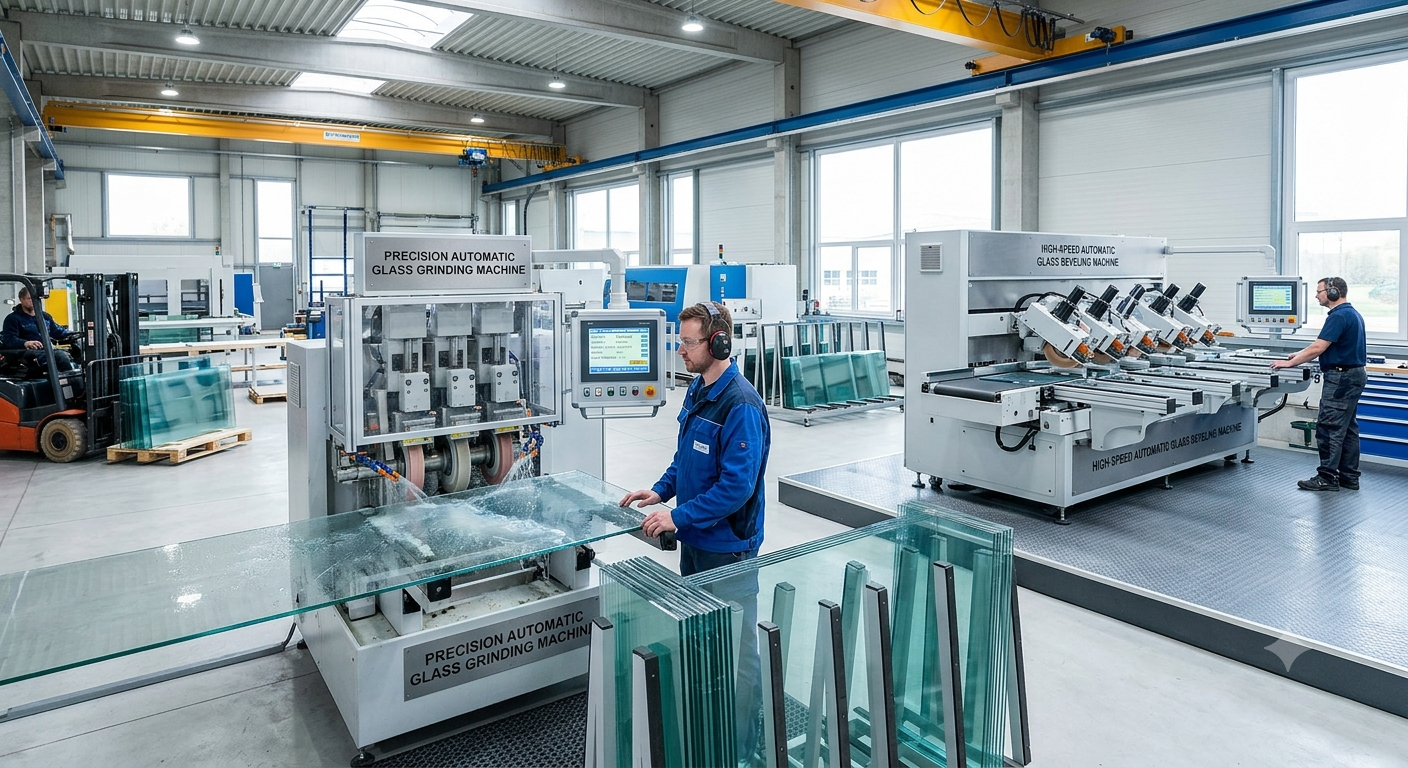
The glass processing industry is evolving rapidly as manufacturers seek better precision, higher productivity, and superior finishing quality. Two important technologies driving this transformation are the glass grinding machine and glass beveling machine. These machines help transform raw or cut glass into finished products with smooth edges, accurate dimensions, and attractive decorative profiles.
From architectural glass and furniture panels to automotive components and shower enclosures, precision edge processing has become essential. Understanding how these machines work, their applications, differences, and selection criteria can help manufacturers choose the right solution for their production needs.
What Is a Glass Grinding Machine?
A glass grinding machine is specialized equipment designed to remove sharp, rough, or uneven edges from glass. After glass is cut, its edges may have sharp corners, microscopic cracks, or irregularities. Grinding smooths these edges while improving dimensional accuracy and overall safety.
Modern machines may use diamond grinding wheels or other abrasive tools to process different types and thicknesses of glass. Depending on the configuration, a machine can perform edge grinding, arrissing, polishing, or other finishing operations.
How Does Glass Grinding Work?
The grinding process generally involves several controlled steps:
- The glass sheet is positioned and secured.
- The machine guides the glass through the processing area.
- Abrasive wheels remove unwanted material from the edges.
- Additional wheels may refine the surface and improve smoothness.
- Water cooling can reduce heat and control glass dust.
- The finished glass is inspected for edge quality and dimensional accuracy.
Why Edge Grinding Matters
Proper grinding can help reduce sharpness, improve handling safety, prepare glass for further processing, and create a consistent edge suitable for demanding applications.
What Is a Glass Beveling Machine?
A glass beveling machine is designed to create an angled or sloped edge along the perimeter of a glass panel. Unlike basic edge grinding, beveling focuses on producing a specific decorative or functional profile.
Beveled glass is widely used in interior design, furniture, mirrors, architectural applications, and premium decorative products. The angled edge can create attractive reflections and enhance the visual appearance of the finished glass.
How Does Glass Beveling Work?
A typical beveling operation follows a controlled sequence:
- Glass is loaded onto the machine.
- The panel is aligned according to the required dimensions.
- Grinding wheels remove material at a predetermined angle.
- Successive abrasive stages refine the bevel.
- Polishing wheels create the desired surface finish.
- The finished product is checked for consistency and quality.
The precision of the process depends on machine configuration, abrasive quality, glass type, operator settings, and production conditions.
Glass Grinding Machine vs. Glass Beveling Machine
Although both machines process glass edges, they serve different primary purposes.
| Feature | Glass Grinding Machine | Glass Beveling Machine |
| Primary function | Smooths and finishes glass edges | Creates angled decorative edges |
| Typical result | Flat, rounded, or polished edge | Sloped or beveled edge |
| Main applications | Safety glass, architectural panels, furniture | Mirrors, decorative glass, premium interiors |
| Processing focus | Edge refinement and dimensional control | Bevel profile and visual appearance |
| Common industries | Construction, automotive, furniture | Interior design, mirror, architectural glass |
| Finish options | Grinding and polishing | Bevel grinding and polishing |
Choosing between the two depends mainly on the desired edge profile and final application.
Key Applications of Glass Grinding and Beveling Equipment
The demand for precision glass processing spans multiple industries.
Architectural Glass
Modern buildings increasingly use large glass panels for façades, partitions, doors, and interiors. Grinding equipment helps achieve safe, consistent edges, while beveling machines can provide decorative finishes for high-end projects.
Furniture Manufacturing
Glass tables, shelves, cabinets, and display units require carefully processed edges. Grinding and polishing can improve safety, while beveling adds a premium appearance.
Mirror Production
Beveled mirrors are popular in residential and commercial interiors. A glass beveling machine can produce consistent angled edges that enhance the visual depth and elegance of mirror products.
Automotive Glass
Automotive applications require precision and reliability. Edge processing equipment can help manufacturers achieve the required dimensions and finishing quality for specific glass components.
Shower Enclosures
Glass shower doors and partitions require smooth, professionally finished edges. Precision grinding helps reduce sharp edges and prepares components for installation.
Important Features to Consider Before Buying
Selecting the right equipment requires more than comparing machine prices. Manufacturers should consider production requirements and long-term operating conditions.
1. Processing Capacity
Check the maximum and minimum glass thickness supported by the machine. Production volume and panel dimensions should also match the machine’s working capacity.
2. Edge Profile
Determine whether you need simple edge grinding, arrissing, polishing, or a specific bevel angle. The machine should support the required profile without excessive manual intervention.
3. Automation Level
Automated systems can improve productivity and reduce operator workload. Features such as automatic positioning, digital controls, and conveyor systems can be valuable for high-volume production.
4. Grinding Wheel Quality
The abrasive system directly influences processing quality. High-quality diamond tools can provide reliable material removal and consistent results when properly selected and maintained.
5. Cooling System
Glass processing generates heat and abrasive particles. An effective water-cooling and circulation system can help control processing temperature and support better tool performance.
6. Maintenance Requirements
Consider access to replacement parts, service support, cleaning requirements, and routine maintenance. A machine that is easy to maintain can reduce unexpected downtime.
Benefits of Modern Glass Processing Machines
Investing in suitable glass processing equipment can provide several operational advantages:
- Improved edge consistency
- Higher production efficiency
- Reduced manual finishing
- Better dimensional accuracy
- Enhanced product appearance
- Improved workplace safety
- More consistent polishing quality
- Greater production flexibility
For manufacturers handling large production volumes, these benefits can contribute to improved workflow and reduced processing waste.
How to Choose the Right Machine
Before investing in a glass grinding machine or glass beveling machine, follow these steps:
- Define the types and thicknesses of glass you process.
- Identify your required edge profiles and finishing standards.
- Estimate daily and monthly production volumes.
- Compare manual, semi-automatic, and automatic configurations.
- Evaluate abrasive and polishing systems.
- Review machine safety features.
- Check after-sales service and technical support.
- Consider total operating and maintenance costs.
A machine should be selected based on the complete production process rather than purchase price alone.
Future Trends in Glass Edge Processing
The future of glass manufacturing is increasingly connected to automation, digital controls, and intelligent production. Manufacturers are exploring equipment with improved sensors, automated parameter adjustment, and advanced monitoring systems.
Energy efficiency is also becoming more important. Newer machines are being designed to optimize water usage, reduce waste, and improve overall resource efficiency. As demand for customized architectural and decorative glass grows, flexible processing systems are likely to become increasingly valuable.
Frequently Asked Questions
1. What is a glass grinding machine used for?
It is primarily used to smooth, refine, and finish glass edges after cutting or shaping.
2. What does a glass beveling machine do?
It creates an angled edge on glass and can polish the resulting bevel for a decorative finish.
3. Are grinding and beveling the same process?
No. Grinding generally focuses on edge refinement, while beveling creates a specific angled edge profile.
4. Can these machines process thick glass?
Many industrial machines can process different thickness ranges, but the exact capability depends on the machine model and configuration.
5. Is water required during glass grinding?
Many machines use water cooling to control heat and assist with abrasive processing, although requirements vary by equipment design.
6. Where is beveled glass commonly used?
It is frequently used in mirrors, furniture, interior decoration, architectural projects, and premium glass products.
7. Why is edge polishing important?
Polishing improves the appearance and smoothness of processed edges while helping achieve a higher-quality finished product.
8. How can manufacturers improve grinding accuracy?
Using suitable abrasive tools, proper machine calibration, stable glass positioning, and regular maintenance can support consistent results.
9. Should small manufacturers buy automated equipment?
It depends on production volume, product requirements, available labor, and future growth plans. Automation can be valuable when consistent high-volume processing is required.
10. How often should glass processing equipment be maintained?
Maintenance schedules depend on machine usage and manufacturer recommendations. Regular inspection and cleaning are essential for reliable operation.
https://newsgrow.blogspot.com/2026/06/glass-grinding-machine-powers-precision.html