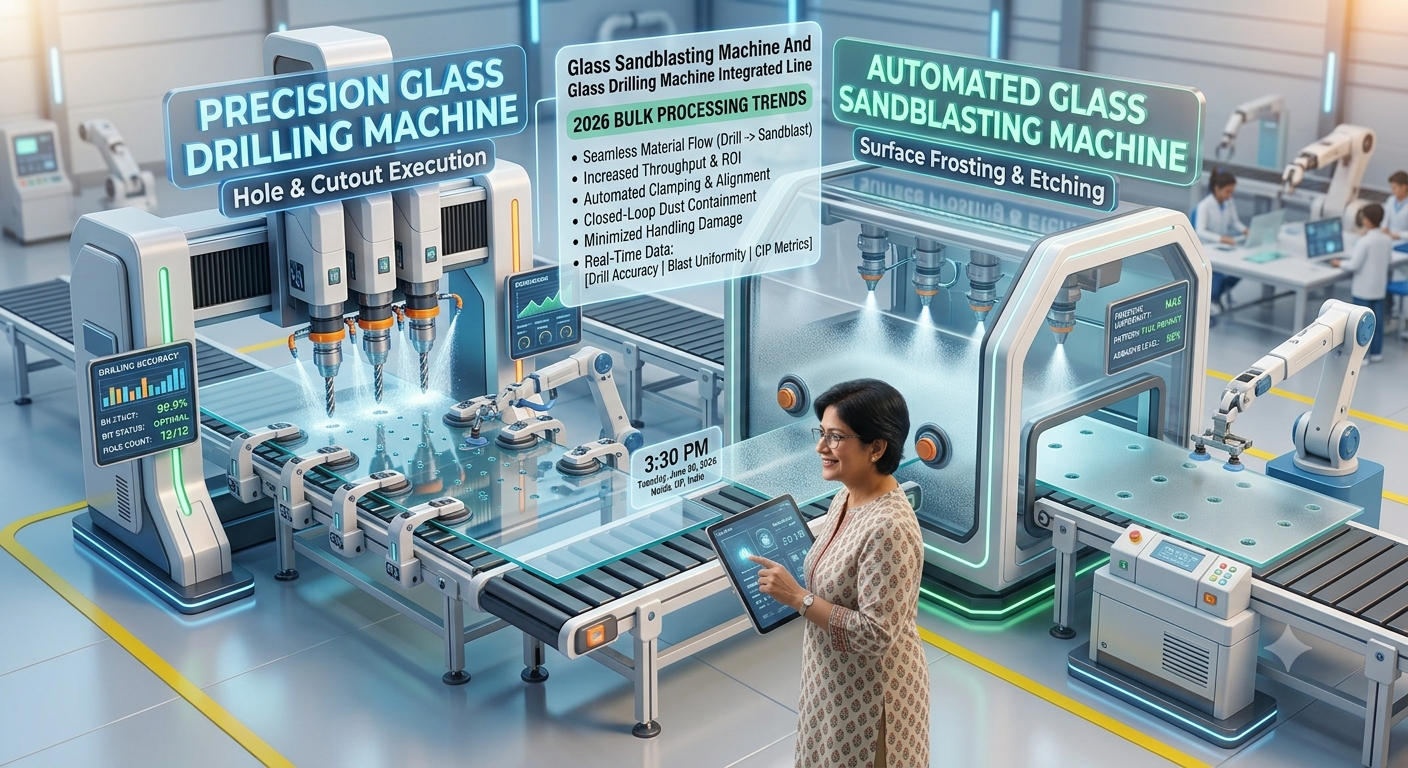
The glass processing industry is entering a new phase of precision, efficiency, and automation as manufacturers increasingly invest in advanced equipment. Among the technologies gaining attention are the Glass Sandblasting Machine and Glass Drilling Machine, two solutions that help transform standard glass sheets into functional, decorative, and highly customized products.
From architectural facades and shower enclosures to furniture, signage, doors, and interior décor, processed glass is now an important element in modern construction and design. As demand grows for accurate holes, attractive surface finishes, and customized patterns, manufacturers are turning to specialized machinery that can deliver consistent results while reducing manual work.
Growing Demand for Advanced Glass Processing Equipment
The shift toward customized architectural and decorative glass has created new opportunities for glass processors. Customers increasingly expect precise dimensions, clean edges, decorative textures, and carefully positioned holes. Traditional manual methods can struggle to meet these requirements at high production volumes.
Modern equipment addresses these challenges by combining automation, digital controls, and precision tooling. A Glass Sandblasting Machine is primarily used to create frosted, matte, patterned, or decorative surfaces, while a Glass Drilling Machine produces accurate holes required for hardware, fittings, handles, hinges, and other applications.
Together, these technologies support a more efficient glass fabrication workflow.
Key Industry Drivers
Several factors are contributing to the growing adoption of advanced glass machinery:
- Rising demand for customized architectural glass
- Expansion of commercial and residential construction
- Increasing use of glass in interior design
- Greater emphasis on automated production
- Demand for consistent quality and repeatability
- Growth in decorative and functional glass applications
How a Glass Sandblasting Machine Is Changing Surface Finishing
A Glass Sandblasting Machine uses abrasive media propelled against a glass surface to create a controlled textured or frosted appearance. Depending on the machine configuration and processing method, manufacturers can produce everything from simple translucent finishes to detailed decorative designs.
The technology is widely used when manufacturers need to improve the visual appeal or privacy characteristics of glass without changing its basic structural properties.
Common Applications of Glass Sandblasting
The technology can be applied across numerous sectors, including:
- Architectural partitions and office interiors
- Glass doors and shower enclosures
- Decorative mirrors
- Furniture and tabletops
- Retail displays and signage
- Hotel and restaurant interiors
- Customized artistic glass panels
Modern systems can also support repeatable patterns and customized designs, helping manufacturers respond to increasingly personalized customer requirements.
Benefits of Sandblasting Technology
The main advantages include:
- Consistent surface treatment
- Customized decorative patterns
- Improved privacy
- Efficient processing of multiple glass pieces
- Reduced dependence on manual finishing
- Greater production repeatability
Why Glass Drilling Machines Are Essential
A Glass Drilling Machine is designed to create precise holes in glass while minimizing the risk of cracks, chips, or breakage. Drilling glass requires careful control because the material is hard but brittle and can be damaged by excessive pressure, vibration, or heat.
Modern drilling equipment uses specialized diamond tools, controlled feeding systems, and cooling methods to improve accuracy and maintain surface quality.
Applications Across Multiple Industries
Precision-drilled glass is essential for products such as:
- Frameless glass doors
- Shower cabins
- Glass railings
- Office partitions
- Furniture components
- Display cabinets
- Architectural installations
- Industrial glass assemblies
As contemporary designs increasingly favor minimal frames and exposed glass surfaces, the need for accurately positioned holes has become more important.
Glass Sandblasting Machine vs Glass Drilling Machine
Although both machines are used in glass processing, their functions are significantly different.
| Feature | Glass Sandblasting Machine | Glass Drilling Machine |
| Primary function | Surface finishing | Hole creation |
| Main result | Frosted or textured surface | Precise drilled holes |
| Typical applications | Decoration and privacy | Hardware and fittings |
| Key requirement | Controlled abrasive treatment | Precision drilling and cooling |
| Common industries | Architecture, décor, interiors | Construction, furniture, fabrication |
| Production focus | Surface appearance | Functional precision |
Manufacturers may use both technologies in the same production facility. For example, a glass door could first be drilled for hinges and handles and then receive a decorative sandblasted design.
Automation Is Reshaping Glass Manufacturing
Automation is becoming one of the most important trends in modern glass fabrication. Manufacturers are looking for machinery that can improve productivity while maintaining consistent quality.
Advanced equipment may incorporate digital controls, programmable settings, automatic positioning, and production monitoring. These features can reduce setup time and help operators reproduce the same design across multiple pieces.
For high-volume manufacturers, automation can also improve workflow management by reducing repetitive manual operations.
Important Features to Consider
Before investing in equipment, manufacturers should evaluate:
- Processing size and glass thickness
- Machine accuracy
- Production capacity
- Automation level
- Cooling system
- Tool compatibility
- Maintenance requirements
- Operator safety features
- After-sales technical support
Choosing equipment based solely on purchase price can be risky. Long-term reliability, productivity, service availability, and operating costs should also be considered.
What Is Driving Future Growth?
The future of glass processing is closely connected with architectural innovation and manufacturing efficiency. As designers continue to use glass in increasingly creative ways, processors need flexible machinery capable of handling different designs and production requirements.
The integration of computer-controlled systems is likely to become more widespread. Manufacturers may increasingly combine automated drilling, surface treatment, cutting, edging, and inspection technologies within connected production lines.
This shift could help businesses improve throughput, reduce material waste, and deliver more consistent products.
Frequently Asked Questions
1. What is a Glass Sandblasting Machine?
A Glass Sandblasting Machine is specialized equipment used to create frosted, matte, textured, or decorative finishes on glass surfaces using abrasive blasting technology.
2. What is a Glass Drilling Machine used for?
A Glass Drilling Machine creates precise holes in glass for applications such as door hardware, handles, hinges, fittings, railings, and furniture components.
3. Can sandblasting create custom designs?
Yes. Depending on the equipment and masking or digital pattern system used, manufacturers can produce customized patterns, logos, graphics, and decorative effects.
4. Is drilling glass difficult?
Glass drilling requires specialized tools and controlled processing because excessive pressure, heat, or vibration can cause cracking or breakage.
5. Why is cooling important during glass drilling?
Cooling helps control heat generated during drilling and can improve tool performance while reducing the risk of thermal damage to the glass.
6. Are these machines suitable for industrial production?
Yes. Industrial models are designed for repeated processing and can support manufacturers handling larger production volumes.
7. Can one glass product require both machines?
Absolutely. A product may need drilled holes for functional hardware and sandblasted areas for decoration or privacy.
8. What industries use glass processing machinery?
Construction, architecture, interior design, furniture, automotive, hospitality, retail, and specialized glass fabrication industries commonly use these technologies.
9. What should buyers consider before purchasing?
Buyers should evaluate glass size, thickness, production volume, automation, precision, maintenance, safety, tooling, and technical support.
10. Is automation important in modern glass processing?
Automation can improve repeatability, productivity, and workflow efficiency, particularly for manufacturers handling large quantities or customized orders.
https://newsgrow.blogspot.com/2026/06/glass-sandblasting-machine-and-glass.html