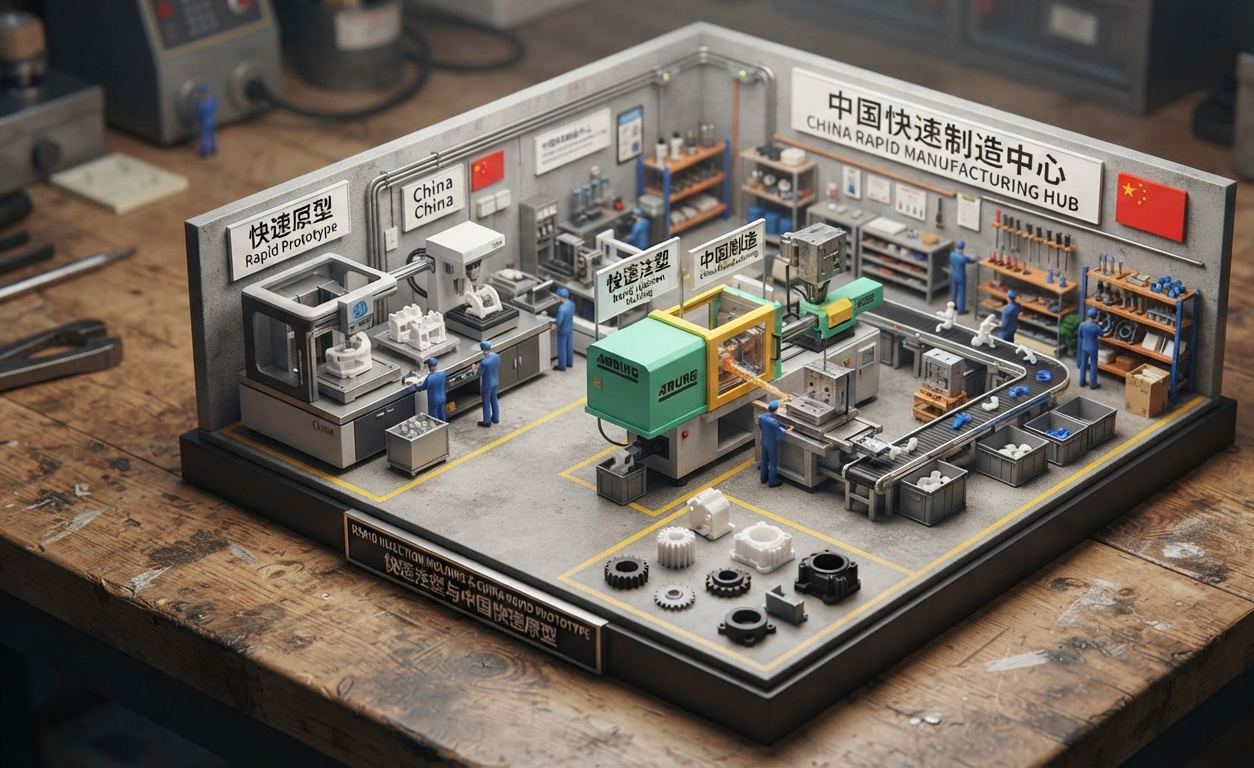
The global manufacturing industry is entering a new phase in which speed, flexibility, and cost efficiency are becoming just as important as production quality. As businesses look for ways to move products from concept to market faster, rapid injection molding and China rapid prototype services are gaining attention across industries such as automotive, consumer electronics, medical devices, industrial equipment, and consumer products.
The combination of fast prototyping and efficient plastic production is helping companies shorten development cycles, identify design problems earlier, and reduce the risks associated with launching new products. For startups and established manufacturers alike, these technologies offer a practical pathway from an initial idea to a market-ready component.
Why Rapid Manufacturing Is Becoming a Business Priority
Traditional product development can involve multiple rounds of design, tooling, testing, and modification. Each stage can add time and expense, particularly when manufacturers discover problems after production tooling has already been created.
Modern rapid manufacturing approaches aim to change this process by allowing engineers and product teams to validate designs earlier. A China rapid prototype service, for example, can help create physical samples that allow designers to examine dimensions, fit, appearance, and functionality before committing to larger-scale production.
This approach offers several potential benefits:
- Faster product development cycles
- Earlier detection of design problems
- Reduced development risks
- Greater flexibility during product testing
- Faster transition from prototype to production
- Better communication between engineering and manufacturing teams
As global competition increases, these advantages can directly influence how quickly a company responds to customer demand.
Rapid Injection Molding Bridges Prototyping and Production
While 3D printing and CNC machining are widely used for early-stage prototypes, they may not always reproduce the exact characteristics of an injection-molded plastic component. This is where rapid injection molding can become valuable.
The process uses accelerated tooling methods to produce functional plastic parts in relatively short production runs. Manufacturers can evaluate parts made using production-intent materials and injection molding processes without necessarily waiting for conventional high-volume tooling.
This makes rapid injection molding particularly useful when companies need to:
- Test real plastic components
- Validate assembly and fit
- Conduct functional testing
- Produce pilot batches
- Gather customer feedback
- Prepare for a product launch
The key advantage is not simply speed. It is the ability to obtain meaningful manufacturing feedback before investing heavily in full-scale production.
China Rapid Prototype Services Gain Global Interest
China has developed a large manufacturing ecosystem supported by experienced engineering teams, extensive supplier networks, advanced machinery, and established production capabilities. As a result, businesses worldwide increasingly explore China rapid prototype solutions for product development and engineering projects.
A capable manufacturing partner may provide several services under one supply chain, including:
- Product design assistance
- 3D printing
- CNC machining
- Vacuum casting
- Sheet metal fabrication
- Rapid tooling
- Injection molding
- Surface finishing and assembly
Having multiple capabilities available through one manufacturing network can simplify project management and reduce the time required to coordinate different suppliers.
However, businesses should evaluate suppliers carefully. Manufacturing experience, material knowledge, quality systems, tooling expertise, communication, and inspection procedures all influence the final result.
Comparing Rapid Injection Molding and Rapid Prototyping
| Factor | Rapid Injection Molding | China Rapid Prototype |
| Primary purpose | Functional plastic production and pilot runs | Fast product validation |
| Typical output | Injection-molded components | Prototype parts and models |
| Materials | Production-grade thermoplastics | Plastics, metals, resins, and other materials |
| Best suited for | Functional testing and small batches | Design testing and early development |
| Tooling | Requires molding tooling | Often requires minimal or no tooling |
| Production volume | Low to medium quantities | Usually low quantities |
| Main advantage | Production-like parts | Rapid design iteration |
The two approaches are not necessarily competitors. In many product development programs, they work together. A company may first create a prototype to validate the overall design and then use rapid injection molding to test parts under more realistic production conditions.
What Businesses Should Consider Before Choosing a Supplier
Selecting a manufacturing partner requires more than comparing quoted prices. A low initial price may not represent the best overall value if it leads to inconsistent quality, communication problems, or unexpected tooling modifications.
Before selecting a supplier, companies should consider:
Technical Capabilities
Review whether the manufacturer has experience with the required materials, part dimensions, tolerances, tooling requirements, and surface finishes.
Quality Control
Ask about inspection methods, dimensional measurement, material verification, and production quality procedures. Clear quality documentation can help reduce uncertainty.
Communication
Successful international manufacturing depends on accurate communication. Engineering drawings, 3D CAD files, material specifications, and inspection requirements should be clearly understood by both parties.
Tooling Expertise
For rapid injection molding, tooling quality can influence part consistency, cycle time, surface finish, and overall production performance.
Scalability
A supplier that supports prototypes should ideally have the capability to help customers transition toward larger production volumes when the product is ready for market.
The Role of Prototyping in Product Innovation
The value of prototyping extends beyond creating a physical model. It provides an opportunity to test assumptions before significant resources are committed.
A prototype can reveal issues involving:
- Product ergonomics
- Component fit
- Assembly sequence
- Mechanical performance
- Material selection
- Visual appearance
- Manufacturing feasibility
This feedback can help engineering teams make informed changes before production tooling becomes more expensive or difficult to modify.
For companies developing complex products, combining China rapid prototype services with rapid tooling can create a more structured development pathway. Teams can move through design validation, functional testing, pilot production, and eventual mass manufacturing with greater confidence.
Frequently Asked Questions
1. What is rapid injection molding?
Rapid injection molding is an accelerated molding approach used to manufacture plastic components using faster tooling and production methods, often for prototypes, pilot runs, or smaller production quantities.
2. What does China rapid prototype mean?
China rapid prototype generally refers to prototype manufacturing services provided by Chinese suppliers using technologies such as 3D printing, CNC machining, vacuum casting, and rapid tooling.
3. Is rapid injection molding suitable for prototypes?
Yes. It is particularly useful when companies need prototypes made from production-intent plastics or require parts that closely represent the final manufacturing process.
4. How is rapid injection molding different from 3D printing?
3D printing builds parts layer by layer, while injection molding uses a mold to form plastic components. Injection molding can better represent the characteristics of many production plastic parts.
5. Why do companies use China rapid prototype services?
Businesses may use these services to access manufacturing expertise, multiple production technologies, competitive project economics, and integrated supply-chain capabilities.
6. Can rapid prototypes be used for functional testing?
Yes. Depending on the manufacturing method and material selected, prototypes can be used to evaluate fit, assembly, performance, and usability.
7. Does rapid injection molding require tooling?
Yes. Injection molding requires a mold, although rapid tooling methods can reduce the time and cost compared with traditional high-volume tooling approaches.
8. Which industries use rapid prototyping?
Automotive, medical technology, electronics, consumer products, aerospace, industrial machinery, and many other sectors use rapid prototyping during product development.
9. How can businesses select a reliable manufacturer?
Companies should assess technical expertise, quality control, communication, equipment, material knowledge, production capacity, and experience with similar projects.
10. Can rapid prototyping reduce product development risks?
Yes. Early physical testing can identify design and manufacturing issues before companies commit to expensive tooling and large production quantities.
https://newsgrow.blogspot.com/2026/07/rapid-injection-molding-and-china-rapid.html