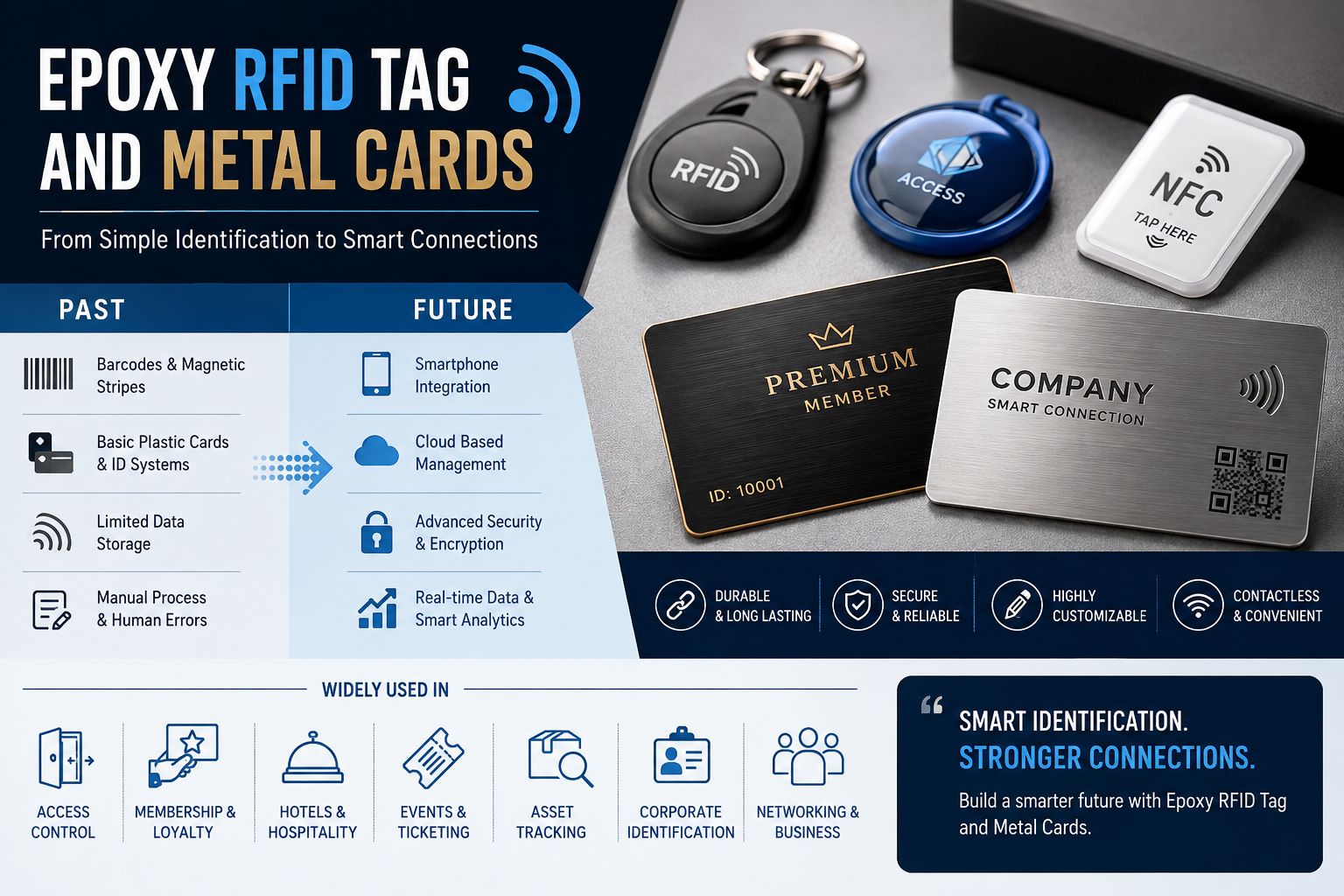
Physical identification is entering a new stage of development as organizations look for solutions that offer more than names, numbers, and printed information. The growing integration of RFID, NFC, cloud platforms, and digital profiles is changing how businesses approach products such as the Epoxy RFID tag and metal cards.
Previously, tags and cards were primarily passive objects. A card displayed information, while a key tag provided basic identification. Modern solutions can connect those physical objects with software, access systems, online profiles, and automated processes.
Industry developments suggest the future will focus increasingly on combining physical durability with convenient digital functionality.
Traditional Identification Created the Foundation
The journey toward smart identification began long before contactless technology became commonplace.
Businesses traditionally relied on paper passes, printed labels, plastic membership cards, magnetic stripes, and barcodes. Each innovation improved efficiency, but many systems still depended on manual handling.
Barcode labels, for example, generally require optical scanning. Magnetic stripe cards require physical interaction with compatible equipment.
RFID introduced a significant change because identification could occur through radio-frequency communication between compatible components.
That development created new opportunities for automated identification across commercial and operational environments.
Epoxy RFID Tags Bring Technology Into Everyday Use
RFID was initially strongly associated with industrial tracking, logistics, inventory management, and controlled-access environments.
As the technology expanded, businesses needed RFID credentials that were easier to carry and more suitable for everyday use.
The Epoxy RFID tag emerged as a compact solution combining contactless functionality with customizable visual presentation.
Why the Epoxy Format Attracted Attention
The epoxy layer provides a smooth exterior over the printed design and can help protect the surface during normal handling.
Depending on the manufacturer and intended application, an Epoxy RFID tag can incorporate:
- Brand logos
- Customized graphics
- Identification numbers
- QR codes
- Personalized text
- Different colors and shapes
- RFID or NFC components
This allows organizations to consider both functionality and brand consistency when selecting an identification product.
RFID Applications Continue to Diversify
The expanding role of RFID is one of the most significant developments within the identification market.
An Epoxy RFID tag may now be considered for employee access, attendance, hotel services, events, memberships, customer loyalty programs, and asset identification.
Automation Is Changing the Value of RFID
The true capability of RFID exists within the wider system rather than the tag alone.
When a compatible reader recognizes a credential, connected software can respond according to configured rules.
For example, a system might:
- Verify whether access is authorized.
- Record an attendance event.
- Retrieve a membership account.
- Identify an assigned asset.
- Update an internal record.
From Physical Credential to Connected Data Point
This represents a major shift from traditional identification.
The Epoxy RFID tag can serve as the physical point where an offline action becomes a digital event. For organizations investing in automation, that connection can help reduce repetitive manual processes.
Metal Cards Transform the Traditional Business Card
While RFID was developing around operational efficiency, metal cards entered the market through another trend: premium presentation.
Traditional paper business cards remain widely used, but businesses seeking stronger differentiation have increasingly explored alternative materials.
Metal offers characteristics that paper cannot easily reproduce. Weight, texture, precision engraving, and distinctive finishes can immediately change the recipient’s perception of a card.
This made metal cards particularly attractive for executive networking, premium memberships, luxury businesses, hospitality, and high-value customer programs.
Digital Connectivity Creates a New Role for Metal Cards
The next development is transforming premium cards from static objects into interactive tools.
A traditional card contains information that cannot change once printed. If a professional changes their telephone number, designation, website, or office, previously distributed cards may become outdated.
NFC and QR technology can help overcome this limitation.
Connecting One Card to a Digital Destination
Appropriately designed metal cards can potentially connect recipients with digital information through NFC or QR interactions.
That destination could contain:
- Professional contact details
- Company information
- Online portfolios
- Product catalogues
- Appointment links
- Social profiles
- Promotional landing pages
The physical product therefore becomes an entry point rather than the final source of information.
Epoxy RFID Tags and Metal Cards Serve Different Needs
Despite increasing digital functionality, the two products should not be treated as identical solutions.
| Consideration | Epoxy RFID Tag | Metal Cards |
| Primary Role | Identification and automation | Branding and networking |
| Typical Technology | RFID/NFC | NFC/QR when required |
| Access Control | Common use | Possible in suitable systems |
| Attendance | Strong application | Less common |
| Professional Networking | Possible | Major application |
| Customization | Printing, shapes, numbering | Engraving, cutting, premium finishes |
| Physical Size | Usually compact | Standard card format |
| Digital Integration | Mature | Expanding |
Selecting the appropriate technology requires understanding both the physical application and the digital system behind it.
Future Epoxy RFID Tag Applications Will Be More Connected
The future of the Epoxy RFID tag is expected to be influenced by broader developments in IoT, cloud computing, automation, and digital identity.
RFID Could Become Part of Smarter Infrastructure
Future workplaces, hotels, factories, campuses, and commercial facilities may rely increasingly on interconnected management platforms.
Within such environments, RFID can provide a practical method of recognizing authorized people or identified assets.
Future developments could include:
- Cloud-managed access credentials
- Automated equipment identification
- Smarter inventory processes
- Mobile-integrated management
- Advanced authentication
- Real-time operational reporting
- IoT connectivity
Data Could Become More Valuable Than the Tag
The physical tag enables identification, but the resulting information can provide greater long-term value.
Businesses may increasingly analyze identification events to understand asset movement, facility usage, inventory activity, or operational patterns.
Responsible data management and appropriate privacy controls will therefore become increasingly important.
Metal Cards Could Redefine Professional Networking
The future of metal cards may be equally interesting.
Premium materials will continue providing differentiation, but digital connectivity can give the physical card a longer and more flexible role.
A Move Toward Reusable Networking
Rather than continuously distributing disposable paper cards, some professionals may prefer a reusable smart card for face-to-face interactions.
A recipient can access the associated digital information through a compatible interaction, while the card remains with its owner.
This approach may be particularly relevant for executives, consultants, sales teams, entrepreneurs, and professionals who attend frequent networking events.
Security Will Become a Greater Priority
As physical credentials become connected to digital platforms, security will remain essential.
RFID and NFC implementations should be selected according to the sensitivity of the intended application. Chip capabilities, authentication, reader compatibility, software configuration, and data handling should all be evaluated.
An Epoxy RFID tag used for basic identification may require different security considerations from one used within a controlled-access environment.
Similarly, metal cards connecting to public professional profiles have different requirements from credentials supporting secure identification.
Technology should therefore be matched carefully to purpose.
Frequently Asked Questions
What is an Epoxy RFID tag?
An Epoxy RFID tag combines an RFID component with a customizable exterior protected by an epoxy surface.
Why are epoxy RFID tags used?
They provide compact contactless identification suitable for access, attendance, membership, loyalty, hospitality, and other applications.
Can an Epoxy RFID tag carry branding?
Yes. Customization may include logos, graphics, text, numbering, colors, shapes, and QR codes.
What are metal cards?
Metal cards are durable premium cards commonly used for networking, memberships, identification, and brand presentation.
Can metal cards include NFC?
Yes. NFC can be integrated into appropriately engineered card designs.
Why are NFC metal cards becoming popular?
They combine premium physical presentation with convenient access to digital profiles and online information.
Is NFC the same as RFID?
NFC belongs to the RFID technology family but is generally designed for very short-range communication.
Can RFID support asset management?
Yes. RFID can help identify assets when used with suitable readers, software, and operational processes.
Can information connected to a metal card be updated?
Digital destination content can potentially be changed without replacing the card, depending on the platform and configuration.
What is driving the future of smart identification?
Automation, IoT, cloud platforms, mobile technology, security, personalization, and demand for contactless experiences are major drivers.