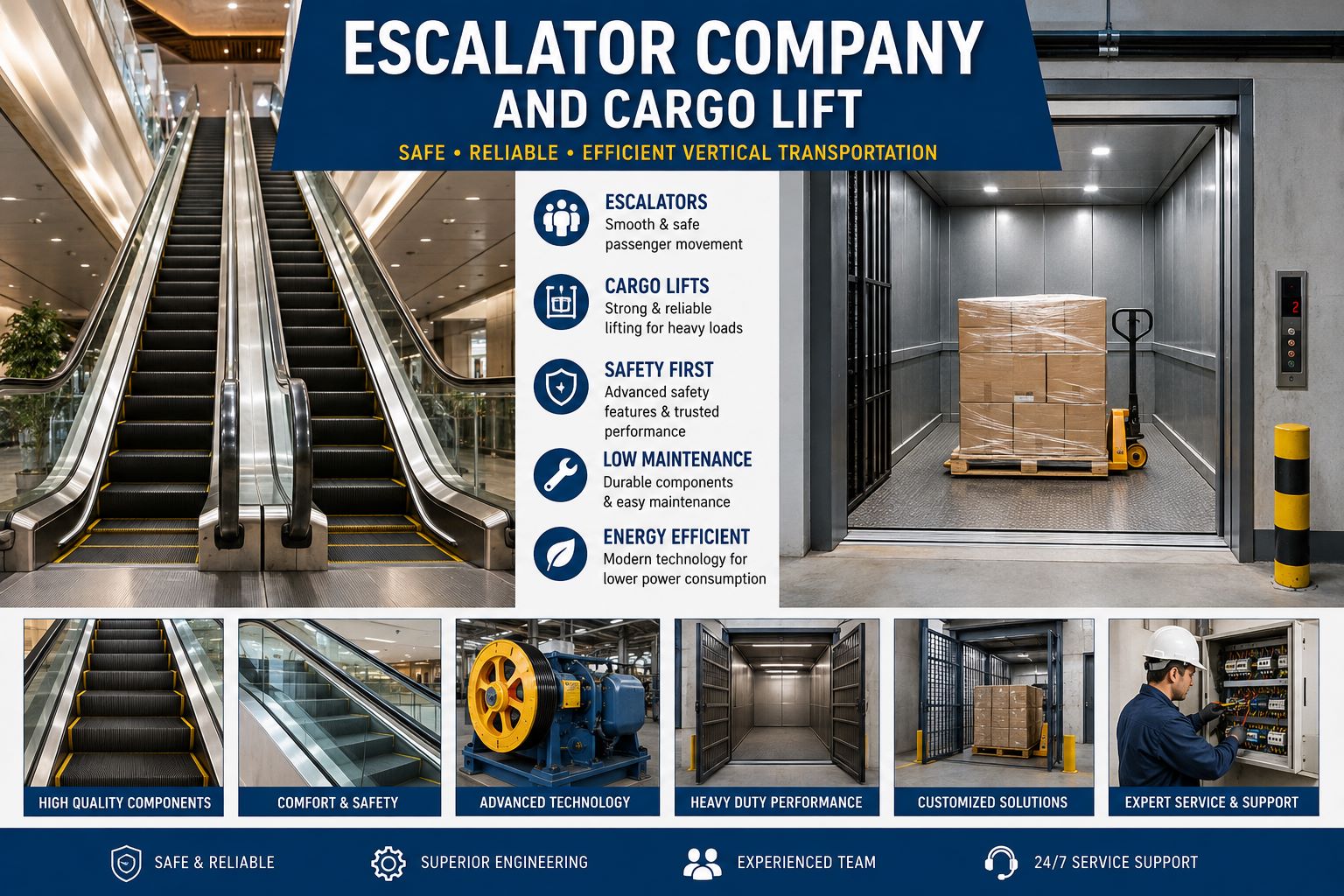
A successful multi-storey building is not only about attractive architecture or efficient floor planning. It is also about movement. Customers need to reach upper floors easily, employees need convenient access, and businesses need reliable ways to transfer products, machinery, stock, and supplies.
Two technologies solve these challenges in very different ways. A professional escalator company develops systems for continuous passenger movement, while a cargo lift is engineered to transport goods and materials vertically.
For property developers and business owners, understanding the difference can lead to better planning, safer operations, and lower long-term costs.
The Hidden Importance of Vertical Movement
Consider what happens inside a large retail centre during a busy weekend. Customers continuously travel between stores located on several floors. If everyone depended entirely on conventional elevators, queues could quickly develop.
The challenge looks different inside a warehouse. Instead of people, operators may need to move hundreds of cartons, pallets, tools, or components between storage levels.
These environments demonstrate why vertical transportation should be planned around the actual purpose of a building.
Effective systems can support smoother traffic, faster material handling, better utilization of available space, and more organized operations.
Why Escalators Remain Essential in High-Traffic Spaces
Escalators are particularly effective when people need to move continuously between nearby levels.
Passengers simply step onto the moving system and continue toward their destination without waiting for a cabin. This continuous-flow characteristic explains why escalators remain common in airports, railway stations, metro facilities, shopping centres, hotels, and large commercial developments.
However, installing an escalator involves considerably more than choosing a model from a catalogue.
What Should an Escalator Company Evaluate?
An experienced escalator company should examine the property and its expected usage before recommending a solution.
Important factors include:
- Expected passenger volume
- Peak-hour traffic
- Vertical rise
- Available installation space
- Step dimensions
- Inclination
- Entry and exit areas
- Operating hours
- Maintenance accessibility
Traffic direction also matters. Some buildings require paired escalators for simultaneous upward and downward movement, while other properties may use different configurations according to passenger circulation.
What Happens Behind an Escalator’s Moving Steps?
What passengers see is relatively simple: moving steps and handrails.
Behind that visible surface is an interconnected mechanical and electrical system.
A typical installation includes a motor, drive mechanism, chains, tracks, steps, braking equipment, handrails, sensors, and controllers working together.
Technology Is Making Escalators Smarter
Modern control technology can monitor system conditions and help improve operational efficiency.
Intelligent Operation During Quiet Hours
Depending on system configuration, sensors can identify approaching passengers. This allows compatible equipment to adjust operation when traffic is low instead of unnecessarily maintaining the same operating pattern throughout the day.
For facilities with long operating hours, intelligent controls can contribute to more efficient energy use.
Cargo Lifts Solve a Completely Different Challenge
If escalators are about passenger flow, a cargo lift is about operational flow.
These systems create a dedicated vertical route for goods.
A manufacturing business might use one to transport components between production areas. A hotel may need it for supplies. Retailers can transfer stock from storage areas, while warehouses may use cargo lifting equipment to move pallets between floors.
Common Cargo Lift Applications
A cargo lift can be useful in:
- Warehouses and distribution centres
- Manufacturing plants
- Retail stockrooms
- Hotels and commercial kitchens
- Workshops
- Storage facilities
- Industrial buildings
- Logistics operations
The equipment can help reduce repetitive manual handling while making multi-level facilities easier to operate.
What Should You Look for in a Cargo Lift?
One common mistake is focusing entirely on lifting capacity.
Capacity is important, but it is only one part of system selection.
Start With the Goods
What will the lift actually carry?
A business transporting compact metal components may need high weight capacity but relatively limited platform space. Another company moving large packaged products might need a spacious platform despite carrying considerably less weight.
Examine Door Dimensions
A platform can be large enough while the entrance remains too narrow for the intended goods.
Door dimensions should therefore be considered alongside platform size.
Consider Loading Methods
Will goods be loaded manually, with carts, using trolleys, or through another handling method?
Design Around Daily Workflow
The best cargo lift is not simply one that can carry the required weight. It should integrate naturally with how goods arrive, move through the building, and reach their destination.
Escalator or Cargo Lift: Understanding Their Roles
| Consideration | Escalator | Cargo Lift |
| What does it move? | People | Goods and materials |
| Movement pattern | Continuous | Trip-based |
| Common setting | Public areas | Service areas |
| Main design factor | Passenger flow | Load requirements |
| Transportation surface | Moving steps | Platform/cabin |
| Typical objective | Reduce passenger congestion | Improve material workflow |
| Major users | Visitors | Commercial/industrial operations |
Large commercial developments may require both because separating passenger and goods movement can improve building organization.
Safety Starts Before Installation
Safety is not something that should be added after equipment installation. It begins during planning.
A qualified escalator company should consider the equipment specification, building environment, installation conditions, and relevant safety requirements from the beginning.
Escalators may incorporate technologies such as emergency stop switches, automatic braking, speed monitoring, handrail monitoring, and protection around moving components.
Cargo lifting equipment may feature:
- Door interlocks
- Overload detection
- Emergency stop controls
- Automatic braking
- Limit switches
- Position monitoring
- Electrical safeguards
- Fault detection
The exact safety configuration should match the equipment design and applicable standards.
Maintenance Is Where Long-Term Value Is Created
Two systems with similar initial specifications can perform very differently after years of operation.
Maintenance is often the reason.
An escalator company offering strong maintenance support can regularly examine motors, drives, brakes, chains, rollers, tracks, handrails, sensors, controllers, and electrical systems.
Cargo lift maintenance similarly involves inspection of drive equipment, platforms, doors, guide systems, controls, safety devices, and electrical components.
Preventive servicing can help identify developing wear before it becomes a major operational problem.
Energy Efficiency Should Be Part of the Conversation
Purchase price is easy to compare because it appears immediately on a quotation. Energy consumption continues for years.
That makes operating efficiency an important part of equipment selection.
Modern escalator systems can incorporate energy-efficient motors, variable-frequency drives, efficient lighting, standby modes, and intelligent control functions.
A cargo lift can also benefit from correctly selected motors and drive technology.
Calculate Value Across the Equipment Lifecycle
Lowest Price Does Not Always Mean Lowest Cost
Businesses should evaluate installation, electricity, maintenance, replacement parts, downtime, repair requirements, and expected service life together.
This provides a more realistic understanding of long-term equipment value.
Should Old Equipment Be Replaced or Modernized?
Older equipment eventually reaches a point where maintenance requirements increase or particular technologies become outdated.
Complete replacement is one option, but modernization may sometimes be practical.
A professional escalator company can assess the condition of existing motors, controllers, drives, brakes, electrical systems, sensors, and safety equipment.
Modernization may allow selected components to be upgraded while retaining suitable parts of the existing installation.
The same approach can be considered for older cargo lifting equipment after a detailed technical assessment.
Frequently Asked Questions
Why hire a professional escalator company?
An escalator company provides technical planning, installation, testing, maintenance, repairs, modernization, and long-term support.
What does a cargo lift transport?
A cargo lift can transport stock, cartons, pallets, equipment, machinery, components, and other commercial or industrial materials.
Are escalators suitable for busy buildings?
Yes. Their continuous movement makes escalators particularly useful in buildings experiencing regular passenger traffic.
How do I determine cargo lift size?
Consider load dimensions, maximum weight, platform area, entrance dimensions, loading method, and available installation space.
Where can cargo lifts be installed?
They are commonly used in warehouses, factories, hotels, shops, storage buildings, workshops, and distribution facilities.
Do escalators need preventive maintenance?
Yes. Routine inspection supports reliable operation and helps identify worn or deteriorating components.
What is overload protection in a cargo lift?
It is a safety function designed to detect loads exceeding the system’s specified operating capacity.
Can escalators operate more efficiently during low traffic?
Certain modern systems can use sensors, intelligent controls, and variable-speed technologies to optimize operation during quieter periods.
Is modernization better than replacement?
It depends on equipment condition, age, reliability, component availability, safety requirements, and expected future use.
What makes a good escalator company?
Look for engineering knowledge, installation experience, safety expertise, maintenance capability, spare-parts support, and dependable after-sales service.
https://gosarkarijobs.com/how-escalator-companies-and-cargo-lifts-are-transforming-modern-buildings/