
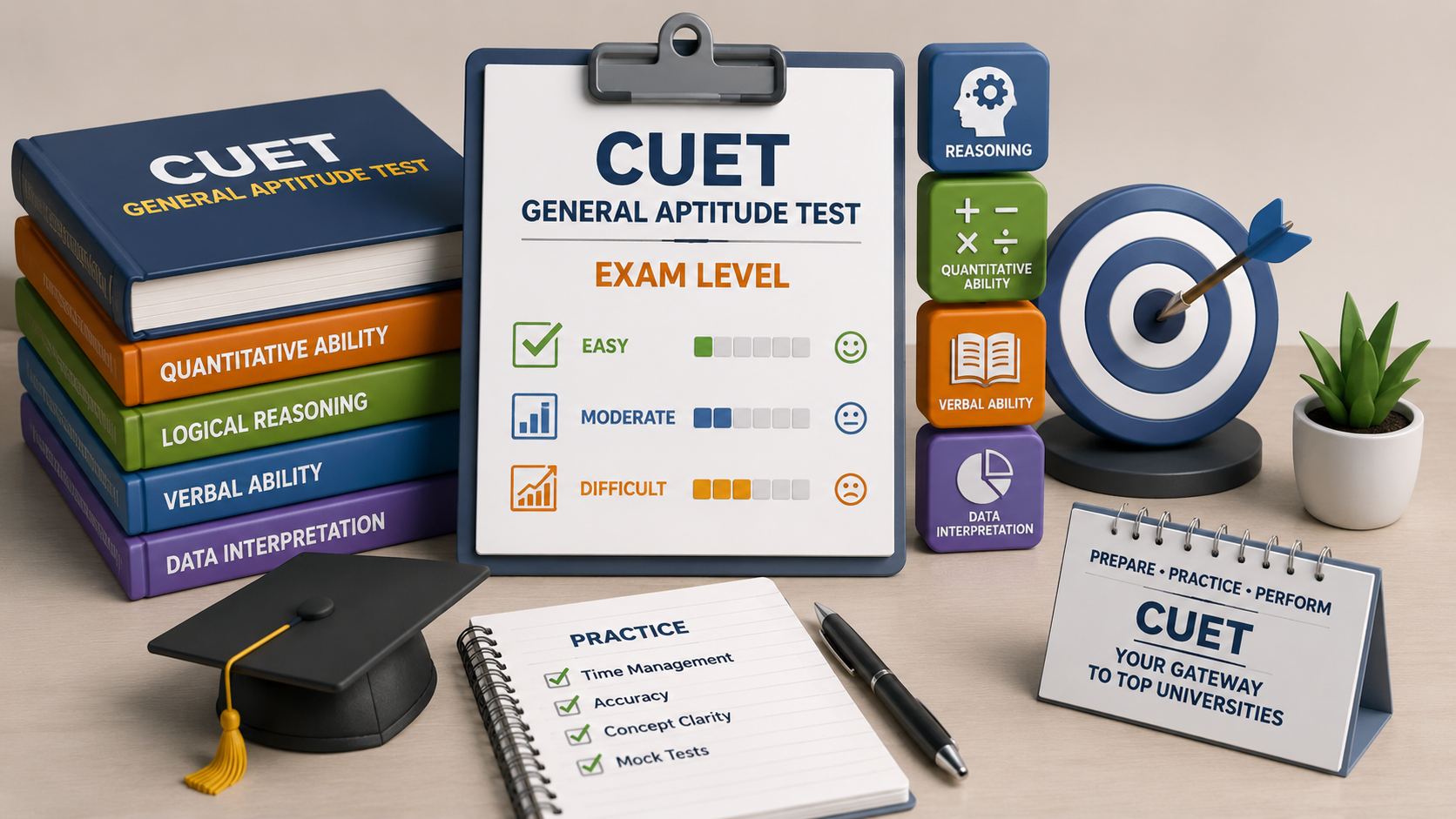
The general aptitude test CUET is an important area of preparation for students whose chosen university programmes require the General Aptitude Test under the Common University Entrance Test (CUET-UG). Unlike subject-specific papers, aptitude preparation focuses on reasoning, numerical ability, general awareness and the ability to solve unfamiliar questions efficiently.
For many students, the bigger concern is not simply what to study, but understanding the CUET exam level and deciding how much preparation is actually required. Is the aptitude section difficult? Which topics deserve more attention? How should students balance speed and accuracy?
This guide explains the General Aptitude Test in practical terms, including its major skill areas, expected difficulty, preparation methods, common mistakes and ways to improve performance.
What Is the General Aptitude Test CUET?
The general aptitude test CUET evaluates a candidate’s ability in areas such as logical reasoning, quantitative aptitude, general knowledge and current affairs. It is designed to assess broader problem-solving and analytical skills rather than knowledge of one academic subject alone.
Students should always check the current CUET-UG information bulletin and the eligibility or subject requirements of their preferred university and programme. Not every course requires the same CUET test combination.
From a preparation perspective, the aptitude test typically requires students to develop competency in:
· Numerical and quantitative reasoning
· Logical and analytical reasoning
· General knowledge
· Current affairs
· Mental calculation
· Data-based problem solving
· Time management and question selection
The key is not merely knowing concepts. Students need to apply them accurately within a limited examination period.
What Is the CUET Exam Level for General Aptitude?
The CUET exam level for aptitude should generally be approached as a test of fundamental concepts combined with speed, reasoning and application. Individual students may find the paper easier or harder depending on their mathematical foundation, reading habits, reasoning ability and familiarity with timed aptitude questions.
Instead of asking whether CUET is simply “easy” or “difficult”, it is more useful to evaluate three factors: concept difficulty, question interpretation and time pressure.
A straightforward percentage or ratio question, for example, may not involve advanced mathematics. However, solving several such questions accurately under examination conditions can still be challenging.
Why Can the General Aptitude Test Feel Difficult?
Students commonly struggle because they:
· spend too much time on one calculation;
· have weak fundamentals in arithmetic;
· practise topics separately but rarely attempt timed mixed tests;
· ignore current affairs until the final weeks;
· use lengthy methods for questions that have shorter solutions;
· guess excessively when unsure;
· fail to analyse mistakes after mock tests.
Therefore, effective CUET preparation should combine knowledge with examination technique.
General Aptitude Test CUET Syllabus Areas to Focus On
Candidates should follow the latest official syllabus for their examination year. For preparation purposes, the aptitude section can be divided into several broad areas.
1. Quantitative Aptitude and Numerical Ability
Numerical ability is one of the areas where regular practice can produce noticeable improvement.
Important concepts may include:
· percentages;
· ratios and proportions;
· averages;
· profit and loss;
· simple and compound interest;
· time and work;
· speed, time and distance;
· fractions and decimals;
· basic algebra;
· geometry and mensuration;
· number-based problems; and
· data interpretation.
The objective should be to understand the method first and improve calculation speed afterwards.
Practical example: If a product priced at ₹2,000 receives a 15% discount, a student should quickly calculate that 10% is ₹200 and 5% is ₹100, giving a total discount of ₹300 and a final price of ₹1,700.
Simple mental techniques like this can save valuable time.
2. Logical and Analytical Reasoning
Reasoning questions assess how effectively students identify relationships, sequences, patterns and conclusions.
Preparation may cover areas such as:
· number and letter series;
· analogy;
· classification;
· coding and decoding;
· direction-based questions;
· blood relations;
· ranking and ordering;
· statements and conclusions;
· logical sequences; and
· analytical problem solving.
Reasoning improves through exposure. Students who solve different question formats regularly are less likely to be surprised by unfamiliar presentation styles.
3. General Knowledge
General knowledge preparation should be systematic rather than random.
Students can build awareness around areas such as:
· Indian history and geography;
· basic economics;
· science and technology;
· important organisations;
· awards and honours;
· sports;
· significant national and international developments; and
· important personalities and events.
Static general knowledge is broad, so preparation should prioritise relevant areas instead of attempting to memorise everything.
4. Current Affairs
Current affairs require consistent preparation.
A short daily routine is generally more manageable than trying to study several months of developments immediately before the examination. Students can maintain concise notes under categories such as national affairs, international affairs, economy, science, environment, sports and awards.
Revision is particularly important because simply reading news does not guarantee recall.
General Aptitude Test CUET vs Subject-Specific Papers
The preparation style for an aptitude paper differs significantly from that required for domain subjects.
| Factor | General Aptitude Test | Domain-Specific Paper |
| Main focus | Reasoning, aptitude and awareness | Subject knowledge |
| Preparation approach | Practice-oriented | Concept and syllabus-oriented |
| Numerical skills | Often important | Depends on subject |
| Current affairs | Relevant | Usually less central |
| Speed requirement | High | Varies |
| Mock-test value | Very high | High |
| Best preparation method | Concepts + timed practice | Syllabus study + practice |
Students preparing for both should therefore avoid using exactly the same study strategy for every CUET component.
How Should You Prepare for the General Aptitude Test CUET?
A strong preparation strategy has four stages: learn, practise, test and analyse.
Step 1: Understand Your Current Level
Start with a diagnostic test before creating a detailed timetable.
Identify:
· topics you solve accurately;
· topics that consume excessive time;
· concepts you have forgotten;
· frequently repeated calculation errors; and
· areas where you depend heavily on guessing.
This creates a realistic starting point.
Step 2: Strengthen Basic Concepts
If arithmetic fundamentals are weak, immediately attempting difficult mock tests can be counterproductive.
First revise core concepts such as fractions, percentages, ratios, averages and basic equations. Once these become comfortable, move towards mixed and time-bound questions.
Step 3: Practise Questions Every Day
Consistency is more useful than occasional long study sessions.
A student might divide a study session between:
1. quantitative aptitude;
2. logical reasoning;
3. current affairs revision; and
4. error correction from previous practice.
The exact time allocation should depend on individual strengths and weaknesses.
Step 4: Attempt Timed Mock Tests
Mock tests help students understand the practical CUET exam level better than theory alone.
A good mock-test routine trains you to:
· choose questions strategically;
· avoid getting trapped by difficult problems;
· maintain concentration;
· calculate quickly;
· recognise familiar patterns; and
· manage examination pressure.
Do not measure progress only by the number of mocks attempted. The analysis after each test is equally important.
How Can You Improve Speed Without Losing Accuracy?
Improve speed by mastering fundamental calculations and practising common question patterns under controlled time limits. Speed should develop from familiarity and efficient methods, not careless rushing.
For quantitative aptitude, practise mental calculations involving percentages, fractions, squares and ratios.
For reasoning, learn to identify the underlying question type before solving it.
During practice, record both accuracy and time per question. A student who answers 20 questions accurately may have a stronger foundation than someone who attempts 30 with frequent errors.
Common Mistakes Students Make in CUET Aptitude Preparation
One common mistake is treating aptitude preparation as something that can be completed entirely at the last minute.
Other avoidable problems include studying without a syllabus, collecting too many books or resources, memorising shortcuts without understanding concepts, ignoring weak topics and taking mock tests without reviewing mistakes.
Avoid Resource Overload
Students often assume that more books, videos and practice platforms automatically mean better preparation.
They do not.
Choose a manageable set of reliable resources and complete them systematically. Repeated revision and targeted practice usually provide more value than constantly switching materials.
Suggested internal link: Best Books for CUET Preparation
How Should You Analyse a CUET Mock Test?
After completing a mock test, divide incorrect or skipped questions into categories.
Ask:
· Was the concept unclear?
· Did I misread the question?
· Was my calculation incorrect?
· Did I use an unnecessarily long method?
· Did I run out of time?
· Was it a blind guess?
Maintain an error notebook containing the question type, reason for the mistake and correct approach.
Over time, patterns become visible. For example, you may discover that most lost marks come from calculation mistakes rather than conceptual weakness. That requires a different solution from simply studying more theory.
Suggested internal link: CUET Mock Tests and Practice Papers
Expert Tips for Handling the CUET Exam Level
Successful aptitude preparation depends heavily on examination discipline.
Prioritise questions you can solve confidently. If a problem is consuming too much time, mark it for review and move forward where the test interface and instructions permit.
Practise mental mathematics, but do not rely on shortcuts you cannot explain. Revise current affairs regularly rather than irregularly. Most importantly, practise in conditions that resemble the actual examination format.
Candidates should also check the official examination instructions for the applicable marking scheme, question pattern and other rules for their CUET year instead of relying solely on older preparation material.
How Much Time Is Needed to Prepare for CUET General Aptitude?
There is no single preparation period suitable for every student.
A candidate with strong reasoning and arithmetic skills may need more emphasis on mock tests and current affairs. Someone who struggles with basic percentages, ratios or logical reasoning will benefit from a longer concept-building phase.
A useful progression is:
Foundation → Topic Practice → Mixed Questions → Timed Tests → Full Mocks → Revision
Starting early provides more opportunity to identify and correct weaknesses without rushing.
Should You Join CUET Coaching or Prepare Independently?
Both approaches can work. The better choice depends on your discipline, current academic level and need for structured guidance.
Self-study may suit students who can follow a timetable, identify reliable resources and analyse their own performance.
Structured coaching may be useful for students who need regular tests, doubt support, guided preparation or accountability.
Before choosing a local CUET coaching programme, consider faculty experience, batch size, doubt-solving support, mock-test quality and whether the teaching approach matches your actual weaknesses.
Avoid choosing a programme solely because it promises unrealistic scores or results.
Suggested internal link: CUET Coaching and Preparation Courses
Looking for Structured CUET Preparation?
If you need help understanding your current aptitude level, consider taking a diagnostic assessment before enrolling in a preparation programme. A personalised study plan based on actual strengths and weaknesses is more useful than following the same timetable as every other student.
CTA: Book a CUET preparation counselling session or diagnostic test to identify the areas that deserve the most attention.
Frequently Asked Questions About General Aptitude Test CUET
What is the General Aptitude Test in CUET?
The general aptitude test CUET assesses broader abilities such as numerical aptitude, logical reasoning, general knowledge and current affairs, subject to the syllabus and pattern announced for the relevant CUET-UG cycle.
What is the CUET exam level?
The CUET exam level varies by section and individual preparation. For aptitude, students should expect fundamental concepts combined with reasoning, application and time-management demands.
Is the CUET General Aptitude Test difficult?
It can be challenging when a student lacks practice or struggles with time management. Strong fundamentals and regular timed practice can make the paper considerably more manageable.
Is mathematics required for CUET general aptitude preparation?
Numerical ability is an important preparation area. Students should be comfortable with fundamental arithmetic and problem-solving concepts included in the applicable syllabus.
How can I improve my CUET aptitude score?
Focus on conceptual clarity, daily question practice, timed mock tests, current affairs revision and detailed analysis of incorrect answers.
How should I prepare for CUET logical reasoning?
Learn individual reasoning patterns first and then practise mixed question sets. Timed exercises are useful once accuracy becomes consistent.
Are mock tests necessary for CUET?
Mock tests are highly valuable because they help students practise question selection, speed, accuracy and time management under examination-like conditions.
How should I study current affairs for CUET?
Study current affairs regularly, organise short notes by topic and revise them repeatedly. Avoid depending entirely on last-minute current affairs compilations.
Can I prepare for CUET General Aptitude through self-study?
Yes. Students with disciplined study habits can prepare independently using the official syllabus, appropriate study material, question practice and mock tests.
How do I know whether my chosen course requires the General Aptitude Test?
Check the latest CUET-UG information bulletin and the admission requirements published by the university offering your preferred programme. Test combinations can differ between programmes and institutions.