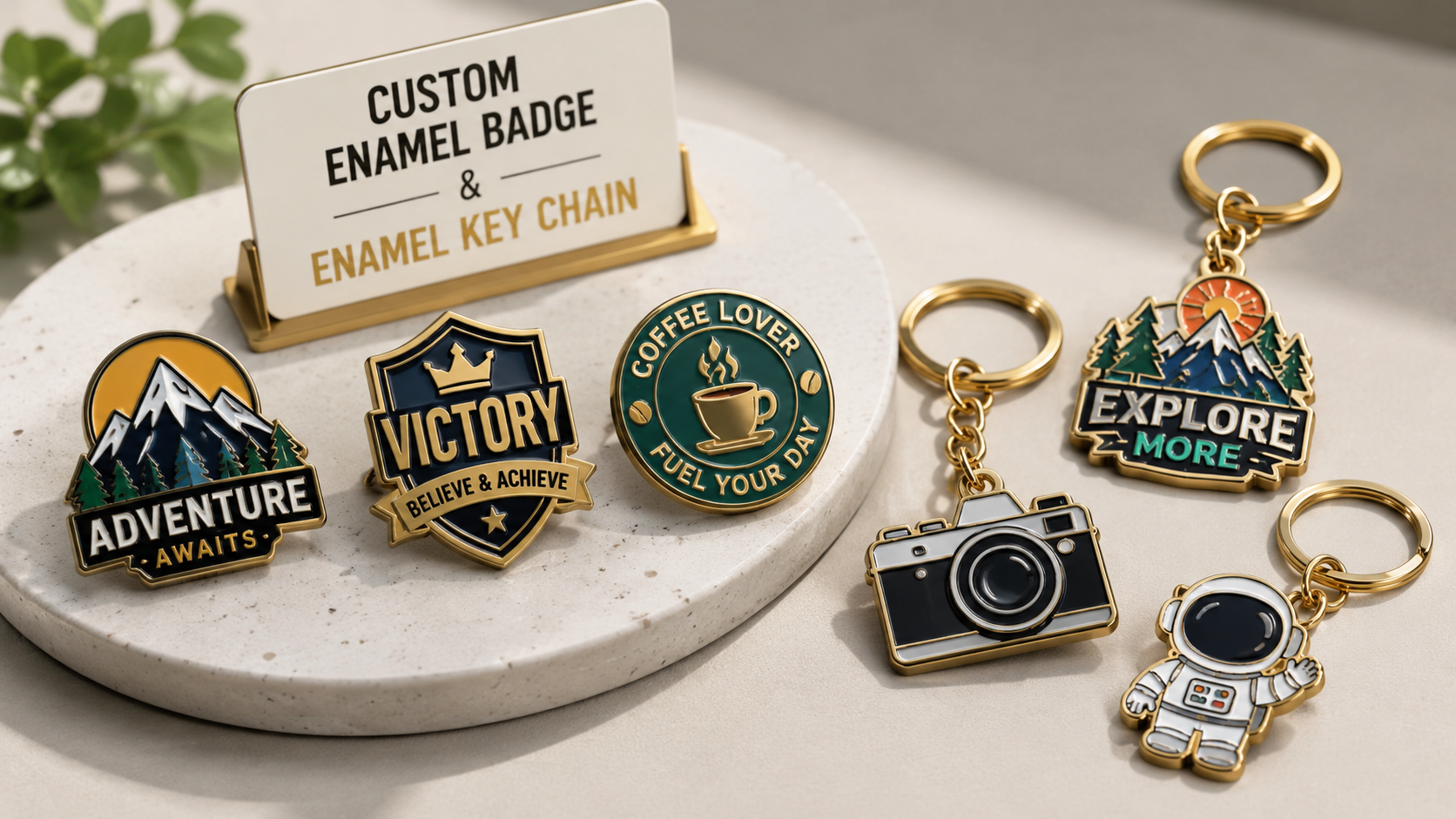
A well-designed custom enamel badge turns a logo, message or piece of artwork into something people can wear, collect and keep. Unlike disposable promotional materials, enamel badges have a physical presence that makes them suitable for businesses, clubs, events, schools, charities, fashion labels and organisations looking for distinctive branded merchandise.
The same design principles can also be applied to an enamel key chain, giving organisations another practical way to transform artwork or branding into an everyday accessory.
Whether you are ordering badges for staff uniforms, launching a merchandise range or creating commemorative pieces for an event, understanding the manufacturing and design options can help you achieve a better result.
What Is a Custom Enamel Badge?
A custom enamel badge is a metal badge produced from bespoke artwork, typically using recessed or defined areas that are filled with coloured enamel. The finished badge can reproduce logos, symbols, typography, mascots and other artwork in a compact, durable format.
Most enamel badges consist of:
· A metal base
· Raised or recessed design details
· Enamel colour fills
· A selected metal plating or finish
· A pin or fastening mechanism
· Optional presentation packaging
The exact construction varies depending on whether soft enamel, hard enamel or another production technique is selected.
Quick Answer
Custom enamel badges are personalised metal accessories created from a customer’s artwork, logo or design and finished with coloured enamel. They are commonly used for branding, merchandise, uniforms, events, membership recognition and promotional campaigns.
This straightforward definition is also useful for customers comparing different personalised badge options.
Soft Enamel vs Hard Enamel Badges
One of the first decisions when ordering a custom badge is choosing between soft and hard enamel.
| Feature | Soft Enamel | Hard Enamel |
| Surface | Textured with recessed colour areas | Smooth and polished |
| Metal lines | Usually more pronounced | Integrated into a flatter surface |
| Design appearance | Bold and dimensional | Refined and premium |
| Fine detailing | Often well suited | Depends on design complexity |
| Common applications | Promotions, clubs, events | Corporate, retail and premium merchandise |
Neither option is automatically better. The right choice depends on the artwork, desired finish, budget and intended application.
For example, a colourful club mascot with strong outlines may work particularly well in soft enamel. A minimalist corporate logo intended for executive gifts may benefit from the polished appearance of hard enamel.
Why Businesses Choose Custom Enamel Badges
Physical branding still matters, particularly when an item becomes part of someone’s clothing, bag or personal collection.
A custom badge can be used to represent identity, achievement, membership or association with an organisation.
Corporate Branding
Companies can incorporate badges into employee uniforms, conference packs, dealer programmes, promotional kits and corporate gifts.
A carefully designed badge can reinforce visual identity without requiring oversized branding.
Events and Exhibitions
Badges work well for exhibitions, conferences, product launches, festivals and corporate events.
Different badge designs can even distinguish exhibitors, organisers, volunteers or VIP participants.
Clubs and Membership Organisations
Sports clubs, associations, societies and community organisations can create personalised badges featuring crests, membership symbols or anniversary artwork.
Retail Merchandise
Artists, fashion brands, museums, creators and independent retailers can sell enamel badges as standalone products or as part of themed collections.
Because the product is highly customisable, multiple designs can be developed around the same brand identity.
How to Design a Better Custom Enamel Badge
Good badge production starts with artwork that works at a small physical scale.
A design that looks impressive on a large computer screen may lose clarity when reduced to 25 mm or 30 mm.
1. Keep the Main Design Recognisable
Prioritise the most important visual elements.
If you are converting a detailed logo into a badge, consider whether every line and word needs to appear. Simplifying minor details can make the final product clearer.
2. Use Strong Colour Separation
Enamel colours are normally divided by metal boundaries. Designs should therefore have clearly defined colour areas.
Your manufacturer should be able to advise whether particular artwork needs modification before production.
3. Consider Badge Size Carefully
Small badges are subtle and lightweight, while larger badges provide more room for typography and complex artwork.
The appropriate dimensions depend on where the badge will be worn and how much information it needs to display.
4. Select the Right Metal Finish
Common choices may include:
· Gold-coloured plating
· Silver-coloured plating
· Black nickel
· Antique-style finishes
· Copper or brass-style finishes
The metal finish should complement rather than compete with the enamel colours.
5. Choose a Suitable Fastening
Different applications require different attachments. Common options include butterfly clutches, rubber clutches, safety-pin-style fittings and other specialist fasteners.
For uniforms or frequently worn badges, attachment security should be considered alongside appearance.
From Artwork to Finished Badge: How Production Works
Although production processes differ between manufacturers, a typical custom badge project follows several stages.
Step 1: Artwork Submission
The customer provides a logo, illustration or design concept. Vector artwork is generally useful because it allows the design to be resized and adjusted accurately.
Step 2: Design Review
The artwork is assessed for manufacturing suitability. Very thin lines, tiny lettering or complicated colour areas may require adjustment.
Step 3: Digital Proof
A production-ready visual is prepared showing the badge shape, colours, metal finish and key design details.
Customers should inspect this proof carefully before approving production.
Step 4: Tooling and Manufacturing
Once approved, the required tooling or mould is prepared and the metal badge is manufactured.
Step 5: Enamel Application
Colours are added to the appropriate areas of the design. The precise process depends on the selected enamel method.
Step 6: Finishing and Attachment
The badge receives its selected plating or surface treatment before the fastening is fitted.
Step 7: Quality Inspection and Packaging
Finished pieces should be checked for issues such as incorrect colours, poor plating, damaged attachments or obvious surface defects before packing.
What Is an Enamel Key Chain?
An enamel key chain uses similar personalised metal and enamel design principles but converts the artwork into a keyring accessory rather than a wearable badge.
It can feature a company logo, character, symbol, slogan, destination, product illustration or commemorative design.
Businesses frequently consider key chains when they want promotional merchandise with a practical everyday function.
Custom Enamel Badge vs Enamel Key Chain
Choosing between the two depends mainly on how customers are expected to use the finished product.
A badge is designed primarily to be worn or attached to clothing, bags, hats and display materials. A key chain is designed to be carried with keys or attached to bags and accessories.
For some campaigns, using both can create a coordinated merchandise collection. The same artwork can be adapted into a badge and an enamel key chain, giving customers different ways to interact with the brand.
What Should You Check Before Ordering?
Price should not be the only consideration when selecting a custom badge manufacturer or supplier.
Before confirming an order, ask about:
· Minimum order quantities
· Available enamel types
· Metal and plating options
· Standard and custom sizes
· Artwork requirements
· Colour-matching methods
· Proof approval procedures
· Sample availability
· Attachment options
· Individual packaging
· Production lead times
· Delivery arrangements
For commercial orders, also confirm exactly what is included in the quotation. Tooling, artwork adjustments, individual packaging and shipping may be treated differently by different suppliers.
Internal link opportunity: Link “custom promotional products” to a broader promotional merchandise category page.
Internal link opportunity: Link “badge design options” to a dedicated customisation or artwork guidelines page.
Choosing a Supplier for Local and Bulk Orders
For customers with local purchasing intent, supplier selection should focus on capability rather than simply geographical proximity.
A suitable supplier should understand the relationship between digital artwork and physical production. They should be able to explain whether a particular logo will work as enamel artwork and identify potential problems before manufacturing begins.
For bulk orders, request clear information about production capacity, quality-control procedures and realistic delivery schedules.
If badges are required for a fixed event date, discuss the deadline before approving the order rather than assuming standard production times will be sufficient.
How Much Does a Custom Enamel Badge Cost?
There is no universal price because several variables affect manufacturing costs.
Important pricing factors include:
· Badge dimensions
· Order quantity
· Soft or hard enamel
· Number of colours
· Design complexity
· Metal finish
· Custom shape
· Fastening type
· Packaging requirements
· Tooling requirements
· Shipping destination
Larger quantities may change the per-unit manufacturing economics, but customers should request a quotation based on their actual specification rather than relying on generic advertised prices.
CTA: Have your artwork, required quantity, approximate dimensions and preferred finish ready when requesting a quote. Providing these details makes it easier for a supplier to recommend an appropriate production method and provide accurate pricing.
Common Mistakes to Avoid
One frequent mistake is attempting to reproduce too much detail in a small badge. Tiny text and extremely fine lines may look clear in digital artwork but become difficult to distinguish after manufacturing.
Another issue is approving artwork without checking dimensions. Always view the design at approximately its intended physical size before confirming it.
Businesses should also avoid selecting finishes solely from screen colours. Digital displays cannot always represent physical enamel and plating perfectly. When exact brand consistency is important, discuss colour references and sampling options with the manufacturer.
Finally, allow enough time for proofing, manufacturing, inspection and delivery—particularly when the badges are required for a launch, exhibition or scheduled event.
Frequently Asked Questions
What is the best size for a custom enamel badge?
There is no single ideal size. The best dimensions depend on design complexity, text size, intended placement and visual impact.
Can I turn my company logo into an enamel badge?
In many cases, yes. The artwork may need to be simplified or adapted so that fine details and colours reproduce effectively.
What is the difference between soft and hard enamel?
Soft enamel generally has recessed colour areas and a textured surface. Hard enamel is finished to create a smoother, more polished appearance.
Can custom enamel badges be made in unusual shapes?
Yes. Bespoke shapes are commonly possible, although manufacturing requirements depend on the complexity of the outline.
How many colours can an enamel badge have?
The practical number depends on the design and manufacturing process. Your supplier should review the artwork before confirming production feasibility.
Can I order an enamel key chain with the same artwork?
Usually, artwork can be adapted for an enamel key chain, although dimensions, attachment points and layout may need modification.
Are enamel badges suitable for corporate gifts?
They can be. A discreet logo badge or commemorative design can complement corporate gift packs, employee recognition programmes and event merchandise.
What artwork format should I provide?
Vector artwork is often preferred for production because it provides scalable lines and shapes. Ask the manufacturer which formats they accept.
Can individual badges be packaged separately?
Many suppliers offer individual bags, backing cards, presentation boxes or other packaging options. Availability and cost vary.
Should I request a sample before bulk production?
For large, technically complex or colour-sensitive orders, discussing sampling or pre-production approval with the supplier can help confirm expectations.